My special offers

Prices

    0
    300
    0€
    300€

Show / Event

Venue

Experience

Calendar

  • Between   and 

Prices

Plainpicture/ Millennium / Luigi Spina

Plainpicture/ Millennium / Luigi Spina

Opera

New

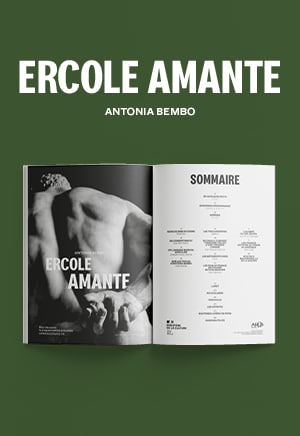
Ercole amante

Antonia Bembo

Opéra Bastille

from 28 May to 14 June 2026

from €37 to €175

3h40 with 1 interval

Synopsis

Listen to the synopsis

0:00 / 0:00

Eight years after the success of Les Indes galantes, conductor Leonardo García Alarcón returns to the Paris Opera with a gem: a score by Antonia Bembo, an 18th century composer whose tumultuous life resembles a novel.

Fleeing a violent husband, this Venetian sought refuge at the court of Louis XIV, where she received the king’s protection. It was in France that she forged a personal style, straddling Italian and French culture, before composing her opera Ercole amante in 1707, based on the libretto previously used by her master Francesco Cavalli.

Never before staged in Europe, this Hercules in love, marked by harmonic originality and outstanding vocal virtuosity, is making its repertoire debut at the Paris Opera.

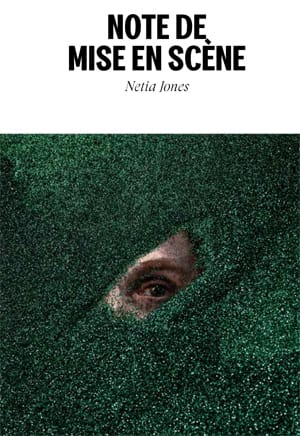
Netia Jones explores the baroque work, full of gods and supernatural elements, and reveals its modernity: that of a powerful but ageing man incapable of accepting a woman’s refusal to consent.

Duration : 3h40 with 1 interval

Language : Italian

Surtitle : French / English

Show acts and characters

Characters

Hercules: Husband of Deianira and father of Hyllus
Deianira: Wife of Hercules and mother of Hyllus
Hyllus: Son of Hercules and Deianira
Iole: Daughter of Euthyrus, King of Eochalia
Lychas: Servant to Deianira
Page: In the service of Hercules
The Shade of Euthyrus: King of Eochalia, father of Iole
Juno, Venus, Pasithea, Neptune, Mercury, Beauty: Gods and goddesses

First part

Act 1:

In Eochalia, the demigod Hercules sinks into the despair of unrequited love: he burns with passion for Iole, the very woman his son Hyllus wishes to marry. Outraged to see his legendary strength yield to the maiden’s refusals, the undefeated hero rebels against Love’s tyranny. Whilst Venus, having descended from Heaven, promises to help him break the girl’s resolve, Juno, hidden in the clouds, looks on in outrage. She castigates the goddess of Love’s ingratitude and Hercules’s audacity. She refuses to let him break his marriage to Deianira to force Iole into a union without her consent – and, moreover, with her father’s murderer. Determined to protect the love that unites Iole and Hyllus, Juno flies to the Cave of Sleep to foil this plan.

Act 2:

Hercules’s secluded palace shelters the promises of love between Iole and Hyllus, but this peace is short-lived in the face of Hercules’s authority; through a young page, he requests an audience with the princess in his gardens. The page is naively astonished by Love’s invisible power. On his way back, he is intercepted by Lychas, Deianira’s servant, who makes him confess Hercules’s amorous intentions. Through this exchange, it emerges that the hero has slain Iole’s father, King Euthyrus.

The latter had in fact preferred to grant his daughter’s wish to marry Hyllus rather than give her in marriage to Hercules, despite his earlier promise. Witnessing these exchanges, Deianira sinks into despair mingled with terror: as she sees her marriage shattered by Hercules’s infidelity, she fears that his fury might go so far as to cost their son Hyllus his life. She implores Lychas for help. Lychas, whilst confessing his own fears, advises her to exercise the utmost caution to escape the hero’s wrath. For her part, Juno goes to the Cave of Sleep to persuade= Pasithea to entrust her husband to her. She then takes the god away in her chariot, relying on his power to thwart Hercules’s plans and avenge the honour of the marital bond.

Act 3:

The action shifts to the gardens of Eochalia where Venus, to serve Hercules, conjures up an enchanted throne from the earth, intended to bewitch Iole and break down her resistance. Under the influence of this magical trap, the princess forgets her father’s murder and declares her passion for Hercules. Hyllus watches, in despair, as this apparent betrayal unfolds. Hercules banishes him without ceremony, sparing his life. However, Juno intervenes with the god of Sleep: she plunges Hercules into a deep slumber and frees Iole from her enchantment. Having come to her senses, Iole, armed by Juno, attempts to stab the sleeping hero to avenge her father and save Hyllus.

But Hyllus intervenes to save Hercules’s life. Suddenly awakened by Mercury, Hercules discovers his son with a weapon in his hand. Convinced that he has attempted to murder him, he lets his fury erupt. Deianira, who witnesses the scene with Lychas, intervenes to beg her husband to spare their child. But Hercules, blinded by this false evidence of parricide and his passion for Iole, renounces his family: he condemns his wife to exile and has his son imprisoned in a tower by the sea. The act closes with the heart-rending farewell between mother and son, whilst Lychas and the Page observe the ravages of Love.

Second part

Act 4:

In his prison tower by the sea, Hyllus receives via the Page a message from Iole saying that she agrees to marry Hercules to save his life. Mad with grief, he throws himself into the sea, but Juno intervenes and persuades Neptune to save him from the waters. The young man asks the goddess for forgiveness for his act of despair and climbs onto her chariot. Meanwhile, in a royal necropolis, Deianira mourns the loss of her son and husband, seeking a tomb in which to be buried. Lychas refuses to help her in this macabre undertaking.

She is joined by Iole, who is leading a funeral procession to her father’s grave. Suddenly, the shadow of Euthyrus emerges from his tomb to curse the sacrilegious union between Hercules and Iole and promise to save Hyllus. But Deianira announces that he has recently drowned. Overwhelmed with grief, Iole contemplates suicide. The faithful Lychas prevents her and suggests that Deianira use the tunic once given to her by the centaur Nessus to win back Hercules’s love.

Act 5:

In the Underworld, the shades of Hercules’s former victims gather under the leadership of Euthyrus. During that time, the wedding of Hercules and Iole is being prepared before the temple of Juno. Following Lychas’ plan, Iole hands Hercules Nessus’ tunic. No sooner has he put it on than the tunic becomes a devouring inferno that consumes him. Realising he is dying without glory, Hercules breathes his last in furious agony, whilst Deianira realises too late the betrayal of the centaur Nessus.

As mourning sets in, Hyllus miraculously reappears, saved from the waters. The joy of their reunion mingles with the pain of the hero’s death. These outpourings are interrupted by the arrival of Juno, who, descending from heaven, announces that he is not dead, but that he has been stripped of his mortal nature to be received into Olympus, where he is now wedded to Beauty. Juno, appeased, finally unites Hyllus and Iole. In a celestial apotheosis, Hercules, now a god, heralds a golden age and countless victories.

Show chronology

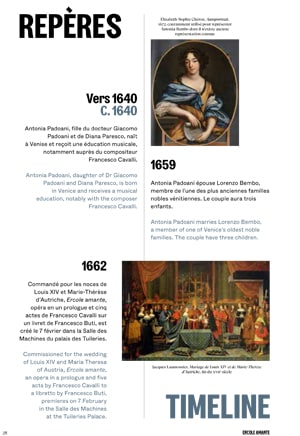
Timeline

  • Vers 1640

    Antonia Padoani, daughter of Dr Giacomo Padoani and Diana Paresco, is born in Venice and receives a musical education, notably with the composer Francesco Cavalli.

    Ercole amante
  • 1659

    Antonia Padoani marries Lorenzo Bembo, a member of one of Venice’s oldest noble families. The couple have three children.

  • 1662

    Commissioned for the wedding of Louis XIV and Maria Theresa of Austria, Ercole amante,an opera in a prologue and five acts by Francesco Cavalli to a libretto by Francesco Buti, premieres on 7 February in the Salle des Machines at the Tuileries Palace.

    Ercole amante

    ©Bridgeman

  • 1674

    Erected by order of Louis XIV in honour of his victories on the Rhine and in Franche- Comté, the triumphal arch at the Porte Saint-Martin depicts the monarch as Hercules, half‑naked, wearing his wig and holding his club.

    Ercole amante
  • 1677

    Fleeing her violent husband, Antonia Bembo leaves Venice for Paris. Presented to Louis XIV, she is granted a royal pension and accommodation in a house adjoining the Petite Union Chrétienne des Dames de Saint-Chaumont, a religious community.

  • 1697-1701

    Antonia Bembo composes her Produzioni armoniche, a vast collection of vocal works in Italian, French and Latin dedicated to Louis XIV.

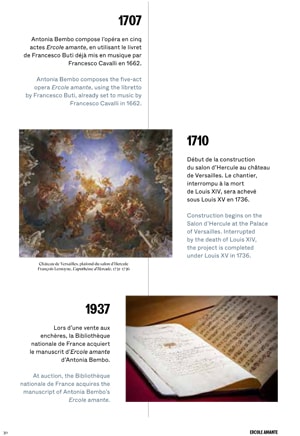
  • 1707

    Antonia Bembo composes the five-act opera Ercole amante, using the libretto by Francesco Buti, already set to music by Francesco Cavalli in 1662.

  • 1710

    Construction begins on the Salon d’Hercule at the Palace of Versailles. Interrupted by the death of Louis XIV, the project is completed under Louis XV in 1736.

    Ercole amante

    ©AKG

  • 1937

    At auction, the Bibliothèque nationale de France acquires the manuscript of Antonia Bembo’s Ercole amante.

    Ercole amante
  • Fin des années 1970

    A movement to rediscover Baroque women composers emerges, marked by new academic research and the first specialist recordings of works by Barbara Strozzi and Élisabeth Jacquet de La Guerre.

    Ercole amante

    ©AKG

  • 2023

    Antonia Bembo’s Ercole amante is premiered in concert by the ensemble Il Gusto Barocco in Stuttgart. Two years later, Ars Minerva, dedicated tothe rediscovery of forgotten music, presents a staged version at the OCD Theater in San Francisco.

  • 2026

    Premiere of Antonia Bembo’s Ercole amante in a staged version at the Paris Opera. The production is directed by Netia Jones and conducted by Leonardo García-Alarcón.

Artists

Opera in five acts (1707)

Creative team

Cast

Orchestre Cappella Mediterranea - Chœur de chambre de Namur
A recording of Ercole Amante will be made on 5 and 9 June 2026, directed by François Roussillon, coproduced by the Opéra national de Paris, Arte and FRA Prod, with the support of the CNC and the Orange Foundation, sponsor of the Paris Opera's audiovisual broadcasts.

The opera will be broadcast at a later date on Arte.tv and Arte, and then on Paris Opera Play, the Paris Opera's streaming website.

Media

ERCOLE AMANTE by Antonia Bembo I Teaser
  • Les Grands Entretiens

    Les Grands Entretiens

    Watch the video

  • About Ercole amante

    About Ercole amante

    Read the article

  • Draw-me Ercole amante

    Draw-me Ercole amante

    Watch the video

  • Anatomy of a Myth

    Anatomy of a Myth

    Watch the video

  • LEONARDO GARCÍA ALARCÓN about ERCOLE AMANTE (interview)

    LEONARDO GARCÍA ALARCÓN about ERCOLE AMANTE (interview)

    Watch the video

  • Ercole Amante, the true/false story

    Ercole Amante, the true/false story

    Discover

Les Grands Entretiens

Watch the video

Alexander Neef, Netia Jones and Leonardo García-Alarcón

15:46 min

Les Grands Entretiens

By Isabelle Stibbe

When an artist meets the Paris Opera's General Manager or its Director of Dance, what do they discuss? In this new series entitled Les Grands Entretiens, the Paris Opera lifts the veil on the artistic line-up of new productions for the 25/26 season. The choice of guest artists, the key themes, the directors' creative intentions and the choreographic styles: these exclusive twenty-minute exchanges offer you the first keys to the works that will soon be on the bill. 

In this interview, Paris Opera General Manager Alexander Neef discusses the repertoire entry of Ercole amante, an opera composed by Antonia Bembo in 1707 and staged for the first time, with Netia Jones, director, and Leonardo García Alarcón, conductor.  

© Plainpicture/ Millennium / Luigi Spina

About Ercole amante

Read the article

07 min

About Ercole amante

By Netia Jones

« Vénus, accompagnée des Grâces, descend du Ciel sur une machine. » Antonia Bembo, Ercole amante

Staging *Ercole amante* by Antonia Bembo at the Paris Opera more than three centuries after its premiere is both a major and an exhilarating event. The work itself is a fascinating example of Baroque spectacle, populated by gods and goddesses, lovers and tyrants, and unfolding across a myriad of settings, from “a chamber in the palace” to “a tower in the middle of the sea” and even “the Underworld.” Baroque staging calls for constant scene changes and continuous movement—trapdoors, flying machinery, a profusion of costumes—and dance plays a central role.

« Ma main droite est plus puissante que ma langue… » Hercule – Ovide, Les Métamorphoses

The story of Ercole amante draws very freely on episodes from both the Greek and Roman traditions of the Hercules myth, in which extraordinary strength, courage, ingenuity, and sexual prowess are among the qualities typically attributed to the hero. Here, however, we encounter him at the end of his life, his triumphs now far behind him and, despite his status and power, confronted with the rejection of a young woman. Antonia Bembo composed her opera to a libretto by Francesco Buti—the same text used by her teacher and mentor Francesco Cavalli for the opera commissioned by Cardinal Mazarin on the occasion of the marriage of Louis XIV fifty years earlier.

« Les années passent les unes après les autres ; le temps nous échappe sans que nous en ayons conscience ; nous vieillissons comme de simples mortels et nous finirons comme eux. » Louis XIV

Is there a difference between two operas based on the same libretto, written fifty years apart—one by a man, the other by a woman? In the hands of Antonia Bembo, composing five decades after Cavalli, at a time when the aging Sun King was seeing his brilliance fade, this story feels both more relevant and more provocative.

While Ercole amante features ancient deities and a mythological imagination, the heart of the drama could not be more human—or more modern. We encounter a man of immense power whose years of glory are now behind him; enraged that he cannot seduce a woman half his age who, moreover, is betrothed to his own son. He embodies a very recognizable form of absolute male dominance and a sense of omnipotence, and it is not difficult, even today, to find equivalents of this aging, voracious, lecherous, and coarse “Ercole.” The opera thus engages with issues of consent, privilege, and power imbalance that our own time has yet to fully resolve.

« Je ne peux pas faire peur aux femmes – j’aime les femmes. » Gérard Depardieu

Antonia Bembo’s biography, insofar as it can be reconstructed, also provides a particularly illuminating reference. Fleeing Venice for Paris to escape a violent and unstable marriage, she embodies the resilience, resistance, and perseverance required of women to survive in a male-dominated, patriarchal, hierarchical, and deeply constraining world. Like so many remarkable women of her time, it was her innate talent and exceptional skills that offered her a path to emancipation from the obedience, constraints, and expectations imposed on her as a woman. And for a stage director working in an art form that can often appear as an impenetrable male stronghold, the very fact that the composer is a woman brings a welcome breath of fresh air.

« Les femmes naissent avec des talents que l’éducation étouffe. » Madame de Lambert, Avis d’une mère à sa fille (1728)

The female characters in Ercole amante are brilliantly drawn, both complex and ambivalent, ranging from Iole, a strong, pragmatic, and fearless heroine, to Juno, the goddess of love and marriage—who despises Hercules and supports Iole’s love for Hyllus, which is far more appropriate to her age. Deianira, once Hercules’ young wife in earlier mythological accounts, appears here as a woman who has been worn down, abandoned, and mistreated, while Venus, the goddess of love, regards coercion as a perfectly acceptable form of romantic conquest.

« Pourvu que tu y trouves du plaisir, que t’importe que ce soit par ruse ou par faveur ? » Vénus – Antonia Bembo, Ercole amante
« Nous défendons une liberté d’importuner, indispensable à la liberté sexuelle. »

Beyond questions of gender and power, Ercole amante unfolds a genuine sense of joy, playfulness, and imagination, as well as striking musical virtuosity. This virtuosity is matched by its staging ambitions: Cavalli conceived his opera for the vast Salle des Machines at the Tuileries, a flagship of the technological innovations of its time. Antonia Bembo’s opera belongs to the same world of theatrical spectacle: had it been performed, it too would have required the full range of the most advanced technical devices of its era.

« Tout est grand, tout est magnifique, tout est fait pour les yeux. » Jean de La Bruyère

In this production, we retain the fundamental principles of Baroque staging while placing them within a resolutely contemporary and luminous imaginary world. We play with perspective, decorative abundance, scene changes, movement, danced interludes, and visual tableaux.

The sets draw on the imagery of the Louvre and Versailles, with their marble floors, French formal gardens, and sculptures—along with the famous Versailles elevator—as well as the more austere architecture of the Opéra Bastille, one of François Mitterrand’s “Grands Projets,” born in a time of great optimism, ambition, and faith in the arts.

The opera unfolds all the expected locations of such a spectacle—gardens, royal tombs, nuptial temples, as well as the “sleeping scene,” one of the most cherished motifs of Baroque theatre, often depicted by painters such as Giulio Carpioni, providing the pretext for gatherings of semi-nude figures abandoned to languid sensuality.

The costumes are inspired by Baroque ideas, blending historical garments and inventions, with a rich palette, experimental materials, and a strong sense of spectacle. The technical innovations of Baroque stagecraft find their contemporary counterpart here in modern technologies such as video, projections, and digital animation.

« Parmi les honnêtes gens, l’égalité des deux sexes n’est plus un principe contesté. » Madame de Saliez, Viguière d’Alby, Le Mercure galant (1682)

There is a real joy in rediscovering women artists of the 18th century who not only created but also managed to flourish, and whose voices asserted themselves collectively. The fact that they were overlooked, or even erased during a more regressive 19th century, makes this process of rediscovery more challenging—but also all the more valuable. We will undoubtedly continue to uncover other works by women composers from the 18th century and beyond, alongside the emergence of a new generation of female voices finding their place within a sometimes still resistant male stronghold. Ercole amante by Antonia Bembo is a dazzling, vibrant, ingenious, and inspiring treasure. The door is opening.

Draw-me Ercole amante

Watch the video

Understand the plot in 1 minute

1:22 min

Draw-me Ercole amante

By Clod

On the occasion of the entry to the repertoire of the Baroque opera Ercole amante by Antonia Bembo, discover a summary of the story in animated images. 

Hercules is passionately in love with Princess Iole, who is betrothed to his own son, Hyllus. Venus promises to make Iole yield to him. Overhearing their conversation, Juno is enraged: Hercules, already married to Deianira, has killed Iole’s father. To help him, Venus gives Hercules an enchanted throne that makes Iole fall in love with him, much to Hyllus’s despair. 

But Sleep, allied with Juno, casts Hercules into a deep slumber. Meanwhile, Juno frees Iole from the spell and gives her a dagger intended to kill Hercules. Hyllus intervenes and seizes the weapon. When Hercules awakens, he believes his son is trying to kill him. He has him imprisoned and banishes Deianira. Thus, Hercules is free to unite with Iole. 

In order to win him back, Deianira persuades Iole to offer Hercules a tunic soaked in the blood of the centaur Nessus, believing it to be a love charm. Alas! When Hercules puts on the tunic, it bursts into flames and kills him. Deianira and Hyllus are reunited in grief to mourn Hercules. Juno, appeased at last, grants Hercules immortality and unites him with Beauty.  

Anatomy of a Myth

Watch the video

Interview with curators Ludovic Laugier and Virginie Guffroy

9:15 min

Anatomy of a Myth

By Isabelle Stibbe

Exaggerated musculature, club, lion skin… 

As Ercole amante by Antonia Bembo enters the repertoire, curators Ludovic Laugier and Virginie Guffroy explore the figure and attributes of Hercules through three sculptures from the Louvre Museum: Hercules on the Pyre by Guillaume Coustou (1704), Hercules Chained by Love by Jean-Joseph Vinache (1741), and the Farnese-type Hercules (2nd century AD).

LEONARDO GARCÍA ALARCÓN about ERCOLE AMANTE (interview)

Watch the video

6:04 min

LEONARDO GARCÍA ALARCÓN about ERCOLE AMANTE (interview)

By Isabelle Stibbe

© Plainpicture/ Millennium / Luigi Spina

Ercole Amante, the true/false story

Discover

01 min

Ercole Amante, the true/false story

By aria

A rivalry opposing a father and his son, divine interventions, supernatural elements… Will you untangle this Ercole Amante’s synopsis?  

  • NETIA JONES about ERCOLE AMANTE (interview)
  • ERCOLE AMANTE, opéra d'Antonia Bembo - Anatomie du mythe d'Hercule #opera
  • Immersion au cœur des ateliers de sculpture : ERCOLE AMANTE #opera
  • NETIA JONES about ERCOLE AMANTE (interview)
  • ERCOLE AMANTE, opéra d'Antonia Bembo - Anatomie du mythe d'Hercule #opera
  • Immersion au cœur des ateliers de sculpture : ERCOLE AMANTE #opera

Access and services

Opéra Bastille

Place de la Bastille

75012 Paris

Public transport

Underground Bastille (lignes 1, 5 et 8), Gare de Lyon (RER)

Bus 29, 69, 76, 86, 87, 91, N01, N02, N11, N16

Calculate my route
Car park

Parking Indigo Opéra Bastille 1 avenue Daumesnil 75012 Paris

Book your spot at a reduced price
super alt text
super alt text
super alt text
super alt text
super alt text
super alt text

In 1662, Ercole amante, an opera in a prologue and five acts by Francesco Cavalli, was premiered. Commissioned by Cardinal Mazarin for the wedding of Louis XIV and Maria Theresa of Austria, the work celebrates royal power by portraying the monarch in the formidable guise of Hercules. The libretto, written by Abbé Francesco Buti, draws on Greek and Roman mythology. Forty-five years later, when Louis XIV was sixty-nine, Antonia Bembo took up this text – omitting only the prologue and six verses – to compose her own Ercole amante.   

BUY THE PROGRAM
  • Cloakrooms

    Free cloakrooms are at your disposal. The comprehensive list of prohibited items is available here.

  • Bars

    Reservation of drinks and light refreshments for the intervals is possible online up to 24 hours prior to your visit, or at the bars before each performance.

In both our venues, discounted tickets are sold at the box offices from 30 minutes before the show:

  • €35 tickets for under-28s, unemployed people (with documentary proof less than 3 months old) and senior citizens over 65 with non-taxable income (proof of tax exemption for the current year required)
  • €70 tickets for senior citizens over 65

Get samples of the operas and ballets at the Paris Opera gift shops: programmes, books, recordings, and also stationery, jewellery, shirts, homeware and honey from Paris Opera.

Opéra Bastille
  • Open 1h before performances and until performances end
  • Get in from within the theatre’s public areas
  • For more information: +33 1 40 01 17 82

Opéra Bastille

Place de la Bastille

75012 Paris

Public transport

Underground Bastille (lignes 1, 5 et 8), Gare de Lyon (RER)

Bus 29, 69, 76, 86, 87, 91, N01, N02, N11, N16

Calculate my route
Car park

Parking Indigo Opéra Bastille 1 avenue Daumesnil 75012 Paris

Book your spot at a reduced price
super alt text
super alt text
super alt text
super alt text
super alt text
super alt text

In 1662, Ercole amante, an opera in a prologue and five acts by Francesco Cavalli, was premiered. Commissioned by Cardinal Mazarin for the wedding of Louis XIV and Maria Theresa of Austria, the work celebrates royal power by portraying the monarch in the formidable guise of Hercules. The libretto, written by Abbé Francesco Buti, draws on Greek and Roman mythology. Forty-five years later, when Louis XIV was sixty-nine, Antonia Bembo took up this text – omitting only the prologue and six verses – to compose her own Ercole amante.   

BUY THE PROGRAM
  • Cloakrooms

    Free cloakrooms are at your disposal. The comprehensive list of prohibited items is available here.

  • Bars

    Reservation of drinks and light refreshments for the intervals is possible online up to 24 hours prior to your visit, or at the bars before each performance.

In both our venues, discounted tickets are sold at the box offices from 30 minutes before the show:

  • €35 tickets for under-28s, unemployed people (with documentary proof less than 3 months old) and senior citizens over 65 with non-taxable income (proof of tax exemption for the current year required)
  • €70 tickets for senior citizens over 65

Get samples of the operas and ballets at the Paris Opera gift shops: programmes, books, recordings, and also stationery, jewellery, shirts, homeware and honey from Paris Opera.

Opéra Bastille
  • Open 1h before performances and until performances end
  • Get in from within the theatre’s public areas
  • For more information: +33 1 40 01 17 82

Partners

  • Grande Mécène de la saison

  • With the support of the Cercle Berlioz

Media and technical partners

Immerse in the Paris Opera universe

Jean-Pierre Delagarde / OnP

Sign up for our newsletter

Our latest news

* Required fields

By clicking on "submit", you agree to receive electronic communications from the Opéra national de Paris and to the processing of your data.
Learn more about managing your data and your rights.

Back to top