My special offers

Prices

    0
    300
    0€
    300€

Show / Event

Venue

Experience

Calendar

  • Between   and 

Prices

Elena Bauer / OnP

Elena Bauer / OnP

Opera

Roméo et Juliette

Charles Gounod

Opéra Bastille

from 07 June to 10 July 2027

3h15 with 1 interval

Synopsis

Listen to the synopsis

0:00 / 0:00

One glance is all it takes for Romeo and Juliet to fall in love. But their passion collides with the ancestral hatred dividing their families in a Verona on the brink of implosion.

Although Charles Gounod had been attracted to Shakespeare’s play from a young age, it was only some twenty years later, after the success of Faust, that he set about transforming it into an opera.

Premiered during the 1867 Exposition universelle, the opera was an immediate popular success. Four love duets, a passionate waltz, luminous music: the entire score quivers with desire.

Who better than Thomas Jolly, one of the most inventive directors of his generation to celebrate this hymn to youth? A connoisseur of Shakespeare, he captures the emotions of adolescence while reintroducing a crucial element from the play: the plague epidemic which infuses the characters with an urgency to live and love.

Duration : 3h15 with 1 interval

Language : French

Surtitle : French / English

Show acts and characters

CHARACTERS

Roméo: A young nobleman from the Montaigu family
Juliette: Capulet’s daughter
Stéphano: Roméo’s page
Gertrude: Juliette’s nurse
Capulet: Juliette’s father, the head of a leading Veronese family
Friar Laurent
Mercutio: Friend of Roméo
Tybalt: Juliette’s cousin
Pâris: Juliette’s fiancé

First part

Prologue
The Capulets and Montaigus, two rival families, have been fighting each other for centuries. Their hatred will seal the fatal fate of their children, Roméo and Juliette.

Act 1:
A masked ball in the Capulet mansion
Juliette, the host’s daughter, is celebrating her birthday. Tybalt, her cousin, and Count Pâris discuss the girl’s future marriage to the Count. Juliette’s appearance on her father’s arm sparks the guests’ admiration. Capulet launches the festivities and invites the dancers to join the party. Roméo, Mercutio and Benvolio, members of the Montaigu family and enemies of the Capulets, have secretly slipped into the party. Roméo is tormented by dark premonitions. His friend Mercutio tries to cheer him up and makes fun of him affectionately. Juliette appears again, accompanied by her nurse Gertrude. The young girl dreams of living and enjoying her youth.

She declares that she is not ready to marry Count Pâris. Roméo sees Juliette for the first time and falls in love, without knowing who she is. He goes to meet her, without telling her his name. Between the two young people, it is love at first sight: they kiss for the first time. Tybalt joins them and recognises Roméo’s voice. The two lovers discover each other’s names and realise that their love is impossible. Juliette senses that her love will be tied to death. Tybalt, enraged that a Montaigu has dared to come to the Capulets’ party, wants to start a fight. As the situation threatens to degenerate, the Montaigus leave the ball and Juliette’s father resumes the festivities.

Act 2:
The Capulet garden
Roméo has been separated from his friends and is looking for Juliette. He finds himself in the Capulet garden under the young girl’s window. He calls out to Juliette, comparing her to the rising sun. She appears on his balcony without seeing him and confesses to the night her dawning love for Roméo. The young man then reveals his presence to her. The two lovers exchange declarations of love and oaths of fidelity. Suddenly they are interrupted by Grégorio and other Capulet servants.

The latter run into the garden looking for Roméo’s page, Stéphano. When calm returns, Roméo emerges from his hiding place and Juliette says she is ready to marry him. Roméo repeats his oath. They are interrupted again, this time by Gertrude calling Juliette. The girl has to return indoors and the two lovers reluctantly part.

Act 3:
Friar Laurent’s cell
Romeo visits Friar Laurent in his cell and reveals his love for Juliette Capulet. Juliette arrives with Gertrude. The two lovers ask Friar Laurent to unite them. Convinced of the strength of their bond, he agrees to marry them.

A street in front of the Capulet mansion
Roméo’s page, Stéphano, is looking for his master and taunts the Capulets with a song addressed to a “white turtledove” held captive in a “nest of vultures”. Grégorio and other Capulet servants appear. Stéphano then challenges Grégorio “in song”. The latter, provoked, starts the duel. Mercutio comes running with Benvolio and protests at this unequal fight. Tybalt, who has arrived with Pâris, warns Mercutio to watch his words and they in turn engage in a duel. When Roméo arrives, Tybalt immediately turns to face him, but Roméo, who remains cool, asks Tybalt to stop fighting and to forget the hatred between the two families.

Mercutio, appalled by his friend’s reaction, lunges at Tybalt to defend Roméo’s honour. Tybalt inflicts a mortal wound on Mercutio. Roméo, overcome with anger, seeks revenge: he fights a duel with Tybalt and deals him a fatal blow. Capulet rushes in only to see his nephew die. The people of Verona, drawn by the sounds of battle, crowd around the dead man. A fanfare announces the arrival of the Duke of Verona. Capulet and the supporters of both houses cry out for justice. The Duke condemns Roméo to exile and demands that the two families stop fighting. Before the curtain falls, however, the members of both houses again swear hatred for each other.

Second part

Act 4:
Juliette’s room
Roméo has secretly slipped into Juliette’s room where they spend their wedding night. Juliette forgives Roméo for killing her cousin Tybalt. They both sing of their love. Suddenly, Roméo hears the lark announce the day and wants to leave. Juliette refuses to believe him: she thinks it is the nightingale that has sung, leaving them with time. But the two lovers realise that they must separate before they are discovered together. Roméo leaves just in time.

Gertrude followed by Capulet and Friar Laurent arrive in the room. Juliette’s father then tells her that her marriage to Pâris has been arranged for the same day, according to Tybalt’s last wish. Juliette is in despair. When her father leaves her room, she tells Friar Laurent that she would rather die than marry Pâris. The priest suggests a ruse: he has prepared a potion that will make her appear to be dead and thus enable her to escape the marriage. The Capulets will transport her body to the family tomb, where Roméo will find her. Juliette agrees. She summons up all her courage to empty the vial.

A room in the Capulet household
Juliette enters to the sound of a wedding march. The guests offer her their best wishes, but when the moment comes to celebrate the marriage with Pâris, she collapses, to everyone’s amazement. Capulet mourns the death of his daughter.

Act 5:
An underground crypt in the Capulet mansion
Friar Jean, a monk entrusted by Friar Laurent with the task of informing Roméo of the ruse, warns that Roméo has not received the letter. Roméo appears in the crypt, believing Juliette to be dead. Beside the girl’s lifeless body, he consumes a poison that he carries with him.

But Juliette awakens and they sing of their love. Roméo confesses that he has just taken poison. He grows weak and collapses. Juliette then reveals a dagger hidden in her clothes and kills herself. They embrace one last time. In a last breath of life, Roméo and Juliette call for divine mercy.

Show chronology

Timeline

  • XIVe siècle

    Publication of Boccaccio’s Decameron, a collection of one hundred short stories written in Italian. At the beginning of the work, the author gives a striking description of the plague that ravaged Florence in 1348.

  • 1597

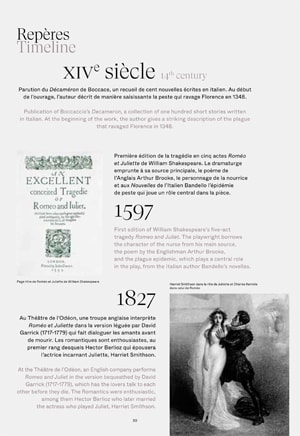
    First edition of William Shakespeare’s five-act tragedy Romeo and Juliet. The playwright borrows the character of the nurse from his main source, the poem by the Englishman Arthur Brooke, and the plague epidemic, which plays a central role in the play, from the Italian author Bandello’s novellas.

  • 1827

    At the Théâtre de l’Odéon, an English company performs Romeo and Juliet in the version bequeathed by David Garrick (1717-1779), which has the lovers talk to each other before they die. The Romantics were enthusiastic, among them Hector Berlioz who later married the actress who played Juliet, Harriet Smithson.

  • 1830

    Premiere of Vincenzo Bellini’s I Capuleti e i Montecchi at La Fenice in Venice. The work is inspired more by Italian sources than by William Shakespeare’s play.

  • 1839

    In November, Charles Gounod attends a rehearsal of Hector Berlioz’s Roméo et Juliette symphony and is struck by the scale of the grand finale.

  • 1867

    At the Théâtre-Lyrique, where he already created Faust in 1859, Charles Gounod conducts his new opera Roméo et Juliette during the Universal Exhibition. The opera is a great triumph.

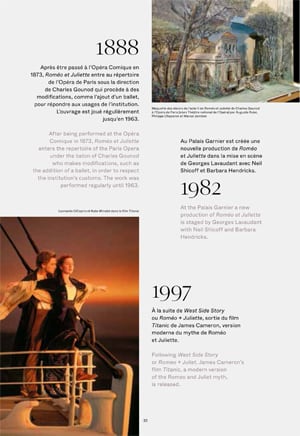
  • 1888

    After being performed at the Opéra Comique in 1873, Roméo et Juliette enters the repertoire of the Paris Opera under the baton of Charles Gounod who makes modifications, such as the addition of a ballet, in order to respect the institution’s customs. The work was performed regularly until 1963.

  • 1982

    At the Palais Garnier a new production of Roméo et Juliette is staged by Georges Lavaudant with Neil Shicoff and Barbara Hendricks.

  • 1997

    Following West Side Story or Romeo + Juliet, James Cameron’s film Titanic, a modern version of the Romeo and Juliet myth, is released.

  • 2016

    Thomas Jolly is invited to the Paris Opera (Palais Garnier) for his first production: Francesco Cavalli’s Eliogabalo under the baton of Leonardo García Alarcón.

  • 2022

    The Bibliothèque nationale de France acquires a set of works by Charles Gounod, including the manuscript score of Roméo et Juliette.

  • 2023

    Absent from the repertoire since 1985, Roméo et Juliette returns to the Paris Opera – on the Bastille stage for the first time – in a new production directed by Thomas Jolly.

Artists

Opera in five acts (1867)

After William Shakespeare


Creative team

Cast

The Paris Opera Orchestra and Chorus

Media

ROMÉO ET JULIETTE by Charles Gounod (trailer)
  • Romeo and Juliet

    Romeo and Juliet

    Discover

Romeo and Juliet

Discover

01 min

Romeo and Juliet

By aria

The most famous couple in History has been an inexhaustible source of inspiration for composers of opera and ballet. Ready ? Please, follow me

  • [EXTRAIT] ROMÉO ET JULIETTE by Gounod (Benjamin Bernheim & Chœurs)- Ah ! jour de deuil et d'horreur
  • [EXTRAIT] ROMÉO ET JULIETTE by Gounod (Elsa Dreisig, Benjamin Bernheim) - "Console-toi, pauvre âme"
  • [EXTRAIT] ROMÉO ET JULIETTE by Gounod (Benjamin Bernheim, Maciej Kwaśnikowski, Huw Montague Rendall)
  • [EXTRAIT] ROMÉO ET JULIETTE by Gounod (Elsa Dreisig, Benjamin Bernheim)
  • [EXTRAIT] ROMÉO ET JULIETTE by Gounod
  • [EXTRAIT] ROMÉO ET JULIETTE by Gounod
  • [EXTRAIT] ROMÉO ET JULIETTE by Gounod
  • [EXTRAIT] ROMÉO ET JULIETTE by Gounod
  • [EXTRAIT] ROMÉO ET JULIETTE by Gounod (Benjamin Bernheim & Chœurs)- Ah ! jour de deuil et d'horreur
  • [EXTRAIT] ROMÉO ET JULIETTE by Gounod (Elsa Dreisig, Benjamin Bernheim) - "Console-toi, pauvre âme"
  • [EXTRAIT] ROMÉO ET JULIETTE by Gounod (Benjamin Bernheim, Maciej Kwaśnikowski, Huw Montague Rendall)
  • [EXTRAIT] ROMÉO ET JULIETTE by Gounod (Elsa Dreisig, Benjamin Bernheim)
  • [EXTRAIT] ROMÉO ET JULIETTE by Gounod
  • [EXTRAIT] ROMÉO ET JULIETTE by Gounod
  • [EXTRAIT] ROMÉO ET JULIETTE by Gounod
  • [EXTRAIT] ROMÉO ET JULIETTE by Gounod
  • Roméo et Juliette (saison 22/23) - Acte I - Chœur

  • Roméo et Juliette (saison 22/23) - Acte IV (Benjamin Bernheim, Elsa Dreisig)

  • Roméo et Juliette (saison 22/23) - Acte II -Orchestre

  • Roméo et Juliette (saison 22/23) - Acte II (Benjamin Bernheim, Elsa Dreisig)

  • Roméo et Juliette (saison 22/23) - Acte V - Orchestre

  • Roméo et Juliette (saison 22/23) - Acte V (Elsa Dreisig, Benjamin Bernheim)

opera logo
Romeo and Juliet


Watch online the recording from season 22/23 on Paris Opera Play

with Elsa Dreisig, Benjamin Bernheim, Lea Desandre...

7-DAY FREE TRIAL Free trial 7 days

Access and services

Opéra Bastille

Place de la Bastille

75012 Paris

Public transport

Underground Bastille (lignes 1, 5 et 8), Gare de Lyon (RER)

Bus 29, 69, 76, 86, 87, 91, N01, N02, N11, N16

Calculate my route
Car park

Parking Indigo Opéra Bastille 1 avenue Daumesnil 75012 Paris

Book your spot at a reduced price
super alt text
super alt text
super alt text
super alt text
super alt text
super alt text

Romeo and Juliet is one of those works, like The Three Musketeers, whose story everyone knows without necessarily having read the text. Its numerous stage or cinema adaptations, more or less faithful to the original, share two common features: amorous passion in conflict with social or moral rules.

BUY THE PROGRAM
  • Cloakrooms

    Free cloakrooms are at your disposal. The comprehensive list of prohibited items is available here.

  • Bars

    Reservation of drinks and light refreshments for the intervals is possible online up to 24 hours prior to your visit, or at the bars before each performance.

In both our venues, discounted tickets are sold at the box offices from 30 minutes before the show:

  • €35 tickets for under-28s, unemployed people (with documentary proof less than 3 months old) and senior citizens over 65 with non-taxable income (proof of tax exemption for the current year required)
  • €70 tickets for senior citizens over 65

Get samples of the operas and ballets at the Paris Opera gift shops: programmes, books, recordings, and also stationery, jewellery, shirts, homeware and honey from Paris Opera.

Opéra Bastille
  • Open 1h before performances and until performances end
  • Get in from within the theatre’s public areas
  • For more information: +33 1 40 01 17 82

Opéra Bastille

Place de la Bastille

75012 Paris

Public transport

Underground Bastille (lignes 1, 5 et 8), Gare de Lyon (RER)

Bus 29, 69, 76, 86, 87, 91, N01, N02, N11, N16

Calculate my route
Car park

Parking Indigo Opéra Bastille 1 avenue Daumesnil 75012 Paris

Book your spot at a reduced price
super alt text
super alt text
super alt text
super alt text
super alt text
super alt text

Romeo and Juliet is one of those works, like The Three Musketeers, whose story everyone knows without necessarily having read the text. Its numerous stage or cinema adaptations, more or less faithful to the original, share two common features: amorous passion in conflict with social or moral rules.

BUY THE PROGRAM
  • Cloakrooms

    Free cloakrooms are at your disposal. The comprehensive list of prohibited items is available here.

  • Bars

    Reservation of drinks and light refreshments for the intervals is possible online up to 24 hours prior to your visit, or at the bars before each performance.

In both our venues, discounted tickets are sold at the box offices from 30 minutes before the show:

  • €35 tickets for under-28s, unemployed people (with documentary proof less than 3 months old) and senior citizens over 65 with non-taxable income (proof of tax exemption for the current year required)
  • €70 tickets for senior citizens over 65

Get samples of the operas and ballets at the Paris Opera gift shops: programmes, books, recordings, and also stationery, jewellery, shirts, homeware and honey from Paris Opera.

Opéra Bastille
  • Open 1h before performances and until performances end
  • Get in from within the theatre’s public areas
  • For more information: +33 1 40 01 17 82

Partners

  • Timepiece of the Paris Opera

Immerse in the Paris Opera universe

Jean-Pierre Delagarde / OnP

Sign up for our newsletter

Our latest news

* Required fields

By clicking on "submit", you agree to receive electronic communications from the Opéra national de Paris and to the processing of your data.
Learn more about managing your data and your rights.

Back to top