My special offers

Prices

    0
    300
    0€
    300€

Show / Event

Venue

Experience

Calendar

  • Between   and 

Prices

Svetlana Loboff / OnP

Svetlana Loboff / OnP

Ballet

Raymonda

Rudolf Nureyev

Opéra Bastille

from 15 June to 14 July 2027

3h05 with 2 intervals

Synopsis

Listen to the synopsis

0:00 / 0:00

Having gone to fight the Saracens in the Holy Land, Count Jean de Brienne returns just in time to rescue his fiancée Raymonda, abducted from her Provençal castle by the mysterious Abderam, to whom she may not be entirely indifferent…

When Rudolf Nureyev presented his own choreography of Raymonda at the Paris Opera in 1983, based on Marius Petipa’s version created at the Mariinsky Theatre in 1898, he reworked the plot to emphasise the young girl’s journey to womanhood and to give greater depth to the character of Abderam.

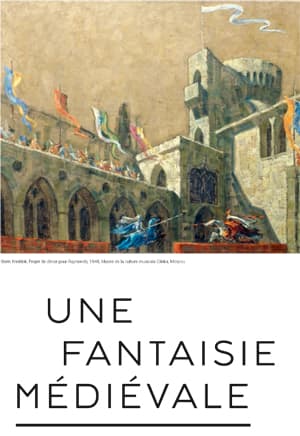
Set to the richly contrasted music of Alexander Glazunov and enhanced by Nicholas Georgiadis’ sumptuous sets and costumes, this ballet proves to be more than a medieval fantasy with a tournament and wedding celebrations. Its enduring power to captivate audiences may lie in its ability to offer a glimpse of the unsettling realms of the unconscious and latent desire.

Duration : 3h05 with 2 intervals

Show acts

Detail of acts

First part

The action takes place in a castle in Provence during the 13th century where fair ladies and damsels temper the torments of solitude by listening to the songs of troubadours while awaiting the return of their valiant husbands and fiancés who left to fight in the Holy Land.

Act 1


At the castle, preparations are underway for a wedding. The Countess of Doris, who has no sons, is anxious to keep the family’s fortune and property in good hands and plans to marry her niece Raymonda to Count Jean de Brienne. Raymonda’s friends Henriette and Clémence fool around with the wedding dress with Béranger and Bernard.

The countess of Doris reproaches the youngsters for their frivolity whilst there is an army of Saracens at the gates of the city. She tells them of the White Lady whose ghost has long haunted the castle: whenever danger threatens, she comes from the netherworld to protect the House of Doris but she can also punish those who neglect their duty and their honour.

The seneschal announces the arrival of the King of Hungary. The latter carries a message from his friend and a fellow crusader, Jean de Brienne. The King hands Raymonda the letter from the Knight Jean de Brienne (in which the latter announces his imminent arrival) and gives the young maiden the gifts that her fiancé whom she has yet to meet has sent her. The gifts include a beautiful tapestry depicting the knight. Everyone dances. The graceful gestures of the ladies are countered by the masculine assurance of the warriors. Universal rejoicing.

Raymonda joins her friends: Henriette, Clémence, Béranger and Bernard. The arrival of an unexpected guest: the leader of the Saracens appears at the castle and presents Raymonda with sumptuous jewels and then withdraws. The Lords and ladies in attendance also take their leave. An ever-pensive Raymonda strums a few notes on her lute. Her friends try to amuse her. The young girl twirls her wedding veil. Henriette, Clémence, Béranger and Bernard let Raymonda rest.

With a melancholy air she bids farewell to her life as an innocent young girl and falls asleep. In her dream, Raymonda sees the White Lady who leads her towards the tapestry depicting the knight. Suddenly, the Knight comes to life. Romantic duo featuring Jean de Brienne and Raymonda, along with the vision of Henriette and Clémence and all the Lords and Ladies of the court. The dream is clouded by the sudden intrusion of the Saracen leader who seems to have taken the place of Jean de Brienne. Abderam renews his advances with added ardour. Raymonda tries to resist him but the foreigner becomes insistent, even violent. Henriette, Clémence, Béranger and Bernard awaken Raymonda, who is still reeling in terror from her nightmare. Her fears are assuaged as she returns to the real world.

Second part

Act 2

Abderam invites the gathered nobles to attend a divertissement which he intends to have performed in Raymonda’s honour. He sets the stage by erecting a giant tent. Abderam pays tribute to the young girl in the company of her friends Henriette, Clémence, Béranger and Bernard. The dance begins. Abderam leads his entourage of Arabs and Spaniards who are gathered in his camp.

In the midst of the general confusion, Abderam tries to abduct Raymonda. The valiant knight arrives just in time to save his fiancée: Jean de Brienne challenges Abderam. The King commands them to settle their differences by duelling in an impartial tournament. The two warriors compete on horseback in a jousting contest and then dismount for a swordfight in which Jean de Brienne fatally wounds Abderam. While the Saracens carry away their dying leader Jean de Brienne and his crusaders dance in victory. Jean de Brienne and Raymonda are reunited at last.

Third part

Act 3

All celebrate the marriage of Jean de Brienne and Raymonda. The presence of the King of Hungary in the Provençal castle gives rise to a grand divertissement set to a selection of Magyar songs.

Show chronology

Timeline

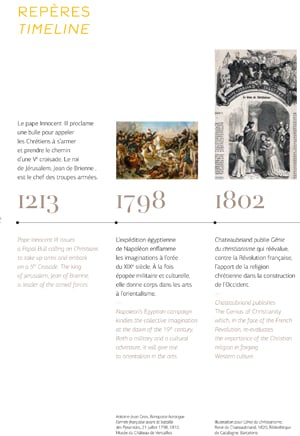
  • 1213

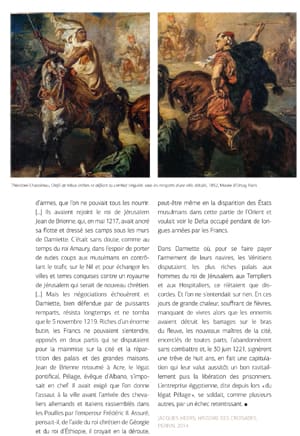
    Pope Innocent III issues a Papal Bull calling on Christians to take up arms and embark on a 5th Crusade. The king of Jerusalem, Jean of Brienne, is leader of the armed forces.

  • 1798

    Napoleon’s Egyptian campaign kindles the collective imagination at the dawn of the 19th century. Both a military and a cultural adventure, it will give rise to orientalism in the arts.

  • 1802

    Chateaubriand publishes The Genius of Christianity which, in the face of the French Revolution, re-evaluates the importance of the Christian religion in forging Western culture.

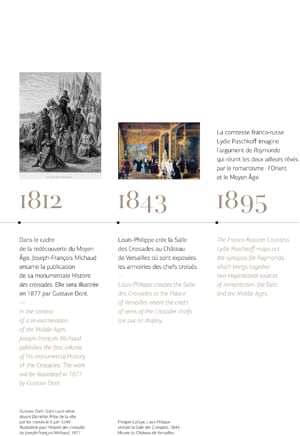
  • 1812

    In the context of a re‑examination of the Middle Ages, Joseph‑François Michaud publishes the first volume of his monumental History of the Crusades. The work will be illustrated in 1877 by Gustave Doré.

  • 1843

    Louis-Philippe creates the Salle des Croisades at the Palace of Versailles where the coats of arms of the Crusader chiefs are put on display.

  • 1895

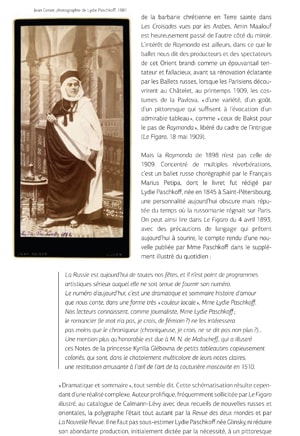
    The Franco-Russian Countess Lydie Paschkoff maps out the synopsis for Raymonda which brings together two inspirational sources of romanticism: the East and the Middle Ages.

  • 1898

    Raymonda has its world premiere at the Mariinsky Theatre in Saint Petersburg with choreography by Marius Petipa.

  • 1909

    For their first season in Paris, Serge Diaghilev’s Ballets Russes present extracts from Raymonda.

  • 1946

    George Balanchine, who danced in Petipa’s version at the Mariinsky Theatre, restages Raymonda with the ballerina Alexandra Danilova for the Ballets Russes of Monte Carlo.

  • 1964

    Raymonda becomes the first ballet which Nureyev revives after his defection to the West. He gives his first version to the Royal Ballet in London.

  • 1983

    Raymonda enters the repertoire of the Paris Opera Ballet in a new production (the fourth) by Rudolf Nureyev. Élisabeth Platel and Charles Jude dance the two principal roles.

  • 2008

    The most recent performance of Raymonda to date at the Paris Opera is performed on December 31, 2008 with the Étoiles Agnès Letestu and José Martinez in the title roles.

Artists

Ballet in three acts

Scenario after Lydie Paschkoff and Marius Petipa

Creative team

With the Paris Opera Étoiles, First Soloists and Corps de Ballet
With the Paris Opera Orchestra

Media

RAYMONDA by Rudolf Noureev (trailer)
  • The costumes for Raymonda: splendour and refinement

    The costumes for Raymonda: splendour and refinement

    Read the article

  • Raymonda: the true/false story

    Raymonda: the true/false story

    Discover

© Christophe Pelé / OnP

The costumes for Raymonda: splendour and refinement

Read the article

An encounter with Susanne Dangel, production manager of the sewing studios

08 min

The costumes for Raymonda: splendour and refinement

By Irina Flament

To mark the revival of Rudolf Nureyev’s emblematic ballet Raymonda, Octave met with Susanne Dangel, production manager at the Paris Opera’s costume department. At the “central” as it is calle the area at the Palais Garnier where all the costumes for a production are gathered together before the dress rehearsal—and a few days before the first rehearsals at the Opéra Bastille where the performances will take place (from December 3 to 31, 2019), Susanne Dangel looks back on the high points that have marked the restoration, decoration and fitting of the costumes for this glittering production.


A production of Raymonda is back on the bill after an eleven-year absence. What were the major steps involved in restoring and / or making the costumes for this production?

It was probably the tutus that required the most work. We had to rework the tulle base—the famous round flat “platter”—on all the original tutus. Since we can longer find stiff, coloured tulle, we first had to dye the tulle in beige and red. And it was an entire procedure finding the right colours… We then entrusted the manufacture of the tutus to an external contractor because it would have taken too long for them to have been done internally. We were able to save and use the old bustiers and the decorative plates and we adapted everything when we were doing the fittings with the dancers.

Is this production identical to the original?

We’ve remained faithful to Nureyev’s production, though I can say we wouldn’t make costumes like that today—especially the bustiers which are extremely rigid. During the fittings, some of the dancers would say “I can’t move” … They were a little concerned, but today we pay close attention to comfort while still achieving the same end-result.

© Christophe Pelé / OnP

Is that due to the technological development of materials and textiles or is it related to the evolution of dance and the silhouettes of the dancers?

It’s related to the evolution of silhouettes, to the style of the dancers which has changed over the last few generations. With the passage of time, there’s been a desire for more and more comfort. But that’s not what the fabrics lend themselves to especially since we work with the same materials: toiles on the interior, superimposed lamé, then lace and tulle… Georgiadis was truly brilliant, it’s ingenious what he did. These are not particularly expensive fabrics, it’s the way he layered them which gives such a fabulous result.

What other fabrics or materials were used to make the costumes?

Tulle is still used for the base, for the juponage—that’s the name given to the layer that gives the volume and the structure of the skirt. Organza is used too. There’s also a lot of muslin which is almost a base. The main leitmotiv of this production are the little golden buttons on the sleeves. Many of them have been re-worked too. There are also mancherons for the men. It’s a capless sleeve, attached to the armhole of the doublet with elastic. We use them on the costumes for the Golden Waltz, the Six Spaniards and in a more elaborate version for Bernard and Béranger’s doublets. It’s very practical, since it’s important for the dancer to be comfortable and retain freedom of movement.

Chenille is used as a decorative element for the costumes of the Spaniards and the Saracens.

Sometimes, when we need to alter or remake a costume, we don’t recognise what type of fabric was used so it requires an almost surgical process to identify it which involves opening up the seams with a pair of scissors.

© Christophe Pelé / OnP

The “platter” tutus are characteristic of productions from the Nureyev period. What else identifies them?

First of all, there’s the panty. It’s elastic and worn high on the waist. We then mount eleven tulle flounces on the panty. For a tutu, you need 12 metres of tulle on 1.40 metres. For this production, there are at least 60 tutus. In the old days we would make them with thirteen flounces but now we stop at eleven in order to make the platter lighter. Once the flounces are mounted, we add a yoke about 10-cm-long which rises to the waist. We then end up with a big chaotic ball in which nothing is held together! To regain control of all that, the costumiers make little stitches—we call it “basting”—which are generally tightly spaced. It all depends on the final effect you want to achieve, namely, a tutu that’s more billowing or one that’s flatter. All this takes an incredible amount of time. Almost a week of work is required to make a single platter. The edge is then “ruched” to give an airier lighter effect.

The platter is very stiff at first and it’s not always easy for the partner. But fortunately, it quickly becomes more supple.

What decorative work needs to be done on the costumes and the accessories?

We receive them as they are and we restore what we can. Given the deadlines, we can’t redo everything. The sequins are hand-sewn by the seamstresses. The Saracen’s headdress that you see there is extremely heavy. During the opera, it can crack here or there so it needs to be repaired between performances.

How are the fittings going with a new generation of dancers, some of whom are performing the ballet for the first time?

The fittings are generally relaxed and fast. The dancers are always rushing between the rehearsals and evening performances. They more or less voice their concerns and their specific requests, which is usually the case! One Étoile will prefer elastic lacing on the bustier rather than fasteners to make it more flexible. Another Étoile will ask to have two pairs of tights of different sizes depending on the costume he’s wearing…

© Christophe Pelé / OnP

How many costumes are in this production?

Altogether, from the soloists to the extras (who number around thirty), there’s a total of 258. And on stage, 181. The soloists’ costumes were made in the Opera’s workshops. The others were tendered to out-of-house contractors because we had a lot of work at the moment with Le Parc, as well as Onegin which is going on tour in Japan, not to forget the world premiere of Crystal Pite’s new work.

How does that compare to other ballets in the repertoire and how long does it take for the costumes to be ready for the first costume rehearsals?

Without a doubt, Sleeping Beauty is more substantial, but Raymonda is already a major task. We began working on the tulles in July—printing, sending them to the factory, then receiving them back in the autumn. We already knew the names of the soloists which meant we were able to move forward. Now, the fitting marathon begins: 4 or 5 costumes per dancer—many are worn by two performers. There’ll be around twenty dressers on stage.

The distinctive feature of Raymonda is that it’s also a ballet of shoes! The boots for the Hungarian soldiers for example, they are made to measure in Italy, and the ones for the Czardas are really beautifully made! Still, with each passing performance the shoes wear quickly due to all the sliding and the friction. The leather is quite thin. They need to be remade for each production. And we also work on the accessories when it involves pieces made of fabric—the soldier’s standards for example.

Mayerling will soon be entering the Paris Opera Ballet’s repertoire in a production from the Royal Opera House. What will your work consist of?

We’re going to remake all the soloists’ costumes. It’s a huge production, very much in Georgiadis’s style: the colour tones, the work on the materials… It’s going to be a major event.

© Svetlana Loboff / OnP

Raymonda: the true/false story

Discover

01 min

Raymonda: the true/false story

By aria

A damsel in distress, a valiant knight and a wicked Saracen. The perfect ingredients for a good story. Can you tell the true from the false in the story of Raymonda?  

  • Raymonda by Rudolf Nureyev (Dorothée Gilbert)
  • Raymonda by Rudolf Nureyev (Marie-Agnès Gillot, Dorothée Gilbert & Émilie Cozette)
  • Raymonda by Rudolf Nureyev (Marie-Agnès Gillot & José Martinez)
  • Raymonda by Rudolf Nureyev (Marie-Agnès Gillot)
  • Raymonda (saison 19/20)- Acte 3

  • Raymonda (saison 19/20)- Acte 2

  • Raymonda (saison 19/20)- Acte 1 (Coda)

  • Raymonda (saison 19/20)- Acte 1 (La Romanesca)

  • Raymonda (saison 19/20) - Acte 1 (Grande valse)

  • Raymonda (saison 19/20)

Access and services

Opéra Bastille

Place de la Bastille

75012 Paris

Public transport

Underground Bastille (lignes 1, 5 et 8), Gare de Lyon (RER)

Bus 29, 69, 76, 86, 87, 91, N01, N02, N11, N16

Calculate my route
Car park

Parking Indigo Opéra Bastille 1 avenue Daumesnil 75012 Paris

Book your spot at a reduced price
super alt text
super alt text
super alt text
super alt text
super alt text
super alt text
super alt text

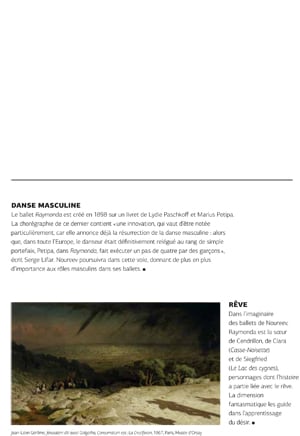
The ballet Raymonda was first performed in 1898 to a libretto by Lydie Paschkoff and Marius Petipa. Serge Lifar wrote that Petipa’s choreography “contained an innovation that was worth noting, in particular because it heralded the resurrection of male dance: whereas throughout Europe, the dancer was permanently relegated to the mere role of a carrier, Petipa, in Raymonda, included a pas de quatre performed by boys.” Nureyev would continue down this path, giving ever-increasing importance to the male roles in his ballets.

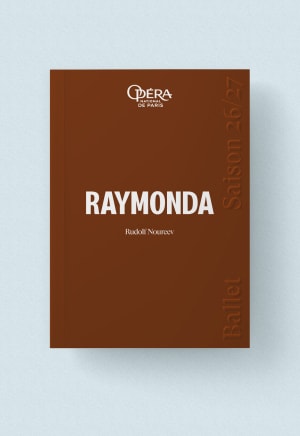
BUY THE PROGRAM
  • Cloakrooms

    Free cloakrooms are at your disposal. The comprehensive list of prohibited items is available here.

  • Bars

    Reservation of drinks and light refreshments for the intervals is possible online up to 24 hours prior to your visit, or at the bars before each performance.

In both our venues, discounted tickets are sold at the box offices from 30 minutes before the show:

  • €25 tickets for under-28s, unemployed people (with documentary proof less than 3 months old) and senior citizens over 65 with non-taxable income (proof of tax exemption for the current year required)
  • €40 tickets for senior citizens over 65

Get samples of the operas and ballets at the Paris Opera gift shops: programmes, books, recordings, and also stationery, jewellery, shirts, homeware and honey from Paris Opera.

Opéra Bastille
  • Open 1h before performances and until performances end
  • Get in from within the theatre’s public areas
  • For more information: +33 1 40 01 17 82

Opéra Bastille

Place de la Bastille

75012 Paris

Public transport

Underground Bastille (lignes 1, 5 et 8), Gare de Lyon (RER)

Bus 29, 69, 76, 86, 87, 91, N01, N02, N11, N16

Calculate my route
Car park

Parking Indigo Opéra Bastille 1 avenue Daumesnil 75012 Paris

Book your spot at a reduced price
super alt text
super alt text
super alt text
super alt text
super alt text
super alt text
super alt text

The ballet Raymonda was first performed in 1898 to a libretto by Lydie Paschkoff and Marius Petipa. Serge Lifar wrote that Petipa’s choreography “contained an innovation that was worth noting, in particular because it heralded the resurrection of male dance: whereas throughout Europe, the dancer was permanently relegated to the mere role of a carrier, Petipa, in Raymonda, included a pas de quatre performed by boys.” Nureyev would continue down this path, giving ever-increasing importance to the male roles in his ballets.

BUY THE PROGRAM
  • Cloakrooms

    Free cloakrooms are at your disposal. The comprehensive list of prohibited items is available here.

  • Bars

    Reservation of drinks and light refreshments for the intervals is possible online up to 24 hours prior to your visit, or at the bars before each performance.

In both our venues, discounted tickets are sold at the box offices from 30 minutes before the show:

  • €25 tickets for under-28s, unemployed people (with documentary proof less than 3 months old) and senior citizens over 65 with non-taxable income (proof of tax exemption for the current year required)
  • €40 tickets for senior citizens over 65

Get samples of the operas and ballets at the Paris Opera gift shops: programmes, books, recordings, and also stationery, jewellery, shirts, homeware and honey from Paris Opera.

Opéra Bastille
  • Open 1h before performances and until performances end
  • Get in from within the theatre’s public areas
  • For more information: +33 1 40 01 17 82

Partners

  • Principal Sponsor of the Paris Opera

Immerse in the Paris Opera universe

Jean-Pierre Delagarde / OnP

Sign up for our newsletter

Our latest news

* Required fields

By clicking on "submit", you agree to receive electronic communications from the Opéra national de Paris and to the processing of your data.
Learn more about managing your data and your rights.

Back to top