My special offers

Prices

    0
    300
    0€
    300€

Show / Event

Venue

Experience

Calendar

  • Between   and 

Prices

Edward Burtynsky, courtesy Flowers Gallery, London / Nicholas Metivier Gallery, Toronto

Edward Burtynsky, courtesy Flowers Gallery, London / Nicholas Metivier Gallery, Toronto

Opera

New

Die Walküre

Richard Wagner

Opéra Bastille

from 11 to 30 November 2025

5h00 with 2 intervals

Synopsis

Listen to the synopsis

0:00 / 0:00

The Paris Opera continues its exploration of Richard Wagner’s colossal Ring, directed by Calixto Bieito. After the final scene of The Rhinegold, in which the gods ascend to Walhalla, The Valkyrie, the second part of the cycle, focuses on humans in the form of twins Sieglinde and Siegmund.

While their irrepressible, incestuous passion unleashes the wrath of Fricka, the goddess of marriage, it deeply moves the Valkyrie Brünnhilde, prompting her to defy her father, the god Wotan.

To express the power of human love, but also the contradictions of a god who wishes to engender a being who is free yet subject to his own will, Richard Wagner writes music that is by turns lyrical and sensual, fiery and heroic, like the famous “Ride of the Valkyries”.  

Duration : 5h00 with 2 intervals

Language : German

Surtitle : French / English

  • Opening

  • First part 65 min

  • Intermission 45 min

  • Second part 90 min

  • Intermission 30 min

  • Third part 70 min

  • End

Show acts and characters

CHARACTERS

Hunding: A mortal, husband of Sieglinde

THE WÄLSUNGS
Siegmund, Sieglinde: Twin demigods, separated in infancy, born of the union between Wälse – Wotan – and a mortal woman

THE DIVINITIES
Wotan: Lord of the gods
Fricka: Goddess of marriage and guardian of social order, Wotan’s wife
Brünnhilde: A Valkyrie, daughter of Wotan and Erda, the Earth Mother
Gerhilde,Ortlinde,Waltraute,Schwertleite,Helmwige,Siegrune,Grimgerde, Rossweisse: Valkyries — Wotan’s warrior daughters, each born of a different mother  

Act 1

First scene
Pursued by enemies, Siegmund takes refuge in an unfamiliar house. His weapons are shattered. Sieglinde appears and gives the stranger something to drink. She informs him that the master of the house is Hunding and welcomes him on his behalf. Siegmund seeks to flee. He does not wish to see the misfortune that dogs him strike Sieglinde. But the latter urges him to remain: here too, misfortune has made its home.

Second scene
Enter Hunding. Struck b y t he r esemblance between Siegmund and Sieglinde, he asks the stranger his name. The latter replies that his unhappy life forces him to call himself Wehwalt (misfortune’s chosen one). He recounts his childhood: his father was called Wolfe. He grew up with his mother and twin sister. One day when father and son were out hunting, his mother was murdered and his sister abducted. He subsequently lost track of his father and ever since has led the life of a wanderer. One day he sought to protect a young girl who was to be married to a man she did not love. The girl was killed and his weapons destroyed. Since then, he has been a hunted man. Hunding informs him that he himself has been called to take vengeance on him. Siegmund is under the enemy’s roof. However, Hunding will not break the oath of hospitality and puts off the duel until the following morning. He leaves the room accompanied by Sieglinde.

Third scene
Left alone, Siegmund thinks of the sword his father promised him and that he was to find in time of distress. Sieglinde appears and begs the stranger to flee. In turn, she tells her story. The very day she was forced to marry Hunding, an old man with a terrifying glare appeared and thrust a sword into the ash tree. Only the wondrous hero able to tear the weapon from the tree trunk would merit it. Siegmund at last understands his father’s promise: he is in the presence of his sister and fiancée. As the couple fall into each other’s arms, springtime enters the house blessing their love. Siegmund wrenches the sword from the tree trunk. An ecstatic Sieglinde baptises her brother with the name of Siegmund (the conqueror).

Act 2

First scene
The god Wotan invites his daughter, the Valkyrie Brünnhilde, to prepare for battle: she is to defend Siegmund against Hunding. In the name of the sacred bonds of marriage of which she is the guardian, Fricka demands that the adulterous and incestuous couple be punished. Wotan judges an oath uniting two people who do not love each other to be irreligious. But Fricka complains that Wotan seeks only to protect the couple, the fruit of his infidelity. Wotan explains that to preserve their immortality a hero who is free and emancipated from the law of the gods must be born: this will be Siegmund. But Fricka knows how to outsmart his ruses: Siegmund is in no way emancipated, for he is continually protected by Wotan. She solemnly requests of Wotan that neither he nor Brünnhilde protect Siegmund anymore. Overwhelmed, Wotan consents to this sacrifice.

Second scene
Going back to the very beginning, Wotan tells Brünnhilde the story of the ring: how it was stolen by Alberich and the ruse he used to take it from the latter; how Alberich placed a curse on the ring and his decision, on the advice of Erda, to give it to the giants in payment for the construction of his palace, Valhalla ; his visit to the goddess Erda to discover his future and the child they conceived, Brünnhilde herself ; the army she forms with her eight sisters, escorting warriors who have died in combat to Valhalla where they form an invincible troop. If Alberich were to obtain the ring, he could bring Wotan’s reign to an end. Having himself given it to Fafner, Wotan cannot take it back. Only a free man emancipated from the gods can do this. There remains only one thing that Wotan desires: the end of the reign of the gods. But Fricka has seen through him: Siegmund is no freer than the others. Wotan must sacrifice him and he orders Brünnhilde to abide by his wife’s wishes.

Third scene.
Sieglinde and Siegmund are on the run. Siegmund wants to confront Hunding. Suffering from hallucinations, Sieglinde sees Hunding pursuing them with hismen and a pack of hounds. She sees Siegmund attacked by the dogs and the sword broken into pieces. Nevertheless, she falls asleep in Siegmund’s arms.

Fourth scene
In accordance with Wotan’s orders, Brünnhilde announces to Siegmund his coming death. It is she that will escort him to Valhalla. When she reveals that Sieglinde will not be able to accompany him, he refuses to follow her. He scoffs at Hunding’s threat: his father’s sword is invincible. The Valkyrie informs him that Wotan has taken away the sword’s power. Siegmund is prepared to kill Sieglinde and then himself. Deeply moved, Brünnhilde decides to protect him from Hunding and bring him victory.

Fifth scene
Hunding approaches. Siegmund is preparing to strike Hunding when Wotan appears and breaks the sword. Hunding kills the unarmed Siegmund. Brünnhilde flees with Sieglinde on her horse. Wotan strikes down Hunding, who falls dead at the god’s feet. The god sets off in pursuit of Brünnhilde resolved to punish her disobedience.

Act 3

First scene.
The Valkyries appear one after the other, each bringing back a dead hero to Valhalla for Wotan’s army. Brünnhilde appears with Sieglinde and asks for her sisters’ help. But they are all frightened by her disobedience. Not wishing to remain alive without Siegmund, Sieglinde asks Brünnhilde to kill her. However, Brünnhilde reveals that Sieglinde is expecting Siegmund’s child and that she must live for him. She tells her to go and take refuge in the forest where  Fafner keeps the ring, a place that Wotan fears and avoids. Sieglinde flees just as Wotan appears.

Second scene
The Valkyries try to intervene on Brünnhilde’s behalf but Wotan reprimands them: they must not protect the rebel. Brünnhilde then appears and asks her father to pronounce the sentence. For having fought against him, Wotan imposes a terrible punishment: He exiles Brünnhilde from Valhalla and excludes her from the race of the immortals. Brünnhilde will go into a long sleep and belong to the first man to awaken her. She will be obliged to give up her virginity to him and become his servant.

Third scene.
Wotan and Brünnhilde are alone. The latter attempts to justify her crime. She claims she was only carrying out Wotan’s orders. Wotan cannot help being moved: Brünnhilde has carried out his deepest wish. She asks one last favour of him: that he does not give her up to the first coward that appears, but that only a hero worthy by birth may deliver her. Wotan accepts her wish and surrounds her sleeping body with a wall of flames. Only a man freer than himself and who does not fear him will be able to deliver her. Wotan kisses Brünnhilde one last time.

Artists

First evening in three acts of Der Ring des Nibelungen (1870)

Creative team

Cast

The Paris Opera Orchestra
E-doggy, chien-robot - Evotech 
Die Walküre will be recorded by France Musique for broadcast on 24 January 2026 at 8 pm on the program “Samedi à l'Opéra” presented by Judith Chaine, then available for streaming on the France Musique website and the Radio France app.

Media

PABLO HERAS-CASADO about DIE WALKÜRE & SIEGFRIED (interview)
  • Toï toï toï: Die Walküre and Siegfried

    Toï toï toï: Die Walküre and Siegfried

    Watch the video

  • Leitmotifs in the Ring #3

    Leitmotifs in the Ring #3

    Watch the video

  • Brünnhilde, the emancipated Valkyrie - Interview with Tamara Wilson

    Brünnhilde, the emancipated Valkyrie - Interview with Tamara Wilson

    Watch the video

  • The Ring? What's that? #2

    The Ring? What's that? #2

    Watch the video

  • The Ring Cycle and the cinema

    The Ring Cycle and the cinema

    Read the article

  • Richard Wagner’s Ring Cycle: The Gods

    Richard Wagner’s Ring Cycle: The Gods

    Read the article

  • Les Grands Entretiens with Alexander Neef and Pablo Heras-Casado

    Les Grands Entretiens with Alexander Neef and Pablo Heras-Casado

    Watch the video

  • Richard Wagner’s Ring Cycle: The Nibelungen and the giants

    Richard Wagner’s Ring Cycle: The Nibelungen and the giants

    Read the article

  • Richard Wagner’s Ring Cycle: The Valkyries and the Wälsung

    Richard Wagner’s Ring Cycle: The Valkyries and the Wälsung

    Read the article

Toï toï toï: Die Walküre and Siegfried

Watch the video

Meet TAMARA WILSON and STANISLAS DE BARBEYRAC

1:29:56 min

Toï toï toï: Die Walküre and Siegfried

By Octave

The Ring adventure continues with a high-profile encounter between soprano Tamara Wilson and tenor Stanislas de Barbeyrac, who perform the roles of Brünnhilde and Siegmund. This special moment devoted to Wagner offers an opportunity to discuss their connection to the composer, his monumental tetralogy, and Calixto Bieito’s new production.

For the second consecutive season, the Paris Opera is offering monthly encounters with artists to shed light on upcoming productions, just days before opening night. Titled Toï toï toï, these exclusive events held at the Amphitheatre or Studio of the Opéra Bastille give audiences a chance to discover new productions or explore the repertoire, and to engage directly with the artists at the end of each session.

Leitmotifs in the Ring #3

Watch the video

The Ride of the Valkyries

3:20 min

Leitmotifs in the Ring #3

By Matthieu Pajot, Coline Delreux

Musical themes to describe a character, an object, a place or an emotion. In Wagner's work, leitmotifs have a closely related dramatic and musical role.
Octave invites you to discover four of them from the Cycle: the ring, Siegfried, Valhalla and the Ride of the Valkyries.

Brünnhilde, the emancipated Valkyrie - Interview with Tamara Wilson

Watch the video

4:50 min

Brünnhilde, the emancipated Valkyrie - Interview with Tamara Wilson

By Marion Mirande

Daughter of the goddess Erda and the god Wotan, raised as an obedient warrior, the Valkyrie Brünnhilde breaks free from her father after discovering love and compassion.

Tamara Wilson performs one of the most subtle yet powerful roles in Richard Wagner’s repertoire in the new production of Die Walküre at the Opéra Bastille.

The Ring? What's that? #2

Watch the video

First journey: Die Walküre

2:53 min

The Ring? What's that? #2

By Octave

4 operas, 34 characters, 15 hours of music ... and 4 videos to find your way!
To mark the Ring Cycle, conducted by Philippe Jordan, the magazine Octave offers a series of videos to discover each of the works on this immense musical journey. Find out almost everything about the prologue, Das Rheingold, and the three days, Die Walküre, Siegfried and Götterdämmerung.

© Collection Christophel

The Ring Cycle and the cinema

Read the article

Wagner, model and source of inspiration for the seventh art

10 min

The Ring Cycle and the cinema

By Laurent Guido

With his Bayreuth theatre, did Richard Wagner anticipate cinema? Often compared to the Wagnerian Gesamkunstwerk on the strength of its all-embracing dimension, the art of cinema has regularly drawn on the unequalled musical and dramatic substance ofThe Ring of the Nibelung.

“The most famous, the most performed, the most thrilling, and the most recorded opera cycle”: these eulogistic words are from a promotional text for the video release of Richard Wagner’sThe Ring of the Nibelung by the Metropolitan Opera of New York (2010 – 2012). This same text boasts, amongst other things, of the hundreds of thousands of people that watched performances of the Ring Cycle, not only at the Met., but above all in cinemas the world over, via satellite broadcast[1]. This emphasis on a technological dissemination of Wagnerian opera harks back to one of the objectives of the earliest promoters of the audio-visual industries. Indeed, from the period of the pioneer Thomas Alva Edison at the end of the 19th century onwards, the eventual possibility of linking up the apparatus for recording both sound and image had nourished the dream of offering remote populations the most spectacular of urban entertainments. As for the public demonstration on 6th August 1926 of Vitaphone’s motion picture sound process, it took place exactly fifty years after the first performancein 1876 of the complete Ring cycle for the inauguration of the Festpielhaus in Bayreuth. The specific arrangements of the Wagnerian stage (darkness, a concealed orchestra, the focus on the “stage image”, the illusion of depth by the bringing forward of the proscenium...) prefigure certain characteristics of the cinema auditorium equipped with loud-speakers.
This vision of Wagner as a prophet of cinema[2]has influenced aesthetic reflections on the filmic medium. Such reflections have been inspired by the concept of the Gesamkunstwerk, as it is presented in Das Kunstwerk der Zukunft(The Artwork of the Future) (1849) or Oper und Drama(Opera and Drama) (1851), to signal the emergence at the heart of technical and scientific modernity of a great “synthetic theatre”, bringing about a “renaissance of Tragedy”[3]. Echoing the frustration experienced by Nietzsche regarding the staging of TheRing at Bayreuth[4], as well as certain reservations on the part of the composer himself[5], these theoreticians saw in cinema a way of overcoming the supposed limits of stage production. As the critic Emile Vuillermozclaimed in 1927, “... If he had been born fifty years later, Wagner would have written his Ring cycle not for the stage but for the screen. [...] If he had had free recourse to the prestigious resources of cinema, he would have built, not a theatre, but a cinema at Bayreuth.”[6]The film-maker Abel Gance took a more ironic view: “A new formula for opera will be born. We will hear the singers without seeing them, oh joy, and the Ride of the Walkyries will be made feasible.”[7] By this argument – still regularly put forward today in this numerical age – the techniques of cinema are capable of realising the slightest nuances of a dreaming poet-musician’s imagination, more particularly in the Ring cycle, underwater pursuits, air-born gallops, fantastic combats, beings that become invisible and the progressive transformations of the sets. But the cinema has above all furthered the ideal of dynamic stylisation which animated, at least with the work of AdolpheAppia onwards, the majority of renovators of the Wagnerian stage. As the experiments of a film-maker like S.M. Eisenstein (director of the 1940 Bolshoi Walküre and inventor of a “vertical” production closely linking musical and visual gestures) demonstrate, cinematic procedures aim to provide directors with a vast iconic palette, as subtle, malleable and poly-expressive as the music itself.

Les Nibelungen - la mort de Siegfried - Fritz Lang, 1924
Les Nibelungen - la mort de Siegfried - Fritz Lang, 1924 © Collection Christophel
The model of Wagnerian opera profoundly inspired the codes of large-scale cinema productions, which were established during the silent movie period through showings using symphony orchestras. The release of Der Nibelungen(Fritz Lang, 1924) in this context represents a major event. Although far removed in conception from the Wagnerian version of the legend, the film’s early showings worldwide,which were accompanied by extracts borrowed from the Bayreuth master, made constant references to the Ring cycle. More generally, the symbiosis between drama and music, as championed by Wagner, occupied pride of place amongst narrative procedures that have continued to dominate, even today, the production of films. The use of leitmotif was thus imposed on the musical system established in Hollywood during the thirties and forties by composers emerging from European post-romantic culture (Erich Wolfgang Korngold, Max Steiner, Franz Waxman)[8]. A French Wagner specialist and contemporary of these composers enthused over their work: “... anyone who wanted to analyse the Ring cycle bar by bar to compare it with such accomplished film scores [...] would no doubt be astonished to discover that Wagner’s music was, so to speak, written for the cinema”.

This alliance between artistic idealism and the cultural industry, as the more radical critics denounced it[9], has manifested itself in contemporary blockbusters such as the Star Wars franchise (on-going since 1977) and, more directly still, Lord of the Rings (based on Tolkien, 2001-2003) that ally narrative breadth and large-scale spectacle. Not only do the internationally popular symphonic scores for these productions make thorough use of leitmotif, but their narratives draw on the mythological world already reinvented in The Ring of the Nibelung[10].
This relationship between the mass media and the work of Wagner also appears in the fragmentation of the operas into individual numbers, that is, the selection from them of “greatest hits”, on the traditional model of concert arias or song anthologies. Numerous films have indeed had recourse to extracts from the Ringcycle in the most diverse contexts (from drama to cartoons, as well as burlesque, documentaries, science fiction etc.) in order to offer an epic or dramatic counterpoint to the visual action. A memorable shot from Birth (Jonathan Glazer 2004) testifies to this. The camera focusses at length on the face of the heroine (Nicole Kidman), who is watching a performance of Die Walküre. Although it echoes personal preoccupations that are completely divorced from the musical storm raging off camera, the tormented Prelude to act I is marvellously adapted to the expression of her inwardly troubled state.

Excalibur, John Boorman, 1981, avec Nigel Terry
Excalibur, John Boorman, 1981, avec Nigel Terry © Collection Christophel
The poignant, funereal harmonies relayed by the best-known passages of TheRing have for many years imposed a morbid vision of Wagner, stamped with a sombre solemnity. Whilst some have sought to appropriate this musical power, others have reduced it to swingeing ideological caricature, harking back unfailingly to Hitler’s infamous appropriation of Wagner. Thus Siegfried’s Trauermusikin Götterdämmerunghas been associated just as easily with the first leader of the Soviet Revolution in Three Songs about Lenin (D. Vertov, 1934), or with the Arthurian heroes of John Boorman’s 1981 Excalibur, as with the implacable attitude of the Nazi officers in American fiction from the forties onwards, in which intensive use is made of Siegfried’s leitmotif to qualify the German aggressor, particularly in the propaganda films of Frank Capra. Over and above their function in ridiculing the robust phenotype of Wagnerian heroines (from Bugs Bunny to Fellini), the rousing accents and galvanising virtues of the Ride of the Valkyries haspunctuated the cavalcade of the Ku Klux Klan in The Birth of a Nation (D. W. Griffith, 1915), then the German and Japanese air raids during Axis news footage during the Second World War, before culminating in a more ambiguous manner – the music being broadcast by the protagonists themselves – during the celebrated helicopter attack in Apocolypse Now (F. F. Coppola, 1979).

Over and above such totalitarian connotations, cinematic references to Wagner have also evoked the mythical backgrounds of his music dramas. More than anyone else, Jürgen Syberberg, in both his theoretical writings and his films, sought tirelessly to explore the multiple facets of the great composer in order to secure his redemption. His complex portraits of King Ludwig (1972) and of Hitler (1977) are peppered with extracts from the Ring Cycle illustrating as much the emphatic perversity of oppressive powers (the Funeral March from Siegfried, the Descent intoNibelheim...) as the resurgence of the romantic ideals perverted by the 3rd Reich and by the materialism of capitalist societies (the abundantly lyrical finale of Götterdämmerung)[11]. More recently, in The New World (Terrence Malick, 2007), the Prelude to Das Rhingoldsignalled the ambivalent attitude of the first settlers on American soil, ranging from romantic pantheism to the conquest of virgin territory. As for the Entrance of the Gods into Valhalla from the same opera, in Alien Covenant (Ridley Scott, 2017), it marks the triumph ofan artificial being’spretentionsto divine status of. All these instances demonstrate the extent to which TheRing remains influential in the troubled imagination of the 21stcentury, whether to evoke the weight of history or to reflect on the stakes involved in an eminently technological future.

[1] Product Description” from the Universal Classics DVD and Blue Ray boxed edition.
[2] The idea has been put forward by authors like Claude Levi-Strauss and Friedrich Kittler. See my work De Wagner au cinema. Histoire d’unefantasmagorie, Mimesis, Paris, 2019. 
[3]RicciottoCanudo, “La Naissance d’unesixième Art [1911]”, L’Usine aux images, Séguier-Arte, Paris, 1995, p.34.
[4] F. Nietzsche, Le Cas Wagner followed by Neitzschecontre Wagner, Gallimard, Paris, 1991, p. 67.
[5] On Wagner’s quip as to the possibility of “invisible theatre”, see Carl Dahlhaus, L’Idée de la musiqueabsolue, Contrechamps, Geneva, 1997, [1978] p. 36.
[6] Jacques Bourgeois: “Musiquedramatique et cinéma”; Revue du Cinéma, no. 10, February 1948, pp. 25-33.
[7] Theodor W. Adorno: Essay on Wagner, Gallimard, Paris, 1966 [1962] and (with Hans Eisler), The Music of Cinema, L’Arche, Paris, 1972.
[8] The publicity for the video edition of the Met Ring cycle mentioned above did not hesitate to describe Wagner’s work as “the Lord of the Rings of the classical music world”!    
[9]Vuillermoz, “La musique des images”, L’Artcinématographique; III, 1927, pp. 53-57.
[10] A. Gance: “Le temps de l’imageestvenu!”,Ibid; p. 94, pp. 101-102. 
[11] On this considerable contribution to perceptions of Wagner, as on that by Werner Herzog – who also uses extracts from the Ring in several of his films, oscillating constantly between irony and the sublime, see my book, Cinéma, mythe et idéologie. Échos de Wagner chez Hans-JurgenSyberberg et Werner Herzog,Hermann, Paris, 2020.    

© Pablo Grand Mourcel

Richard Wagner’s Ring Cycle: The Gods

Read the article

Discover the characters

05 min

Richard Wagner’s Ring Cycle: The Gods

By Marion Mirande

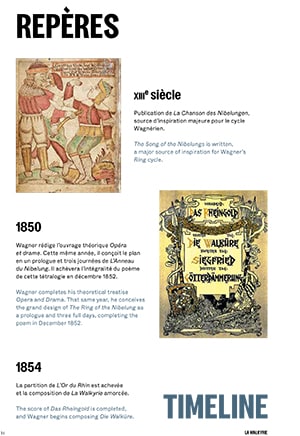
The characters in the Ring Cycle are primarily inspired from Medieval transcriptions of Norse and Germanic mythology, and more particularly from the 13th century German saga The Nibelungenlied (The Song of the Nibelungs). As he developed the librettos of the four operas which make up The Ring of the Nibelung, Richard Wagner brought those legends and their variations closer to his other sources of inspiration—namely Greek tragedy and Shakespearian drama—and added his own interpretations.


The Gods

© Pablo Grand Mourcel

Wagner retained seven gods from the pantheon of Norse mythology. These gods represent the highest order of beings in the universe. In Siegfried, where he appears as the Wanderer, Wotan describes his fellow deities as "light spirits who inhabit the cloudy heights ". Their mad quest for absolute power, represented by gold forged into a ring will lead them to their own destruction.

Wotan

The god of the gods—Odin or Wotan, depending on Norse or Germanic mythology—is the god of the dead, victory and knowledge. Left blind in his left eye after he sacrificed it in exchange for knowledge, he can be identified by his spear and the presence of two crows at his side—Huginn and Muninn (who respectively embody “thought” and “memory”). These attributes are replicated in the character created by Wagner. Wotan appears as the archetypal man of power: insatiable, unscrupulous and hypocritical. He is the master of Valhalla, a castle fortress perched on top of the mountains; a dazzling manifestation of his power. His power over the world is based on laws and covenants which will progressively be undermined and erased. Throughout the libretto, his authoritarianism gives way to growing insecurity. The husband of Fricka, he is also the father of the Valkyries as well as of Siegmund and Sieglinde.

Loge

Loge, the demigod of fire, is an amalgam of two mythological figures: Logi and Loki. While both embody fire, the latter also personifies cunning and trickery. In the Ring cycle, Loge retains this duality: he appears as both the god of fire and Wotan’s masterly advisor ultimately enabling Wotan to take possession of the ring. He is also one of the rare characters who is truly free. He alone will be able to distance himself from the system that Wotan has created, and he alone will resist the lure of the ring. A calculating character, Loge takes pleasure in playing with the gods and he possesses a perceptiveness that his peers lack. Throughout the Ring cycle, he forsakes his human persona to appear in his elemental form: fire.

Fricka

Fricka, the wife of Wotan and sister of Freia, Donner and Froh, is a divinity inspired by the goddess Frigg (or Frigga) from Norse mythology. In the Ring cycle she is the personification of lawfulness and fidelity. Tired of her husband’s infidelities, Fricka trys to make Wotan settle down and urges him to build Valhalla, a divine abode for them to live in. While Fricka is eager to defend the institution of marriage, she seeks above all to preserve the original values of divine society: respect for law and morality. In Die Walküre, she confronts Wotan with his own contradictions by reminding him that the guarantor of laws should not support Siegmund.  

Freyja

Freyja is a key divinity of Norse and Germanic mythology. A creature of incredible beauty, she is the goddess of love and fertility. In the Ring cycle, Freia is the sister of Fricka. In Valhalla, the gods are blessed with eternal youth thanks to her cultivation of golden apples. Coveted by Fafner and Fasolt in Das Rheingold, Freia serves as a bargaining chip for Wotan who promises her to two giants in exchange for the construction of Valhalla. Without Freia, the gods find themselves deprived of their source of eternal youth and begin to waste away.

Donner

The personification of Strength and power, Thor (also known as Donner) is one of the most popular gods in Germanic mythology. His hallmark is his hammer which is the source of thunder and lightning. Present only in Das Rheingold, Donner nevertheless occupies a strategic place among the other characters. He embodies the figure of a military leader who thinks in warlike terms to counter the threat posed by Alberich. His hammer, evocative of violence, is a symbolic counterforce to the inherent lawfulness represented by Wotan's spear.  

Froh

Along with Odin and Thor, Freyr is one of the three major gods in Germanic mythology. The personification of fertility he is also the brother of Freyja. Known as Froh in the Ring cycle, he only appears in Das Rheingold. His perseverance in defending Freia and the words he has for her reflects the closeness of the two characters. 

Erda

Inspired by the goddesses Jördh and Gaia from Nordic and Greek mythology, Erda is the maternal god of the Earth. She is the personification of ancestral, intuitive and prophetic wisdom. A veritable Pythia, she can simultaneously see the past, the present and the future. As the mother of the Norns who spin the threads of fate, she holds universal knowledge. In Das Rheingold, she arouses doubt and anxiety in Wotan by warning him that his thirst for power risks provoking his own demise. By begetting Brünnhilde with the latter, she gives life to the woman who will save the universe. In Siegfried, Wotan, in the guise of the Wanderer, calls on Erda one last time in a scene that seals their antagonisms.    

Les Grands Entretiens with Alexander Neef and Pablo Heras-Casado

Watch the video

Alexander Neef, Pablo Heras-Casado

20:45 min

Les Grands Entretiens with Alexander Neef and Pablo Heras-Casado

By Isabelle Stibbe

When an artist meets the Paris Opera's General Manager or its Director of Dance, what do they discuss? In this new series entitled Les Grands Entretiens, the Paris Opera lifts the veil on the artistic line-up of new productions for the 25/26 season. The choice of guest artists, the key themes, the directors' creative intentions and the choreographic styles: these exclusive twenty-minute exchanges offer you the first keys to the works that will soon be on the bill. 

What does the Ring represent for an opera house? On the occasion of the new productions of Die Walküre and Siegfried, Paris Opera General Manager Alexander Neef discusses the unique aspects of this colossal undertaking with conductor Pablo Heras-Casado.   

© Pablo Grand Mourcel

Richard Wagner’s Ring Cycle: The Nibelungen and the giants

Read the article

Discover the characters

04 min

Richard Wagner’s Ring Cycle: The Nibelungen and the giants

By Marion Mirande

The characters in the Ring Cycle are primarily inspired from Medieval transcriptions of Norse and Germanic mythology, and more particularly from the 13th century German saga The Nibelungenlied (The Song of the Nibelungs). As he developed the librettos of the four operas which make up The Ring of the Nibelung, Richard Wagner brought those legends and their variations closer to his other sources of inspiration—namely Greek tragedy and Shakespearian drama—and added his own interpretations.


The Nibelungen

© Pablo Grand Mourcel

In Norse mythology, the albes are a race apart from men, gods and giants. They are divided into two distinct species, the quasi-angelic albes of light, and the quasi-demonic black albes. In Germanic legend, the were called the Nibelungen, a name that means “those from the world below”. These denizens of the Nibelheim or underworld work as craftsmen or blacksmiths and possess great wealth. In the Ring cycle, the Nibelungen are portrayed as jealous, cunning, ambitious creatures, fundamentally hostile to the gods. 

Alberich

In the Ring cycle, Alberich is the one through whom misfortune manifests itself. He is dubbed the “black albe”. He dreams of conquering the world, renouncing love and cursing the one who gains possession of the ring which he forged. Associated with the gold he stole in Das Rheingold, Alberich’s power is utterly lawless and built on theft. 

Mime

Mime is Alberich’s brother and Siegfried’s adoptive father. In the Ring cycle, he represents permanent failure. Aware of the powers of the sword Nothung, and recognising the fact that only he who forged it will be capable of seizing the ring and the Tarnhelm which are held by the giant Fafner, he seeks in vain to restore it to its original form. Siegfried manages to reforge his father’s sword and recover the treasure, but he knows he is threatened with death by Mime. However, the latter is ultimately killed by the hero. 

Hagen

Hagen is one of the principal heroes of The Song of The Nibelungen. Motivated by moral values, this Medieval character becomes a manipulator and a cynic under Wagner. The son of Alberich and half-brother to Gunther and Gutrune, he represents in his father’s eyes the primary means of recovering the lost ring. His Machiavellian nature allows him to gain the upper hand over the other characters in Götterdämmerung. He manipulates Gunther and Gutrune and tricks Siegfried in order to kill him.

The giants

© Pablo Grand Mourcel

In Norse mythology, the giants are the ones who created the world and are frequently at war with the gods. To a large extent, they represent the forces of chaos. Using magic, cunning and physical force, they try to change the order of the universe. In medieval literature, they assumed the disposition of ugly and stupid characters often driven by bad intentions, as is the case in the Ring cycle.

Fasolt

Regarding the two giants in the cycle, Fasolt comes across as “the most docile”. In Das Rheingold, unlike his brother Fafner, Fasolt does not look upon Freia as a bargaining chip to seize control of Valhalla. He sincerely loves her. The motives of the two brothers are different: Fafner has political aims whereas Fasolt has a far more discreet temperament. Through their relationship, the conflict between love and power assumes all its significance.

Fafner

Of the two giants, Fafner stands out as “the malicious one”. Ever hungry for wealth, he is the first to react when he learns of the theft of the gold and the power of the ring. In his attempts to obtain the latter, he does not hesitate to murder his brother. In Siegfried, with the help of the Tarnhelm, the magic helmet, he morphs into a dragon and spends his days sleeping on his gold. He will ultimately be slain in his cave by Siegfried.

© Pablo Grand Mourcel

Richard Wagner’s Ring Cycle: The Valkyries and the Wälsung

Read the article

Discover the characters

04 min

Richard Wagner’s Ring Cycle: The Valkyries and the Wälsung

By Marion Mirande

The characters in the Ring Cycle are primarily inspired from Medieval transcriptions of Norse and Germanic mythology, and more particularly from the 13th century German saga The Nibelungenlied (The Song of the Nibelungs). As he developed the librettos of the four operas which make up The Ring of the Nibelung, Richard Wagner brought those legends and their variations closer to his other sources of inspiration—namely Greek tragedy and Shakespearian drama—and added his own interpretations.


The Valkyries

© Pablo Grand Mourcel

In Norse mythology, the Valkyries are virgin warriors charged with the mission of selecting the most courageous warriors fallen on the battlefield and leading them into Valhalla. In the Ring cycle, there are nine of them: Brünnhilde, Grimgerde, Gerhilde, Helmwige, Ortlinde, Rossweisse, Schwertleite, Siegrune, and Waltraute. Presented as the daughters of Wotan and of different conquests, they appear together for the first time in Act III of Die Walküre. Only two of them have major roles: Waltraute and Brünnhilde, both of whom were the love children of Wotan and Erda.

Brünnhilde

In Germanic literature, Brynhildr is portrayed as a Valkyrie who an adept of magic and the art of healing. In the Ring cycle, Brünnhilde appears as Wotan’s favourite even though she has rebelled against her father. Wagner made Brünnhilde the only character who connects the three days of the Ring. Her psychological and spiritual development progresses in three stages: her realisation of the greatness of love in Die Walküre, her emotional growth from experiencing love in Siegfried, and her rise to tragic greatness through renunciation in Götterdämmerung.

Waltraute

Waltraute is arguably the closest to Brünnhilde. She flouts Wotan’s interdictions to go and find her sister on her rock. In Götterdämmerung, concerned by Valhalla’s decline, she tries to convince Brünnhilde to part with the accursed ring and return it to the Rhinemaidens. In her mind, it is the only way to re-establish the course of things and save the gods.

The Wälsungen

© Pablo Grand Mourcel

Children of the "wolf" in Norse and Germanic mythology—one of Wotan’s reincarnations originally known as Wälse—they are the descendants of a mortal woman and Wotan. These creatures have an instinctive sense of freedom and for Wotan they represent a means to win back the ring. 

Siegmund

Siegmund is the earthly son of Wotan and the twin brother of Sieglinde. His incestuous relationship with Sieglinde gives rise to the line of the Wälsung. He is the father of Siegfried and he possesses the sword Nothung. He was sired by Wotan to fulfil the task of retrieving the ring. Courageous and of rare nobility, he has inherited the positive qualities of his father without any of his faults, and places love before self-interest. The intrinsic heroism of the character is revealed when he refuses to abandon Sieglinde and to enter Valhalla, preferring to die with her.

Sieglinde

Sieglinde is Siegmund’s twin sister. Abandoned as a child, she was forced to marry Hunding. In Die Walküre, Sieglinde possesses the valour of the heroes of mythical times. Despite her distress following the death of Siegmund, she gives birth to Siegfried with the assistance of Brünnhilde. Through the Valkyrie, Sieglinde realises that the salvation of the world depends on her maternity.

Siegfried

The son of Siegmund and Sieglinde, and the grandson of Wotan, Siegfried is one of the most significant characters in the Ring cycle. The embodiment of the quintessential hero, he symbolises hope. Wotan counts on him to retrieve the ring. More unsophisticated than cerebral, he acts on instinct. He has no conception of fear which enables him to confront Fafner and pass through the circle of fire on the rock on which Brünnhilde is imprisoned. Siegfried is also the archetypal Wagnerian character in search of his roots.

  • LA WALKYRIE by Richard Wagner "War es so schmählich" (Tamara Wilson & Christopher Maltman)
  • LA WALKYRIE by Richard Wagner "O fänd' ich ihn hier" (Elza van den Heever & Stanislas de Barbeyrac)
  • LA WALKYRIE by Richard Wagner "Ich weiss ein wildes Geschlecht" (Günther Groissböck)
  • LA WALKYRIE by Richard Wagner "Deiner Ew'gen Gattin" (Ève-Maud Hubeaux)
  • LA WALKYRIE by Richard Wagner "Deiner Ew'gen Gattin" (Ève-Maud Hubeaux)
  • LA WALKYRIE by Richard Wagner "War es so schmählich" (Tamara Wilson & Christopher Maltman)
  • LA WALKYRIE by Richard Wagner "O fänd' ich ihn hier" (Elza van den Heever & Stanislas de Barbeyrac)
  • LA WALKYRIE by Richard Wagner "Ich weiss ein wildes Geschlecht" (Günther Groissböck)
  • LA WALKYRIE by Richard Wagner "War es so schmählich" (Tamara Wilson & Christopher Maltman)
  • LA WALKYRIE by Richard Wagner "O fänd' ich ihn hier" (Elza van den Heever & Stanislas de Barbeyrac)
  • LA WALKYRIE by Richard Wagner "Ich weiss ein wildes Geschlecht" (Günther Groissböck)
  • LA WALKYRIE by Richard Wagner "Deiner Ew'gen Gattin" (Ève-Maud Hubeaux)
  • LA WALKYRIE by Richard Wagner "Deiner Ew'gen Gattin" (Ève-Maud Hubeaux)
  • LA WALKYRIE by Richard Wagner "War es so schmählich" (Tamara Wilson & Christopher Maltman)
  • LA WALKYRIE by Richard Wagner "O fänd' ich ihn hier" (Elza van den Heever & Stanislas de Barbeyrac)
  • LA WALKYRIE by Richard Wagner "Ich weiss ein wildes Geschlecht" (Günther Groissböck)
  • La Walkyrie (saison 25/26) - Acte 3 - Leb wohl

  • La Walkyrie (saison 25/26) - Acte 3 - War es soi schmählich

  • La Walkyrie (saison 25/26) - Acte 1 - Ich weiss ein wildes geschlecht

  • La Walkyrie (saison 25/26) - Acte 2 - Da mit dir ich sagte

  • La Walkyrie (saison 25/26) - Acte 2 - Deiner ew'gen Gattin

  • La Walkyrie (saison 25/26) - Acte 2 - Raste nun hier

  • La Walkyrie (saison 25/26) - Acte 1 - Friedmund darf ich nicht heissen

  • La Walkyrie (saison 25/26) - Acte 2 - Lass ich'S verlauten

Press

  • Stanislas de Barbeyrac, the first French Siegmund of international stature since the 1960s

    Le Monde, 2025
  • In the title role, Tamara Wilson has found a job that suits her perfectly, where presence and power never sacrifice nuance.

    La Terrasse, 2025

Access and services

Opéra Bastille

Place de la Bastille

75012 Paris

Public transport

Underground Bastille (lignes 1, 5 et 8), Gare de Lyon (RER)

Bus 29, 69, 76, 86, 87, 91, N01, N02, N11, N16

Calculate my route
Car park

Parking Indigo Opéra Bastille 1 avenue Daumesnil 75012 Paris

Book your spot at a reduced price
super alt text
super alt text
super alt text
super alt text
super alt text
super alt text

Imagined as benchmark, richly illustrated booklets, the programmes can be bought online, at the box offices, in our shops, and in the theatres hall on the evening of the performance.    

BUY THE PROGRAM
  • Cloakrooms

    Free cloakrooms are at your disposal. The comprehensive list of prohibited items is available here.

  • Bars

    Reservation of drinks and light refreshments for the intervals is possible online up to 24 hours prior to your visit, or at the bars before each performance.

In both our venues, discounted tickets are sold at the box offices from 30 minutes before the show:

  • €35 tickets for under-28s, unemployed people (with documentary proof less than 3 months old) and senior citizens over 65 with non-taxable income (proof of tax exemption for the current year required)
  • €70 tickets for senior citizens over 65

Get samples of the operas and ballets at the Paris Opera gift shops: programmes, books, recordings, and also stationery, jewellery, shirts, homeware and honey from Paris Opera.

Opéra Bastille
  • Open 1h before performances and until performances end
  • Get in from within the theatre’s public areas
  • For more information: +33 1 40 01 17 82

Opéra Bastille

Place de la Bastille

75012 Paris

Public transport

Underground Bastille (lignes 1, 5 et 8), Gare de Lyon (RER)

Bus 29, 69, 76, 86, 87, 91, N01, N02, N11, N16

Calculate my route
Car park

Parking Indigo Opéra Bastille 1 avenue Daumesnil 75012 Paris

Book your spot at a reduced price
super alt text
super alt text
super alt text
super alt text
super alt text
super alt text

Imagined as benchmark, richly illustrated booklets, the programmes can be bought online, at the box offices, in our shops, and in the theatres hall on the evening of the performance.    

BUY THE PROGRAM
  • Cloakrooms

    Free cloakrooms are at your disposal. The comprehensive list of prohibited items is available here.

  • Bars

    Reservation of drinks and light refreshments for the intervals is possible online up to 24 hours prior to your visit, or at the bars before each performance.

In both our venues, discounted tickets are sold at the box offices from 30 minutes before the show:

  • €35 tickets for under-28s, unemployed people (with documentary proof less than 3 months old) and senior citizens over 65 with non-taxable income (proof of tax exemption for the current year required)
  • €70 tickets for senior citizens over 65

Get samples of the operas and ballets at the Paris Opera gift shops: programmes, books, recordings, and also stationery, jewellery, shirts, homeware and honey from Paris Opera.

Opéra Bastille
  • Open 1h before performances and until performances end
  • Get in from within the theatre’s public areas
  • For more information: +33 1 40 01 17 82

Discover opera and ballet in another way

QR code

Dive into the Opera world and get insights on opera and pop culture or ballet and cinema. Scan this code to access all the quiz and blindtests on your mobile.

opera logo

5 min

Die Walküre

The true/false story of Die Walküre

Discover the story of Wagner's opera Die Walküre

Discover

Partners

  • Grande Mécène de la saison

  • With the exceptional support of Bertrand and Nathalie Ferrier, Élisabeth and Bertrand Meunier

Media and technical partners

Immerse in the Paris Opera universe

Follow us

Back to top