My special offers

Prices

    0
    300
    0€
    300€

Show / Event

Venue

Experience

Calendar

  • Between   and 

Prices

Edward Burtynsky, courtesy Flowers Gallery, London / Nicholas Metivier Gallery, Toronto

Edward Burtynsky, courtesy Flowers Gallery, London / Nicholas Metivier Gallery, Toronto

Opera

RING Festival

Das Rheingold (RING Festival)

Richard Wagner

Opéra Bastille

from 06 to 15 November 2026

from €40 to €290

2h30 no interval

Synopsis

Listen to the synopsis

0:00 / 0:00

Unique in the history of opera, The Ring of the Nibelung is the colossal tetralogy Richard Wagner worked on for thirty years. First performed in 1869, the Prologue The Rhinegold unveils from its first telluric chord a world riddled with existential questions. Who will obtain the power of the ring forged from the gold of the Rhine? The gods, the giants or the Nibelungen?

Borrowing from Norse and Germanic mythology, Wagner conceived an extraordinary cycle that reflected his innovative ambition: to create a total work of art inspired by ancient tragedy. As well as revolutionising the art of opera, he also devised theatrical material open to multiple interpretations.

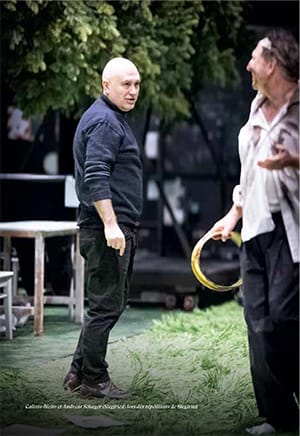
Director Calixto Bieito places The Rhinegold in a context dominated by digital virtuality and questions the impact of technology and science on human beings.  

Duration : 2h30 no interval

Language : German

Surtitle : French / English

  • Opening

  • 150 min

  • End

Show acts and characters

CHARACTERS

THE GODS
Wotan: Ruler of the gods
Fricka: Goddess of marriage, Wotan’s wife
Donner: God of thunder, brother of Fricka, Freia and Froh
Froh: God of spring, brother of Fricka, Freia and Donner
Loge: Demi-god of fire
Freia: Goddess of eternal youth, sister of Fricka, Donner and Froh
Erda: Mother-goddess of Earth

THE GIANTS
Fafner: Fasolt’s brother
Fasolt

THE NIBELUNGEN
Alberich: A deformed and grasping dwarf
Mime: A blacksmith, Alberich’s brother

THE RHINEMAINDENS
Woglinde
Wellgunde
Flosshilde

Previous events

Wotan has asked Fafner and Fasolt to build him a palace in order to consolidate his position of power. As a reward, he has promised them his sister-in-law Freia, who guarantees eternal youth and beauty.

Scene 1

Alberich avidly approaches the three Rhinemaidens who, initially seductive, toy with him before brutally humiliating him. In the process, they unwittingly reveal to Alberich the secret of the gold they are meant to guard: only he who forsakes love can forge from the Rhine gold the ring that confers absolute power. Since he dreams of social ascension and wealth, Alberich curses love and steals the gold.

Scene 2

Mighty Wotan dreams of “endless glory”. Now that the brothers Fafner and Fasolt have finished building his palace, his wife Fricka is worried about her sister Freia. She furiously accuses her husband of sacrificing everything to his thirst for power and demands that he protect Freia. Fafner and Fasolt arrive promptly to demand their contractually agreed wages. But for the moment, Wotan merely mocks these “oafs”, so much so that they decide to take Freia by force. Donner and Froh at first manage to defend their sister, until Loge appears, whom Wotan has been expecting for some time. His dubious adviser claims to have found no substitute for Freia anywhere around the world, since nobody is willing to forsake love. Nobody except Alberich, who has stolen the gold from the Rhinemaidens and forged it into a ring of power. Fafner convinces his brother to exchange Freia for gold as payment. The brothers will hold her hostage until Wotan brings them the gold. Wotan wants both the gold and the ring. Since Freia has been kidnapped and the family is already beginning to lose its vital forces, Wotan immediately sets off with Loge to rob Alberich of the gold stolen by the latter, along with the ring.

Scene 3

To consolidate his power, Alberich has enslaved his own brother, Mime, who has had to forge a magic helmet for him. This helmet can make its owner invisible or give him any appearance he wishes. In the greatest secrecy, Alberich produces humanoids, artificial creatures resembling humans, with whose assistance he aims to dominate the world. After descending to Nibelheim, Wotan and Loge first meet Mime, who has been humiliated and from whom Loge extracts all the important information. At first, Alberich is sceptical about these unwelcome visitors; he boasts of his power and wealth, but the wily Loge manages to trap him with hypocritical flattery. He feigns disbelief to make Alberich demonstrate how the “marvel” of the magic helmet works. Thus Alberich is transformed first into a “giant dragon” and then into a toad, allowing Wotan to capture him.

Scene 4

Wotan and his strategist Loge have kidnapped Alberich. They have chained him up and are forcing him to give up not only his gold, but also the magic helmet and the ring. Humiliated, Alberich strikes back with a terrible curse before disappearing: everyone will covet the ring, but it will bring death to all who possess it. Fafner and Fasolt return with Freia to exchange her for money. Fasolt demands that the gold be piled up, using Freia as a yardstick: the gold must hide her completely. Finally, they ask Wotan to give up the ring as well. When he refuses, Erda appears. She possesses all knowledge. She warns him about the ring, as it brings misfortune. No sooner has Wotan laid it down than the curse is fulfilled: a dispute breaks out over the division of the gold, and Fafner kills his brother. The whole family then enters the new palace that Wotan has mysteriously dubbed “Walhalla”, whilst Loge already foresees their end. From afar, the Rhinemaidens lament the loss of the “pure gold”, which, on Wotan’s orders, Loge merely comments upon with cynicism.

Artists

Prologue in four scenes to "Der Ring des Nibelungen" (1869)

Creative team

The Paris Opera Orchestra

Media

DAS RHEINGOLD by Richard Wagner - TRAILER (english version)
  • 3 questions for Ingo Krügler

    3 questions for Ingo Krügler

    Read the article

  • 3 questions for Rebecca Ringst

    3 questions for Rebecca Ringst

    Read the article

  • Leitmotifs in the Ring #4

    Leitmotifs in the Ring #4

    Watch the video

  • 3 questions for Sarah Derendinger

    3 questions for Sarah Derendinger

    Read the article

3 questions for Ingo Krügler

Read the article

Costume designer

3 questions for Ingo Krügler

By Alice de la Bouillerie

What is your personal connection to Richard Wagner’s Ring?

I’ve always had a particular relation to the works of Richard Wagner. As a German, I find they possess this profoundly Germanic vision of romanticism, imbued with a melancholic fascination for decline. This is doubtless very German. I’ve worked on several of his operas throughout my career: first of all Rienzi, then Tannhäuser at the Flanders Opera and Ballet, co-produced with Bern and Leipzig; Tristan and Isolde in Vienna; Lohengrin in Berlin. But the Ring is clearly his absolute masterpiece, a challenge for every creative team and an opportunity to offer a new reading of the work.

What part do the costumes play in your vision of the Ring?

My costumes are not simply there to distinguish between the different types of characters (Gods, mortals, Nibelungs, giants, etc.), they are more angled towards highlighting the hierarchy of power in a world that remains fairly close to a contemporary human reality. Nowadays, power belongs to those who possess information, Big Data. Our inspiration for the gods and the giants were American and international oligarchs who have concentrated wealth and power among themselves. They are a collection of very different personalities, each with his or her own obsession or personal belief. They all pursue to some extent the same objective: to attain power through obtaining gold.

The characters’ development through the Tetralogy is mirrored in their costumes. In The Valkyrie, Brünnhilde goes from a “Daddy’s little girl” in her big blue dress inspired by Yórgos Lanthimos’s Poor Things to an emancipated warrior. Between Rhinegold and The Valkyrie Fricka has cosmetic surgery, a final attempt to tame her wandering Wotan. Mime, a slave in rags in Rhinegold, puts his new-found wealth on show in Siegfried; he has gamed the system and joined the dominant class.

Nazi Germany, the darkest period in that nation’s history which pushed exploitation and domination to their extremes, was a natural point of reference. For Mime in Siegfried and above all Hunding, I was inspired by Nazi dignitaries, particularly Göring with his obsession for medals which thus adorn their costumes.

What inspired your work and how did you liaise with the teams of the Paris National Opera?

The costumes are the fruit of a variety of different influences. The outlines of the Norns were based on photographs of bourgeois women at the time of the Industrial Revolution and those of the Gibichungs the cinematic world of Luis Buñuel. As for the reality of war, I looked to Nazi Germany, the war in Ukraine and the apocalyptic scenes in Danila Kozlovski’s film Chernobyl. Modern art and fashion also influence my creations: artists such as Oleg Vdovenko and Vincent Rosenblatt have left their mark on my work on the Ring.

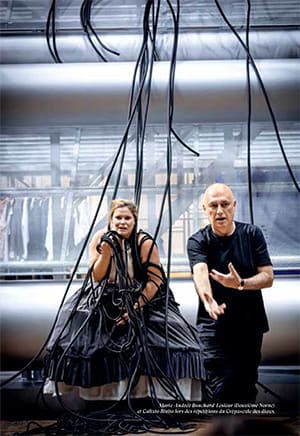
Teamwork with other artists also creates new ideas. A part of Alberich’s initial costume was born of Rebecca Ringst’s set design. We wanted to show his enslavement, which is why we decided to add the tubes from the set into his costume. Our work is constantly changing: the costumes are not always set in stone, they can be modified throughout the rehearsal period according to artistic discoveries, an individual singer’s needs and through dialogue with the workshops.

I feel very privileged to have been able to work closely with the extraordinary costume workshops of the Paris National Opera. Their technical mastery, creativity and engagement have been pivotal in the creation of these costumes.


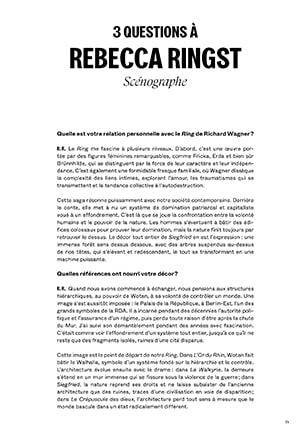
3 questions for Rebecca Ringst

Read the article

Set designer

04 min

3 questions for Rebecca Ringst

By Alice de la Bouillerie

What is your personal connection to Richard Wagner’s Ring?

The Ring fascinates me on several levels. First of all, it’s a work carried by some remarkable female characters, such as Fricka, Erda and Brünnhilde, who are notable by their strength of character and independent nature. It is also a extraordinary family saga where Wagner dissects the complexity of intimate ties, exploring love, traumas transmitted from one person to another and the collective tendancy to self-destruct.

Lastly, this saga resonates powerfully with contemporary society. Behind the storyline we see a system of patriarchal, capitalist domination destined to collapse. That is where human will and the force of nature meet head on. The men strive to build colossal edifices to prove their domination but nature will always win. This is demonstrated in the set of Siegfried: an immense inverted forest, trees suspended over our heads, rising and falling, transforming itself into a powerful machine.

What influenced your design choices?

When we started to brainstorm we thought of hierarchical structures, Wotan’s power and his desire to control the world. We immediately envisaged the Palace of the Republic in East Berlin, one of the great symbols of the German Democratic Republic. For decades it was the nerve centre of political authority and the confidence of a regime which became irrelevant after the fall of the Berlin Wall.

I was fascinated for years watching it being dismantled, it was like the collapse of an entire system, to the point where there were just a few fragments left, remnants of a perished city. This image is the point of departure of our Ring. In Rhinegold, Wotan commissions the building of Valhalla, symbol of a system based on hierarchy and control. The architecture develops with the story: in The Valkyrie, the residence is shown as an immense wall which cracks under the effects of war; in Siegfried, nature reasserts itself, leaving mere ruins, traces of a fading civilisation; in Twilight of the Gods, the architecture loses all logical form as the world tips into a radically different state.

What I’ve always loved about Wagner is how he perceives the metamorphosis of space in his music: he introduces these changes into the score, giving the scenery time to travel from one world to another. He calls it Verwandlung, transformation, which is central to my work. I’m only captivated by a set if it transforms before my eyes in symbiosis with the voices and the score. This synergy raises emotions to unimaginable heights.

What were the main artistic and technical challenges you faced?

One of the main challenges has been the postponement of the production because of Covid restrictions: we feared that a ten-year-old project might no longer be relevant today. But our initial concept, that of an enormous metallic Valhalla, was actually very flexible. We made it a gigantic data centre riddled with cables, mirroring the growing influence technology has on our everyday lives.

We soon realised we needed to rethink the set of Twilight of the Gods. The world has changed immensely these last ten years: there are more wars and we can no longer rely on established values, such as democracy. This last episode is therefore a reflexion on collective amnesia and the loss of memory where elements of the previous operas only reemerge in the form of ruins of a lost world.

The richness of a project such as this owes everything to the collaboration between the different members of the artistic team and the synergy of their work. The Valkyrie is a good example. When lit, the aluminium panel has a fascinating presence: it can reflect like polished silver then change dramatically to profound darkness. The perforated panels can both let light through, disappearing to reveal a hidden world behind this monumental creation, and serve as a video screen. We found a common language where every element supports the others, interweaving to create an infinitely larger entity.

Leitmotifs in the Ring #4

Watch the video

Siegfried

3:21 min

Leitmotifs in the Ring #4

By Matthieu Pajot, Coline Delreux

Musical themes to describe a character, an object, a place or an emotion. In Wagner's work, leitmotifs have a closely related dramatic and musical role.
Octave invites you to discover four of them from the Cycle: the ring, Siegfried, Valhalla and the Ride of the Valkyries.

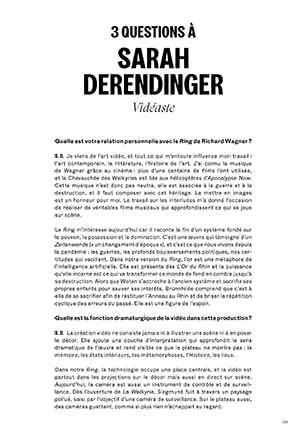
3 questions for Sarah Derendinger

Read the article

Videographer

04 min

3 questions for Sarah Derendinger

By Alice de la Bouillerie

What is your personal connection to Richard Wagner’s Ring?

I come from the video art world, and everything around me influences my work: contemporary art, literature, art history. I first heard Wagner’s music in the cinema – it’s been used in over a hundred films – and The Ride of the Valkyries is inextricably linked with Apocalypse Now. There’s nothing anodine there, this music is connected with war and destruction, we have to deal with that heritage.

Representing it in video form is an honour for me, working on these interludes has given me the chance to create actual musical films which complement the action on stage. The Ring interests me now as it tells the story of the end of a system based on power, possession and domination. It represents a Zeitenwende – a change of era – and it’s what we’ve been living since the covid pandemic: wars, profound political change, we can no longer take nothing for granted. In our version of the Ring, gold is a metaphor for artificial intelligence. We see it already in Rhinegold and its power continues to utterly transform the world all the way to oblivion. While Wotan clings onto the old, outmoded system and sacrifices his children to save his own interests, Brünnhilde understands that she needs to sacrifice herself to return the Ring to the Rhine and break the vicious circle of past errors. She is a figure of hope.

What is video’s dramaturgical function in this production?

Videos are never used to illustrate a scene or provide a set. They add a layer of interpretation which intensifies the work’s dramatic meaning and shows that which the stage cannot: memories, emotional states, metamorphoses, history, places.

In our Ring, technology is central to the concept and video is omnipresent in projections on the set but also directly on the stage. Nowadays, a camera is also an instrument of control and surveillance. From the very beginning of The Valkyrie, Siegmund flees across a polluted landscape, caught in the lens of a CCTV camera. The cameras lurk on stage, too, as if nothing can ever escape their attention.

I also use a thermal imaging camera, the type that hunters use to locate a prey’s body heat. This tracking device then becomes an artistic tool: Siegmund and Sieglinde appear as hunted animals but also as the last creatures who still emanate heat and love. They represent the last remnants of heat and life in the middle of an otherwise dead world.

How have you aligned your work with the other artists on this Ring?

We’ve been working on this Ring for eight years and the world has changed significantly in that time. Before lockdown we had a different concept. Then covid interrupted the rehearsals. We subsequently put up Lohengrin in Berlin in an empty auditorium with the premiere on livestream. The world was deserted, we couldn’t go out, we had to make do with ourselves. After that difficult period, we felt we couldn’t tell the story of the Ring the same way. What followed was charged with new urgency. Our common language was refined over a number of years.

The video aspect is lodged between the set and lighting design: Rebecca Ringst created the sets with Calixto Bieito, I inserted the video and Michael Bauer developed the lighting in conjunction with the film. With Calixto, we often work against the music. Where Wagner unleashes all his forces, I often chose the opposite: calm, silent images in slow motion. This discrepancy creates an interesting tension between moving pictures and music. And sometimes in rehearsal we found that, all the stage elements – the set, video, light and music – despite their differences finally converged in a one and single direction allowing the whole meaning to burst forth.

  • L’Or du Rhin (saison 24/25) - Scene 3 - Interlude

  • L’Or du Rhin (saison 24/25) - Scene 3 - Die in linder Lüfte Wehn

  • L’Or du Rhin (saison 24/25) - Scene 4 - Bei des Rheines Töchtern

  • L’Or du Rhin (saison 24/25) - Scene 4 - Bin ich nun frei

  • L’Or du Rhin (saison 24/25) - Scene 4 - Weiche Wotan

  • L’Or du Rhin (saison 24/25) - Scene 4 - Schwüles Gedünst

  • L’Or du Rhin (saison 24/25) - Scene 4 - Rheingold!

opera logo
[LIVE] Aida


Join us on Sunday 15 November at 2:30pm to watch Wagner's opera live on POP!

7-DAY FREE TRIAL Free trial 7 days

Access and services

Opéra Bastille

Place de la Bastille

75012 Paris

Public transport

Underground Bastille (lignes 1, 5 et 8), Gare de Lyon (RER)

Bus 29, 69, 76, 86, 87, 91, N01, N02, N11, N16

Calculate my route
Car park

Parking Indigo Opéra Bastille 1 avenue Daumesnil 75012 Paris

Book your spot at a reduced price
super alt text
super alt text
super alt text
super alt text
super alt text
super alt text

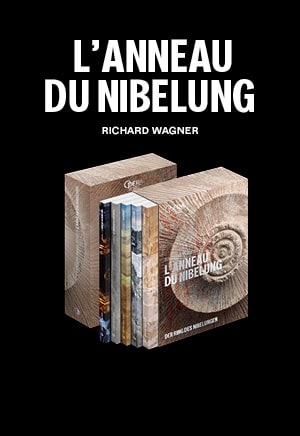
In 2026, while we are celebrating the 150th anniversary of the first performance of the Ring cycle at the Bayreuth Festival, we observe how this work never ceases to be relevant. Its poetic power, musical ambition, dramatic breadth and profound conviction in the strength of theatre remain as compelling today as they were at its creation.  

BUY THE PROGRAM
  • Cloakrooms

    Free cloakrooms are at your disposal. The comprehensive list of prohibited items is available here.

In both our venues, discounted tickets are sold at the box offices from 30 minutes before the show:

  • €35 tickets for under-28s, unemployed people (with documentary proof less than 3 months old) and senior citizens over 65 with non-taxable income (proof of tax exemption for the current year required)
  • €70 tickets for senior citizens over 65

Get samples of the operas and ballets at the Paris Opera gift shops: programmes, books, recordings, and also stationery, jewellery, shirts, homeware and honey from Paris Opera.

Opéra Bastille
  • Open 1h before performances and until performances end
  • Get in from within the theatre’s public areas
  • For more information: +33 1 40 01 17 82

Opéra Bastille

Place de la Bastille

75012 Paris

Public transport

Underground Bastille (lignes 1, 5 et 8), Gare de Lyon (RER)

Bus 29, 69, 76, 86, 87, 91, N01, N02, N11, N16

Calculate my route
Car park

Parking Indigo Opéra Bastille 1 avenue Daumesnil 75012 Paris

Book your spot at a reduced price
super alt text
super alt text
super alt text
super alt text
super alt text
super alt text

In 2026, while we are celebrating the 150th anniversary of the first performance of the Ring cycle at the Bayreuth Festival, we observe how this work never ceases to be relevant. Its poetic power, musical ambition, dramatic breadth and profound conviction in the strength of theatre remain as compelling today as they were at its creation.  

BUY THE PROGRAM
  • Cloakrooms

    Free cloakrooms are at your disposal. The comprehensive list of prohibited items is available here.

In both our venues, discounted tickets are sold at the box offices from 30 minutes before the show:

  • €35 tickets for under-28s, unemployed people (with documentary proof less than 3 months old) and senior citizens over 65 with non-taxable income (proof of tax exemption for the current year required)
  • €70 tickets for senior citizens over 65

Get samples of the operas and ballets at the Paris Opera gift shops: programmes, books, recordings, and also stationery, jewellery, shirts, homeware and honey from Paris Opera.

Opéra Bastille
  • Open 1h before performances and until performances end
  • Get in from within the theatre’s public areas
  • For more information: +33 1 40 01 17 82

Discover opera and ballet in another way

QR code

Dive into the Opera world and get insights on opera and pop culture or ballet and cinema. Scan this code to access all the quiz and blindtests on your mobile.

opera logo

4 min

Das Rheingold (RING Festival)

Das Rheingold, the true/false story

A river, a legend and a treasure… Can you untangle this true/false synopsis of Der Ring des Nibelungen’s prologue by Wagner?

Discover

Partners

  • Grande Mécène de la saison

  • With the exceptional support of Bertrand and Nathalie Ferrier, Élisabeth and Bertrand Meunier

  • Sponsor of the Paris Opera initiatives for young people and of the previews

Immerse in the Paris Opera universe

Jean-Pierre Delagarde / OnP

Sign up for our newsletter

Our latest news

* Required fields

By clicking on "submit", you agree to receive electronic communications from the Opéra national de Paris and to the processing of your data.
Learn more about managing your data and your rights.

Back to top