My special offers

Prices

    0
    300
    0€
    300€

Show / Event

Venue

Experience

Calendar

  • Between   and 

Prices

Bernd Uhlig / OnP

Bernd Uhlig / OnP

Opera

Lady Macbeth of Mtsensk

Dmitri Chostakovitch

Opéra Bastille

from 13 to 28 March 2027

from €17 to €180

3h25 with 1 interval

Synopsis

Listen to the synopsis

0:00 / 0:00

Like a Russian Madame Bovary, Katerina is profoundly bored in the company of her husband. The arrival of a new employee, Sergei, leads her into adultery and then crime, making her more akin to Lady Macbeth. But unlike Shakespeare’s character, Katerina acts not out of a thirst for power but to satisfy urges stifled by a sordid environment.

Premiered in 1934 in Leningrad when Dmitri Shostakovich was only 28 years old, Lady Macbeth of Mtsensk was a triumph that nevertheless sealed the composer’s fate. Stalin deemed the opera scandalous and incompatible with “socialist realism”. The composer was threatened with deportation and the work banned for more than 25 years before resurfacing in a diluted version.

Performed in its original version, Shostakovich’s powerful and tense score is reinforced by Krzysztof Warlikowski’s staging. By placing the characters in a slaughterhouse, he restores this 20th century masterpiece’s unflinching brutality.

Duration : 3h25 with 1 interval

Language : Russian

Show acts and characters

CHARACTERS

Boris Timofeyevich Izmailov: Owner of an industrial slaughterhouse
Zinoviy Borisovich Izmailov: Son of Boris and heir to the business
Katerina Lvovna Ismailova: Zinoviy’s wife
Sergei: An employee of the Izmailovs and Katerina’s lover
Aksinya: A young girl in the Izmailovs’ service
A shabby peasant: A worker in the Izmailovs’ service who is drunk most of the time
The orthodox priest
The police commissioner
Sonietka: A young prisoner

First part

Act 1

Locked in a loveless marriage with Zinoviy Borisovich, Katerina feels dispirited. Her father-in-law, Boris Timofeyevich, who runs an industrial slaughterhouse, reproaches her for failing to provide his son with an heir after four years of marriage. Katerina holds her husband responsible for their childless union. When her husband is obliged to leave for a few days to resolve an unexpected work‑related issue, Boris Timofeyevich compels Katerina to swear before all the workers that she will remain faithful to her spouse. Aksinya, a young woman in the family’s service, evokes the reputation of the newly-hired Sergei: he’s a handsome fellow but also an inveterate womaniser.

He was forced to leave his last place of employment after he tried to seduce the mistress of the household. A group of workers, led by Sergei, harass Aksinya. Katerina intervenes and chastises the men for their disrespectful behaviour. Sergei challenges her to wrestle with him. Katerina accepts, but soon has to concede defeat. Just then, her father-in-law unexpectedly appears. Katerina invents a story to dispel any suspicion surrounding her and Sergei. Alone in her room, Katerina voices her frustrations: she yearns to be loved and desired. Her father-in-law advises her to go to sleep rather than burn the candle unnecessarily. However, someone knocks at the door: it is Sergei who pretends to have come to borrow a book. His true intentions, though, are all too obvious and, after some resistance, Katerina abandons herself to him.

Act 2

Suffering from insomnia, Boris looks back nostalgically on the excesses of his youth. Suddenly, he sees Sergei climbing out of Katerina’s bedroom window. He catches him and wakes everyone with his yelling. He demands that a whip be fetched and gives Sergei a severe beating. Powerless, Katerina is obliged to witness the scene. Boris locks up Sergei and orders Katerina to prepare him a meal since all the whipping has made him hungry. She goes and makes the mushroom dish that she usually prepares for him and laces it with rat poison. Soon thereafter, the old man goes into convulsions. Ignoring his cries, Katerina takes the keys to the warehouse where Boris locked up Sergei and leaves.

In the morning, the workers find Boris at death’s door and summon the priest. In his death throes, the old man accuses his daughter-in-law of having poisoned him, however, the priest does not understand his mutterings. Katerina feigns affliction. Katerina shares the conjugal bed with Sergei. The latter is troubled because he knows Zinoviy will soon return home. Katerina reassures him and tells him he has nothing to fear: he will be her husband. Her only cause for trepidation is Boris’s ghost, who appears in her bedroom every night to curse her. Not long after, Zinoviy returns home without warning. Sergei barely has time to hide. Zinoviy has heard what happened in his absence and he questions Katerina. She denies any involvement until Zinoviy beats her with Sergei’s belt. The latter comes to her aid and while he immobilises Zinoviy, Katerina strangles him. They then hide the body in the food cellar.

Second part

Act 3

Zinoviy is missing and presumed dead. Katerina and Sergei are getting married. Katerina is tormented by remorse. However, Sergei reproaches her for being so anxious at a time when everyone is preparing to celebrate. In a cabaret number, the shabby peasant suggests that Zinoviy’s corpse might be located nearby.

The police officers are also happily participating in the festivities. Most of the guests are now inebriated. Suddenly, Katerina realises that the body has been discovered. She warns Sergei, but the latter is reluctant to flee and abandon all the wealth now within his reach. When he finally agrees to take flight, it is too late: the police intervene. Unable to control herself, Katerina confesses and the two accomplices are arrested.

Act 4

Sergei and Katerina along with a group of other convicts are on their way to a prison camp. Sergei no longer wants anything to do with Katerina: he blames her for having destroyed his life. He tries to seduce Sonietka, a young prisoner. In exchange for her favours, she asks him to find her a pair of stockings. Sergei goes to see Katerina and, after claiming to have been injured by his shackles, he manages to convince her to let him have her stockings to make a bandage. However, Katerina soon realises that she has been duped.

The other prisoners mock her. Adding insult to injury, Sonietka offers her cynical thanks for the stockings. The prisoners arrive at a bridge. Katerina approaches Sonietka, pushes her into the river and jumps into the water after her. The two women drown. The convoy resumes its journey.

Show chronology

Timeline

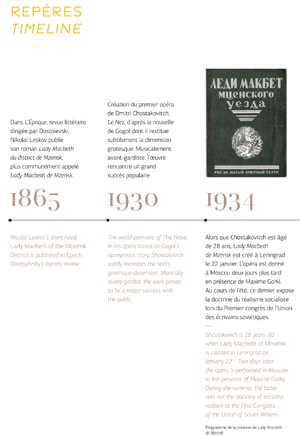
  • 1865

    Nicolai Leskov’s short novel Lady Macbeth of the Mtsensk District is published in Epoch, Dostoyevsky’s literary review.

  • 1930

    The world premiere of The Nose. In his opera based on Gogol’s eponymous story, Shostakovich subtly recreates the text’s grotesque dimension. Musically avant-gardist, the work proves to be a major success with the public.

  • 1934

    Shostakovich is 28 years old when Lady Macbeth of Mtsensk is created in Leningrad on January 22nd. Two days later, the opera is performed in Moscow in the presence of Maxime Gorky. During the summer, the latter sets out the doctrine of socialist realism at the First Congress of the Union of Soviet Writers.

  • 1936

    In January, Pravda, the official press organ of the Kremlin, lambasts Lady Macbeth of Mtsensk as “musical chaos” and makes a personal attack on Shostakovich. The opera remains on the bill until March at which point it is banned.

  • 1937

    Shostakovich composes his 5th Symphony in a classical style. The work, described as a “creative response by a Soviet artist to justified criticism”, is given a favourable reception and allows the composer to regain favour in the eyes of the regime.

  • 1948

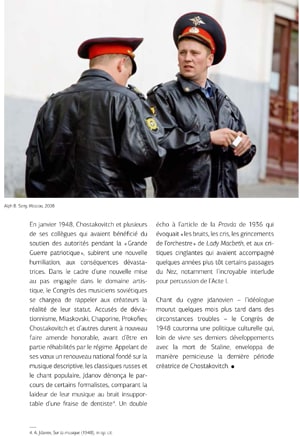
    Criticised for his formalism, Shostakovich is sanctioned by the Communist Party’s Central Committee. He is dismissed from his teaching posts at the Leningrad Conservatory. Certain of these decisions are reviewed and revoked ten years later in 1958.

  • 1953

    Stalin dies and Nikita Khrushchev becomes First Secretary of the Communist Party of the Soviet Union. His appointment ushers in a so‑called “thaw” characterised by the condemnation of Stalin’s purges and the implementation of more liberal reforms.

  • 1960

    Dmitri Shostakovich is elected secretary of the Union of Composers. The following year, he joins the Communist Party.

  • 1963

    One year after the ban on it is lifted, the second reworked and toned‑down version of Lady Macbeth of Mtsensk premieres under the title of Katerina Ismailova.

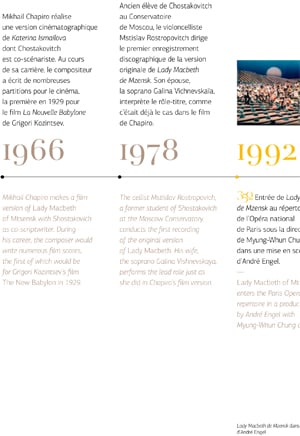
  • 1966

    Mikhail Chapiro makes a film version of Lady Macbeth of Mtsensk with Shostakovich as co-scriptwriter. During his career, the composer would write numerous film scores, the first of which would be for Grigori Kozintsev’s film The New Babylon in 1929.

  • 1978

    The cellist Mstislav Rostropovich, a former student of Shostakovich at the Moscow Conservatory, conducts the first recording of the original version of Lady Macbeth. His wife, the soprano Galina Vishnevskaya, performs the lead role just as she did in Chapiro’s film version.

  • 1992

    Lady Macbeth of Mtsensk enters the Paris Opera’s repertoire in a production by André Engel with Myung‑Whun Chung conducting.

Artists

Opera in four acts and nine parts (1934)

After Nikolaï Leskov

Creative team

Cast

The Paris Opera Orchestra and Chorus

Media

LADY MACBETH DE MZENSK by Dmitri Chostakovitch (trailer)
  • “Brother humans who live after us”

    “Brother humans who live after us”

    Read the article

  • Transgression in Lady Macbeth of Mtsensk

    Transgression in Lady Macbeth of Mtsensk

    Read the article

  • Sergei, the villain

    Sergei, the villain

    Watch the video

  • Requiem for a Russian woman

    Requiem for a Russian woman

    Watch the video

  • Draw-me Lady Macbeth of Mtsensk

    Draw-me Lady Macbeth of Mtsensk

    Watch the video

© FineArtImages/Leemage

“Brother humans who live after us”

Read the article

Lady Macbeth, the reasons for a scandal

06 min

“Brother humans who live after us”

By Charlotte Ginot-Slacik

The text remains famous: On January 28, 1936, the newspaper Pravda (Truth) published an editorial entitled “Chaos replaces music” which took aim at Dmitri Shostakovich’s latest opera, Lady Macbeth of the Mtsensk District. Dissonant modernity and neurasthenic amorality were cited as proof of the young composer’s “petit-bourgeois” spirit. Behind these moralistic and aesthetic attacks, was Stalin’s rush to curg the composer based more on intrinsically political considerations?


Let us go back in time.
1932: The young composer had just completed his second opera, a tale of the violent liberation of a woman trapped in a loveless marriage and left to suffocate in her world of provincial merchants. “I saw in Katerina Ismailova a beautiful, talented and energetic woman who dies in the midst of a morbid and oppressive family environment in bourgeoise and feudal Russia1 ” (Shostakovich).
That same year, the Communist Party dissolved the artistic associations that until then had guaranteed a certain aesthetic tolerance and transformed them into a system of unions which would henceforth govern all aspects of musical life.
1934: Lady Macbeth of the Mtsensk District premieres simultaneously in Moscow and Leningrad. That same year, the Moscow trials trigger the elimination of Stalin’s presumed and known political opponents.
1936: The publication of “Chaos replaces music”.
That same year, the Great Purges form a mass-elimination within the Soviet Union’s civilian population.

The closeness of the dates is striking. As the work was gaining momentum, the vice was tightening in the U.S.S.R. “We are like rabbits in a boa constrictor’s cage. In the blink of an eye, someone else disappears. We feel that the circle is tightening and tightening. At first, it was only people we distantly knew. Then it became friends, then my husband and Witek. Now it’s my father and Doulia. Every day, someone disappears. It doesn’t stop.” (Diary of Emma Korzeniowska, September 19372)
Undeniably, Katerina Ismailova, a triple-murdering adulteress, dominated by her carnal desires, remained alien to the new ideal of the strong, positive, altruistic Soviet woman. “No man will hold me by the waist, no man will put his lips on mine / no man will caress my white breast, no man will exhaust me with his passionate desire…” so sings the heroine in the first act. To read Shostakovich, this yearning for desire has a political dimension: “In Lady Macbeth, I sought to create a satire that could reveal, unmask and spawn contempt towards the appalling arbitrariness and oppression of the way of life of the merchant classes3.” The work was also part of a much larger project that the musician wanted to devote to the Russian woman, leading to the evocation of female emancipation in the Soviet Union. Lady Macbeth was to have been the first component, focusing on the oppression of women in the Tsarist era. Shostakovich hereby reveals himself to be a reader of Dostoevsky who, from the middle of the 19th century, was calling for the emancipation of women: “The more society evolves correctly, the more it will normalise and the closer we will get to the ideal of humanity and our attitude towards women will be determined by itself, without preliminary projects and utopian imagination4 .” By subversively ridiculing the moral and political authority (police officers, judges…), the heroine’s desires and their murderous consequences destabilise the entire domestic and social order.
Even more than the explicit portrayal of the love act at the end of Act I, it is the carnal desire that has become a factor in the destruction of moral values and social authority which for us seems extremely shocking. At a time when Soviet society was reinforcing familiar principles (family stability, patriotic nationalism), Shostakovich’s unbridled individualism in hindsight seemed like a reckless provocation.

Dmitri Chostakovitch dirigeant un orchestre (URSS), 1930. Photographie de Boris Ignatovitch
Dmitri Chostakovitch dirigeant un orchestre (URSS), 1930. Photographie de Boris Ignatovitch © Musée Nicéphore Niépce, Ville de Chalon-sur-Saône / adoc-photos

The Gulags—a second scandal
The creative process of Lady Macbeth ran counter to the policy shifts initiated by the Soviet authorities. The disappearance of individuals and arbitrary arrests became increasingly common. In that sense, the work was a tragic augur of the Great Purges. The portrait of the prison outlined by the musician is all the more unbearable. Wretched were the prisoners who were forced down that road. Almost six years after Janáček’s From the House of the Dead, Shostakovich’s portrayal of prison life again reminds us of Dostoevsky’s writings: “Every human being, whoever he may be, however base he may be, instinctively and unconsciously retains a demand: that his human dignity be respected. The prisoner knows that he is a prisoner, a pariah, and he knows his place in the hierarchy: however, no red-hot iron, no chain can make him forget that he is a human being. And since it is a fact that he is a human being we must therefore treat him as such5.”

Following the heroine’s final murder, spawned out of jealousy for her former lover’s preference for a younger inmate, the prisoners resume their journey, singing of the vastness of the Siberian steppes. Shostakovich embellishes this tragic denouement (which incidentally remains incompatible with the optimism of socialist realism!) with one of the most celebrated chorales by Bach, “Ich ruf zu dir, Herr Jesu Christ” BWV 639: “I call to you, Lord Jesus Christ”. The convicts are transformed into universal figures, namely, prisoners with pathos. The moving chant borrowed from Bach turns the “human brothers” into culprits whose crimes cannot overshadow the suffering. The prison ethic according to Shostakovich is one of compassion. Was this not the work’s inexpiable crime during the dark days of the Great Purges?


1.  SHOSTAKOVITCH, (Dimitri), in “Soviet Art”, 14 December 1933, Lady Macbeth of the Mtsensk District, Paris, Avant-Scène Opéra N° 141, April 2011, p. 71   
2. KIZNY (Tomasz), The Great Terror in the USSR, 1937-1938, Paris, Éditions Noir sur Blanc, 2013, p.87 
3. SHOSTAKOVITCH (Dimitri), Ibid., p. 70.    
4. DOSTOEVSKY (Fédor), Récits, chroniques et polémiques, Paris, Gallimard, 1969, p. 1144.   
5.  DOSTOEVSKY (Fédor), Carnets de la maison des morts, Actes-Sud, Babel, 1999    . 

© plainpicture/Millennium/Benedetta Casagrande

Transgression in Lady Macbeth of Mtsensk

Read the article

How music violated Soviet morality

07 min

Transgression in Lady Macbeth of Mtsensk

By Etienne Barilier

Composed under Stalin, Shostakovich’s opera is a cry of carnal passion. But perhaps more than the idea of sensuality, exacerbated by the orchestra, it is that of liberty that the composer seemed to have wished to express.

In the edition of Pravda that, on 28th January 1936, condemned Shostakovich’s opera to public obloquy, stupidity really wore the visage of a bull ready to charge. The article denounced and threatened the composer as an enemy of the people. Enough to make anyone tremble, all the more so in that it had been directly inspired if not written by Stalin in person, who had been present at the performance. The tirade reproached the composer for two reasons: he had written a cacophonie (the word was in French in the original text), and he had represented love “in its most vulgar form”. But these two criticism were one and the same: “The music clucks, rumbles, gasps and puffs to represent the love scenes with realism”. Or again: “This is musical noise called upon to express passion”. On this point, the article was right: the transgression was, in effect, two-fold. Words and music.
In the libretto, Shostakovich dared to speak of love and depict love in the crudest manner. And to that end, he did not hesitate to modify the text of the novella from which he drew his inspiration. Witness this sequence in which, in Leskov, Katerina’s servant has herself weighed in a barrel, a scene that, under Shostakovich’s pen becomes a collective rape. Witness also the character of the father-in-law, even more libidinous than he is pitiless; he whips the lover before his daughter-in-law’s eyes, experiencing through this action genuine sexual pleasure. Witness yet again the manner in which the husband’s impotence is announced, not to mention the scenes in which the desire that inhabits the heroine is expressed in its raw state, without the slightest circumlocution: “The stallion hastens to join the mare, the tom howls for the she-cat, the pigeon seeks the dove. But no one rushes towards me [...] No one presses his lips against mine, nobody caresses my white bosom, no one arouses me with a passionate caress.”
So much for the text. As for the music, it never fails to express desire in all its fullness, sexual passion in all its fury. It conveys such violence to the impulses that inhabit the characters that the murders they commit seem natural to us: the paroxysms of a savage, almost raging love. This is not to suggest that Shostakovich does not offer us passages of tenderness and lyricism. Thus, at the very beginning, Katerina’s song which recounts her boredom at having nothing to do, an almost romantic ennui; one is reminded, for a moment, of Emma Bovary. Here the music seems innocent, evoking a Russian folk song. However, an insistent pounding in the bass provides a dark counter-rhythm to the melody: the nagging throb of desire.
At the end of the first act, Katerina, in her tortured solitude, groans her need for a lover. A moment before, when her father-in-law orders her to go to bed, a recurring motif can be heard in the strings, soft but obsessive. Then follow drum rolls and a creeping figure in the bass clarinet. Then in the vocal line the sexually explicit “The stallion hastens to join the mare” emerges, accompanied by sumptuous strings, whilst the latent threat in the bass clarinet persists. Little by little, the vocal line becomes a desperate cry, which is not without evoking the fury of Salome. This is the music of imbalance and frustration.
Soon the harp can be heard, followed by the celesta, shreds of innocence. Sergei approaches, accompanied ironically by the piccolo, drum rolls in the timpani and derisory notes in the celesta. The melody has an ironic, skipping lilt. Its false gaiety teeters above the abyss; hypocritical flirting, before desire is unleashed in all its stark reality. The least one can say is that the music is worthy of the text. It soon supplants it, gasping with the characters’ bodies, in an amorous struggle that is a struggle for life itself. A terrifying, suffocating progression, which could be that of an act of carnage, or which is precisely that, for does not the very word carnage signify the consummation of the flesh, the ravaging of the flesh? Explosions in the brass, spiralling motifs in the strings, maniacal glissandi in the trombones and bombarding percussion. Literally, with rare ferocity, shots are fired. Then everything breaks down and collapses, in an abrupt post-orgasmic detumescence.
At the very end of the opera, the same percussion instruments that expressed desire beat out the march towards death, that of the convicts in the steppe. Only Wozzeck had previously explored these remote regions – and we know that Shostakovich had been strongly impressed by Alban Berg’s opera. The music then is as transgressive as the libretto. Not only because it accompanies with its precise hurricanes the violence of the text, but also because Shostakovich combined in it all kinds of musical languages (tonal, modal, plurimodal, chromatic and atonal), whilst making use of unusual combinations of instruments and timbres and of constant changes of atmosphere in a sort of vertiginous iridescence: enough to provoke cries of “left-wing chaos” from Pravda.

Dmitri Chostakovitch lisant La Pravda
Dmitri Chostakovitch lisant La Pravda © akg-images / Sputnik

But perhaps there was still more, something that is the real mark of Shostakovich, of whom we are never sure if his music represents a mask or a face: an inextricable mixture of tragedy and satire, of lyricism and sarcasm, of emotion and irony, of gravity and laughter. A work of extreme pliability and emotional complexity. And, in addition, a fundamentally ambiguous vision of the human soul. This ambiguity could well have been both the cause and the consequence of the oppression the composer endured during his life. The cause, because even despite his most desperate endeavours, the composer remained incapable of writing music that was simple, realist and socialist. The consequence because his inherent richness and subtlety, under the influence of fear, were perhaps constrained to become dissimulation, a salutary ambivalence, as in the famous Symphony no. 5, acknowledged by the establishment the year after his condemnation in Pravda (in 1937) as a song of triumph and a sign of the composer’s repentance, but one can also find it cruelly and deliberately hollow. At the beginning of the thirties, when Lady Macbeth of Mtsensk was written, the complexity, the indefinability of Shostakovich was certainly not the result of dissimulation. Except perhaps in the scene in which the police sergeant expresses a wish to search Katerina’s house simply because he has not been invited to her wedding. “We need a reason” he ruminates cynically, “but a reason, that can always be found”. A denunciation of Czarist arbitrariness, it would seem. Shostakovich was thus irreproachable. But it doubtless fooled nobody, least of all Stalin, a past master in the art of “finding reasons”.
This allusion, however, despite its mortal insolence, cannot have irritated the father of the people as much as the opera’s music, which was guilty of the ultimate crime, that of saying: no, the world is not as simple as a despot’s dream. Taken all in all, the erotic transgression of the work, and the impression it gave of saying and showing everything immodestly, masked an even graver transgression, that of complexity, of ambiguity. A true artist, the eternal enemy of those terrible agents of simplification, never ceases to suggest that, although the human body can be stripped bare, the soul never will be entirely.

© DR

Sergei, the villain

Watch the video

Meet with Pavel Černoch

3:16 min

Sergei, the villain

By Cyril Pesenti

In Lady Macbeth of the Mtsensk District, an opera by Dmitri Chostakovitch, Sergei is an object of desire. In this subversive production by Krzysztof Warlikowski, Pavel Černoch has free rein to interpret a powerful and passionate Sergei. The Czech tenor, normally best known for his prince roles, seems delighted to play this evil character.

© Markus Werner / OnP

Requiem for a Russian woman

Watch the video

Interview with Ingo Metzmacher

6:52 min

Requiem for a Russian woman

By Marion Mirande

Inspired by the profile of an adulterous and murderous woman, "Lady Macbeth of Mtsensk" is a work whose sexual energy did not escape Stalin when he discovered it in 1936. From then onwards, publicly accused of pornography, Dmitry Shostakovich lived in fear of being deported to Siberia, just like his heroine Katerina Izmailov. Ingo Metzmacher, conducting this new production, discusses the score's subversive force and his choice to punctuate the third and fourth acts with the Soviet composer's Quartet No. 8.

Draw-me Lady Macbeth of Mtsensk

Watch the video

Understand the plot in 1 minute

1:15 min

Draw-me Lady Macbeth of Mtsensk

By Matthieu Pajot

Of Shostakovich’s initial undertaking – a trilogy on the tragic destinies of Russian women through the ages – only one opera was ever written: the hard-hitting Lady Macbeth of Mtsensk. Although one of the mainsprings of the work, the Shakespearean parallel is here bitterly ironic: unlike Lady Macbeth, Katerina Ismaïlova who, in the remote reaches of rural 19th century Russia, falls in love with one of her husband’s employees and is finally forced to commit suicide, is less a manipulator than a victim of a violent and patriarchal society. Krzysztof Warlikowski liberates all the subversive power of this scorching and scandalous work, which marked the early years of the Opéra Bastille.

  • Lady Macbeth de Mzensk by D. Chostakovitch (Aušrinė Stundytė & Pavel Černoch)
  • Lady Macbeth de Mzensk by D. Chostakovitch (Aušrinė Stundytė & Pavel Černoch)
  • Lady Macbeth de Mzensk by D. Chostakovitch (Alexander Tsymbalyuk)
  • Lady Macbeth de Mzensk (saison 18/19)- Acte I

  • Lady Macbeth de Mzensk (saison 18/19)- Acte I

  • Lady Macbeth de Mzensk (saison 18/19)- Acte IV - Alexander Tsymbalyuk (Le Vieux Bagnard) Et Chœur

  • Lady Macbeth de Mzensk (saison 18/19)- Acte IV - Alexander Tsymbalyuk (Le Vieux Bagnard) Et Chœur

  • Lady Macbeth de Mzensk (saison 18/19)- Acte II - Pavel Černoch (Serguei)

  • Lady Macbeth de Mzensk (saison 18/19)- Acte II - Pavel Černoch (Serguei)

  • Lady Macbeth de Mzensk (saison 18/19)- Interlude Orchestral

  • Lady Macbeth de Mzensk (saison 18/19)- Interlude Orchestral

  • Lady Macbeth de Mzensk (saison 18/19)- Acte II - Dmitry Ulyanov (Boris Ismailov)

  • Lady Macbeth de Mzensk (saison 18/19)- Acte II - Dmitry Ulyanov (Boris Ismailov)

  • Lady Macbeth de Mzensk (saison 18/19)- Acte I - Aušrinė Stundytė (Katerina Ismailova)

  • Lady Macbeth de Mzensk (saison 18/19)- Acte I - Aušrinė Stundytė (Katerina Ismailova)

Access and services

Opéra Bastille

Place de la Bastille

75012 Paris

Public transport

Underground Bastille (lignes 1, 5 et 8), Gare de Lyon (RER)

Bus 29, 69, 76, 86, 87, 91, N01, N02, N11, N16

Calculate my route
Car park

Parking Indigo Opéra Bastille 1 avenue Daumesnil 75012 Paris

Book your spot at a reduced price
super alt text
super alt text
super alt text
super alt text
super alt text
super alt text

By pitting the bourgeois and merchant classes against the proletariat, Shostakovich’s opera emphasizes hierarchical relationships and social divisions. The solitude and social deprivation portrayed in several scenes through brutish and pitiful characters highlight the opera’s humanist dimension, bringing it close to works like Alban Berg’s Wozzeck or Leoš Janáček’s From the House of the Dead. However, the composer’s uncompromising vision of Man rejects all duality and in this sense is incompatible with Soviet ideology which opposed the contemptible rich and the respectful working classes. In Shostakovich’s view, each is as bad as the other and all stand out by their stupidity

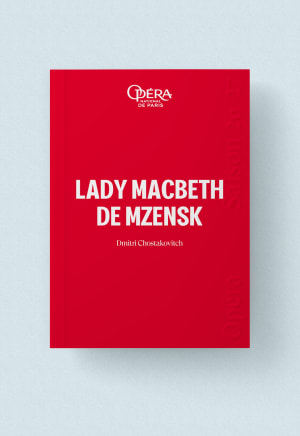
BUY THE PROGRAM
  • Cloakrooms

    Free cloakrooms are at your disposal. The comprehensive list of prohibited items is available here.

  • Bars

    Reservation of drinks and light refreshments for the intervals is possible online up to 24 hours prior to your visit, or at the bars before each performance.

In both our venues, discounted tickets are sold at the box offices from 30 minutes before the show:

  • €35 tickets for under-28s, unemployed people (with documentary proof less than 3 months old) and senior citizens over 65 with non-taxable income (proof of tax exemption for the current year required)
  • €70 tickets for senior citizens over 65

Get samples of the operas and ballets at the Paris Opera gift shops: programmes, books, recordings, and also stationery, jewellery, shirts, homeware and honey from Paris Opera.

Opéra Bastille
  • Open 1h before performances and until performances end
  • Get in from within the theatre’s public areas
  • For more information: +33 1 40 01 17 82

Opéra Bastille

Place de la Bastille

75012 Paris

Public transport

Underground Bastille (lignes 1, 5 et 8), Gare de Lyon (RER)

Bus 29, 69, 76, 86, 87, 91, N01, N02, N11, N16

Calculate my route
Car park

Parking Indigo Opéra Bastille 1 avenue Daumesnil 75012 Paris

Book your spot at a reduced price
super alt text
super alt text
super alt text
super alt text
super alt text
super alt text

By pitting the bourgeois and merchant classes against the proletariat, Shostakovich’s opera emphasizes hierarchical relationships and social divisions. The solitude and social deprivation portrayed in several scenes through brutish and pitiful characters highlight the opera’s humanist dimension, bringing it close to works like Alban Berg’s Wozzeck or Leoš Janáček’s From the House of the Dead. However, the composer’s uncompromising vision of Man rejects all duality and in this sense is incompatible with Soviet ideology which opposed the contemptible rich and the respectful working classes. In Shostakovich’s view, each is as bad as the other and all stand out by their stupidity

BUY THE PROGRAM
  • Cloakrooms

    Free cloakrooms are at your disposal. The comprehensive list of prohibited items is available here.

  • Bars

    Reservation of drinks and light refreshments for the intervals is possible online up to 24 hours prior to your visit, or at the bars before each performance.

In both our venues, discounted tickets are sold at the box offices from 30 minutes before the show:

  • €35 tickets for under-28s, unemployed people (with documentary proof less than 3 months old) and senior citizens over 65 with non-taxable income (proof of tax exemption for the current year required)
  • €70 tickets for senior citizens over 65

Get samples of the operas and ballets at the Paris Opera gift shops: programmes, books, recordings, and also stationery, jewellery, shirts, homeware and honey from Paris Opera.

Opéra Bastille
  • Open 1h before performances and until performances end
  • Get in from within the theatre’s public areas
  • For more information: +33 1 40 01 17 82

Partners

Immerse in the Paris Opera universe

Jean-Pierre Delagarde / OnP

Sign up for our newsletter

Our latest news

* Required fields

By clicking on "submit", you agree to receive electronic communications from the Opéra national de Paris and to the processing of your data.
Learn more about managing your data and your rights.

Back to top