My special offers

Prices

    0
    300
    0€
    300€

Show / Event

Venue

Experience

Calendar

  • Between   and 

Prices

Émilie Brouchon / OnP

Émilie Brouchon / OnP

Opera

La Clemenza di Tito

Wolfgang Amadeus Mozart

Palais Garnier

from 24 November to 25 December 2026

from €50 to €225

2h45 with 1 interval

Synopsis

Listen to the synopsis

0:00 / 0:00

The title of La Clemenza di Tito says it all: the emperor of Rome, although betrayed by his friend who has attempted to kill him for the love of a woman, will choose to pardon the conspirators. Themes of imperial mercy were standard fare for operas, especially when written on royal commission. 


This is precisely the case with this work, composed in just eighteen days by Wolfgang Amadeus Mozart for Prague in 1791, on the occasion of the coronation of Leopold II, alongside The Magic Flute and the Requiem. Despite a libretto by the poet Metastasio that had been set many times by other composers, and a musical form – opera seria – already considered outdated, Mozart’s subtle and delicate music lays bare the truth of the characters’ emotions. 


In Willy Decker’s stylised staging, a marble block at the centre of the stage gradually reveals the emperor’s hidden face: that of a solitary, wounded man.

Duration : 2h45 with 1 interval

Language : Italian

Surtitle : French / English

Show acts and characters

CHARACTERS

Titus: Emperor of Rome
Vitellia: Daughter of the ex-emperor Vitellius, deposed by Titus
Sextus: Friend of Titus, Servilia’s brother, in love with Vitellia
Annius: Friend of Sextus, in love with Servilia
Servilia: Sextus’s sister
Publius: Captain of the Roman guard  

Act 1

Titus has become emperor of Rome and wishes to marry his beloved African princess Berenice. The Roman Vitellia, who herself has her sights on the throne, is in the throes of anger. She demands that her suitor, Sextus, assassinate the emperor. Despite the deep friendship he has for Titus, the young man, blindly in thrall to Vitellia, is ready to fulfil her wishes. He buries his scruples and agrees to obey her. Annius announces that the emperor, yielding to the pressure of the Roman people, is ready to renounce the foreign princess. Vitellia orders Sextus to postpone the murder.

Sextus, pained at finding himself Vitellia’s plaything, raises some desperate objections, which the young woman, unruffled, sweeps aside. Annius, who wants to marry Servilia, Sextus’s sister, begs him to intercede with Titus in his favour. The emperor bids farewell to Berenice; the people and the Senate have forced her to leave. Deeply unhappy, Titus seeks comfort from his friends Sextus and Annius. As proof of his affection, he declares that he has chosen Servilia to be his wife. In the presence of the two dismayed young men, Titus sings of the joy he feels at bringing happiness to others and asks a despairing Annius to bear the happy tidings to the lucky bride‑to-be.

But Servilia refuses to wear the imperial ermine; not for one moment will she think of abandoning Annius, and the two lovers swear eternal fidelity. Servilia throws herself at Titus’s feet and avows that her heart belongs to Annius. Touched by her sincerity, her courage and the strength of her love, Titus yields to her wishes. Enter Vitellia, who, seeing Servilia’s joy, believes in a new betrayal by Titus. She bitterly reproaches Sextus and again urges him to accomplish her vengeance.

Resigned, sword in hand, Sextus begs for one last glance. Sure that vengeance will be hers, Vitellia is informed by Publius, Titus’s minister and strongman of Rome, that Titus has chosen her to be empress. Alas, she has just dispatched Sextus with the order to kill the emperor. The young man is about to perpetrate the deed. He wanders, veering between fury and despair. In Rome revolt is brewing. The Capitol is in flames. In the general confusion, with the determination brought on by madness, Sextus obeys Vitellia’s order. Titus is dead…  

Acte 2

Titus lives… The emperor has escaped the assassination attempt. Lentulus, one of the insurgents, had taken his crown and cloak to lead the uprising and, striking him, Sextus believed he had killed Titus. Overwhelmed by his feelings of guilt, Sextus confesses to Annius, who advises him to present himself before the emperor and admit to his crime. Vitellia, on the other hand, urges Sextus to flee. He promises not to betray her and to take his secret to the grave. Publius arrests Sextus. Titus cannot believe Sextus guilty. Annius comes to beg for mercy for his friend, who has been condemned to death by the Senate.

Despite his disappointment, Titus cannot make up his mind to sign the decree condemning Sextus without hearing him one last time. Sextus is brought before him. The two men hardly recognise each other. Sextus, not wishing to betray Vitellia, will not speak and bids farewell to the emperor with a broken heart. Titus cannot resign himself to sending him to his death and decides to pardon him. Annius and Servilia come to entreat Vitellia to use her power over Titus to save Sextus.

Moved by Sextus’s greatness of soul (he has not denounced her), she decides to confess the truth to the emperor and to bid farewell to life. While everyone is present and Sextus awaits execution, Vitellia admits that she is behind the plot. Titus is distraught: everyone has been leagued against him and even wanted to kill him. Is there no love and no true loyalty in life? At the cost of a great effort over himself and to set a good example, Titus grants a general pardon. His friends and enemies, the people and the Senate celebrate the emperor’s goodness. Titus remains in the background, alone.

Show chronology

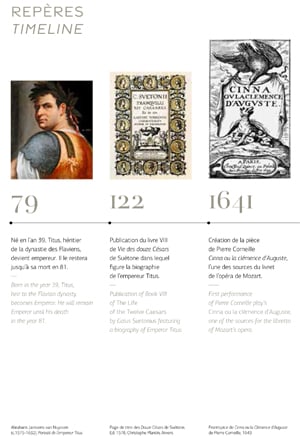
Timeline

  • 79

    Born in the year 39, Titus, heir to the Flavian dynasty, becomes Emperor. He will remain Emperor until his death in the year 81.

  • 122

    Publication of Book VIII of The Life of the Twelve Caesars by Gaius Suetonius featuring a biography of Emperor Titus.

  • 1641

    First performance of Pierre Corneille play’s Cinna ou la clémence d’Auguste, one of the sources for the libretto of Mozart’s opera.

  • 1670

    In his play Bérénice, Jean Racine focuses on Titus’s renunciation of love due to matters of State.

  • 1734

    Pietro Metastasio delivers the libretto for La Clemenza di Tito to the composer Antonio Caldara. Some forty composers, including Mozart, will set the work to music.

  • 1752

    Gluck’s La Clemenza di Tito, which is also set to Metastasio’s libretto, has its premiere in Naples.

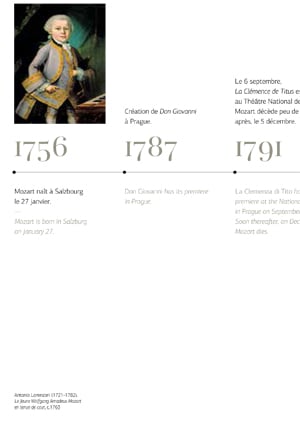
  • 1756

    Mozart is born in Salzburg on January 27.

  • 1787

    Don Giovanni has its premiere in Prague.

  • 1791

    La Clemenza di Tito has its premiere at the National Theatre in Prague on September 6. Soon thereafter, on December 5, Mozart dies.

  • 1816

    At the Théâtre-Italien, French premiere of La Clemenza di Tito in the original language

  • 1987

    La Clemenza di Tito enters the Paris Opera’s repertoire in a production by Federik Mirdita at the Salle Favart

  • 1997

    The premiere of Willy Decker’s production at the Palais Garnier.

Artists

Opera seria in two acts (1791)


Creative team

Cast

The Paris Opera Orchestra and Chorus

Media

LA CLÉMENCE DE TITUS by Wolfgang Amadeus Mozart (trailer)
  • Imaginarie La Clemenza di Tito

    Imaginarie La Clemenza di Tito

    Watch the video

  • Draw-me La Clemenza di Tito

    Draw-me La Clemenza di Tito

    Watch the video

  • The Emperor's March

    The Emperor's March

    See the slideshow

  • La Clemenza di Tito in a nutshell

    La Clemenza di Tito in a nutshell

    Watch the video

  • Imperial Tête-à-tête in La Clemenza di Tito

    Imperial Tête-à-tête in La Clemenza di Tito

    Read the article

  • 5 questions about Mozart

    5 questions about Mozart

    Discover

Imaginarie La Clemenza di Tito

Watch the video

A repertoire work narrated in a visual poem born of popular culture.

1:03 min

Imaginarie La Clemenza di Tito

By Marc de Pierrefeu

For Mozart, La Clemenza di Tito marked a return to opera seria. It was a style he had already tried his hand at (Mitridate, re di Ponto in 1770; Lucio Silla in 1772; Idomeneo in 1781) and which he particularly appreciated, as a letter to his father in 1778 bears witness: “Do not forget my desire to write operas! I envy anyone who does; I positively weep tears of regret when I read an aria or hear one sung. But it has to be in Italian, not German, an opera seria and not buffa.” If seria – and its musical dramaturgy – was traditionally the antithesis of buffa, La Clemenza is nonetheless a work which synthesizes Mozart’s stylistic input into the two genres of melodrama, whilst also including some of the characteristics of dramma giocoso

Draw-me La Clemenza di Tito

Watch the video

Understand the plot in 1 minute

1:26 min

Draw-me La Clemenza di Tito

By Matthieu Pajot

If the liaison between Titus and Berenice inspired one of the greatest French playwrights, it was the Roman Emperor himself, an incarnation of absolute sovereignty, that occupied the central position in what was to be Mozart’s last opera. Marking a return to opera seria in its formal constraints and choice of subject, the work nevertheless defies expectations, its humanity shining forth through an obscure clarity in which the hidden melancholy of a score composed by an already declining Mozart is discernible. Willy Decker’s streamlined production offers an exploration of the nature of power in which forgiveness and reconciliation are examined in all their strength and fragility.  

© Eléna Bauer / OnP

See the slideshow

La Clemenza di Tito at the Palais Garnier

01 min

The Emperor's March

By Octave

Every revival of La Clemenza di Tito offers the opportunity for the Emperor's bust - one of the monumental elements of the set - to travel between the Ateliers Berthier and the Palais Garnier. A closeup on this extraordinary journey in a reportage by photographer Elena Bauer (2013).

© Sébastien Mathé / OnP

La Clemenza di Tito in a nutshell

Watch the video

Mozart's opera in 40 seconds

000:41 min

La Clemenza di Tito in a nutshell

By Margot Gallimard

At the piano dress rehearsal of La Clemenza di Tito, we placed a camera in the Palais Garnier auditorium to give you a picture of Willy Decker's production of Mozart's opera in 40 seconds flat.

Listen to La Clemenza di Tito's playlist

© Christophe Pelé / OnP

Imperial Tête-à-tête in La Clemenza di Tito

Read the article

A production remembered

03 min

Imperial Tête-à-tête in La Clemenza di Tito

By Angelika Potier, Hébert Desormière

In his production of La Clemenza di Tito, Willy Decker focusses on “Titus the man, plunged in solitude, dying little by little as the soulless statue of the public figure, the hero, the emperor takes shape.” From the moment the curtain rises, a block of marble occupies the centre of the stage. The hero’s dramatic arc corresponds to the evolution of this block, from its raw initial state to the finished bust of Titus. An opportunity to explore the sculpture workshop of the Paris Opera: part of the technical department, it rubs shoulders with the other workshops: carpentry, painting, metalwork, upholstery and composite materials. Angelika Potier, head of department and Hebert Desormière, sculptor, describe the genesis of the four sculptures created for the production.   

Angelika Potier : We were very proud to see our creations back on stage for this sixth revival. I must say that the sculpture department did us proud! During the first production in 1997, the biggest challenge for us was reproducing the portrait. The bigger the portrait, the more afraid one is of making a mess of it.

Hebert Desormière : On the subject of the portrait, that of Titus was not our visual starting point. The decorator thought that Titus “didn’t look right for the job” and preferred the portrait of Julius Caesar with its piercing expression.

A.P. Our team at that time consisted of six sculptors to create both the model and the four blocks. This represented about five weeks’ work. It was from the initial model by John Macfarlane that our former head of the workshop created that of the face on which we worked. It was more detailed to make scaling it up easier. Each person was responsible for one stage in the process. The first virgin block, also known as the bloc capable, was realised by a former colleague, Charlie, who had a particular gift for creating the effect of different textures. Hebert made one of the two unfinished busts with the head emerging from the block, whereas I did the final bust of Titus, to which a plinth inscribed with his name was added.

H.D. : For the second unfinished bust, I adapted the steps, which had to be both practical and discrete, because the character, lying on top of the sculpture, has to descend gradually whilst singing. For all four blocks, we used polystyrene, unbeatable for it lightness and malleability. Before the sculptures went to the painting workshop, the composite materials workshop covered them with a fine layer of resin, about one millimetre thick. Being such a fragile material, polystyrene has to be covered with this resin to protect it from knocks.

A.P.: As a spectator, I have very pleasant memories of “La Clemenza”, which for me is pure opera – visually and musically coherent. Through the sculpting of a block, I witnessed the emergence of an emperor: the excess matter was pared away until the portrait of the hero was revealed.


Interviewed by Anna Schauder

Photos taken in the sculpture workshop for the production of La Clemenza di Tito, directed by Willy Decker.
Photos taken in the sculpture workshop for the production of La Clemenza di Tito, directed by Willy Decker. 7 images

5 questions about Mozart

Discover

01 min

5 questions about Mozart

By aria

Mozart’s last opera, La Clemenza di Tito was composed for Emperor Leopold II’s coronation as King of Bohemia. If Antonio Salieri was initially asked to write the work, it would finally be the composer of Don Giovanni who would inherit the commission.

Written by Caterino Mazzolà, after Metastasio, the libretto was imposed on Mozart and set to music in record time – in under three weeks. It was an exhausting period for the composer because, in addition to this work and despite failing health, he was also working on the scores of The Magic Flute and the Requiem.

  • [EXTRAIT] LA CLÉMENCE DE TITUS by Wolfgang Amadeus Mozart (Stanislas de Barbeyrac)
  • [EXTRAIT] LA CLÉMENCE DE TITUS by Mozart (Amanda Majeski, Michèle Losier & Christian Van Horn)
  • [EXTRAIT] LA CLÉMENCE DE TITUS by Wolfgang Amadeus Mozart (Amanda Majeski)
  • [EXTRAIT] LA CLÉMENCE DE TITUS by Wolfgang Amadeus Mozart (Michèle Losier)
  • [EXTRAIT] LA CLÉMENCE DE TITUS by Wolfgang Amadeus Mozart (Stanislas de Barbeyrac)
  • [EXTRAIT] LA CLÉMENCE DE TITUS by Mozart (Amanda Majeski, Michèle Losier & Christian Van Horn)
  • [EXTRAIT] LA CLÉMENCE DE TITUS by Wolfgang Amadeus Mozart (Amanda Majeski)
  • [EXTRAIT] LA CLÉMENCE DE TITUS by Wolfgang Amadeus Mozart (Michèle Losier)
  • [EXTRAIT] LA CLÉMENCE DE TITUS by Wolfgang Amadeus Mozart (Stanislas de Barbeyrac)
  • [EXTRAIT] LA CLÉMENCE DE TITUS by Mozart (Amanda Majeski, Michèle Losier & Christian Van Horn)
  • [EXTRAIT] LA CLÉMENCE DE TITUS by Wolfgang Amadeus Mozart (Amanda Majeski)
  • [EXTRAIT] LA CLÉMENCE DE TITUS by Wolfgang Amadeus Mozart (Michèle Losier)
  • [EXTRAIT] LA CLÉMENCE DE TITUS by Wolfgang Amadeus Mozart (Stanislas de Barbeyrac)
  • [EXTRAIT] LA CLÉMENCE DE TITUS by Mozart (Amanda Majeski, Michèle Losier & Christian Van Horn)
  • [EXTRAIT] LA CLÉMENCE DE TITUS by Wolfgang Amadeus Mozart (Amanda Majeski)
  • [EXTRAIT] LA CLÉMENCE DE TITUS by Wolfgang Amadeus Mozart (Michèle Losier)
  • La Clémence de Titus (saison 20/21) - Acte I - Deh Se Piacer Mi Vuoi

  • La Clémence de Titus (saison 20/21) - Acte II - Se Al Volto Mai Ti Senti

  • La Clémence de Titus (saison 20/21) - Acte I - Parto Parto

  • La Clémence de Titus (saison 20/21)- Acte I - Ah Se Fosse Intorno

Access and services

Palais Garnier

Place de l'Opéra

75009 Paris

Public transport

Underground Opéra (lignes 3, 7 et 8), Chaussée d’Antin (lignes 7 et 9), Madeleine (lignes 8 et 14), Auber (RER A)

Bus 20, 21, 27, 29, 32, 45, 52, 66, 68, 95, N15, N16

Calculate my route
Car park

Parking Q-Park Edouard VII and Q-Park Meyerbeer 16 rue Bruno Coquatrix 4 rue de la Chaussée d'Antin 75009 Paris

Book your spot at a reduced price
super alt text
super alt text
super alt text
super alt text
super alt text
super alt text

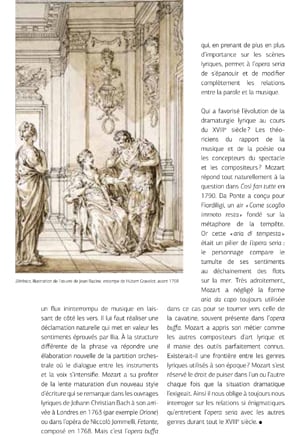
Mozart’s last opera, La Clemenza di Tito was composed for Emperor Leopold II’s coronation as King of Bohemia. If Antonio Salieri was initially asked to write the work, it would finally be the composer of Don Giovanni who would inherit the commission. Written by Caterino Mazzolà, after Metastasio, the libretto was imposed on Mozart and set to music in record time – in under three weeks. It was an exhausting period for the composer because, in addition to this work and despite failing health, he was also working on the scores of The Magic Flute and the Requiem.

BUY THE PROGRAM
  • Cloakrooms

    Free cloakrooms are at your disposal. The comprehensive list of prohibited items is available here.

  • Bars

    Reservation of drinks and light refreshments for the intervals is possible online up to 24 hours prior to your visit, or at the bars before each performance.

At the Palais Garnier, buy €10 tickets for seats in the 6th category (very limited visibility, two tickets maximum per person) on the day of the performance at the Box offices.

In both our venues, discounted tickets are sold at the box offices from 30 minutes before the show:

  • €35 tickets for under-28s, unemployed people (with documentary proof less than 3 months old) and senior citizens over 65 with non-taxable income (proof of tax exemption for the current year required)
  • €70 tickets for senior citizens over 65

Get samples of the operas and ballets at the Paris Opera gift shops: programmes, books, recordings, and also stationery, jewellery, shirts, homeware and honey from Paris Opera.

Palais Garnier
  • Every day from 10 a.m. to 6:30 p.m. and until performances end
  • Get in from Place de l’Opéra or from within the theatre’s public areas
  • For more information: +33 1 53 43 03 97

Palais Garnier

Place de l'Opéra

75009 Paris

Public transport

Underground Opéra (lignes 3, 7 et 8), Chaussée d’Antin (lignes 7 et 9), Madeleine (lignes 8 et 14), Auber (RER A)

Bus 20, 21, 27, 29, 32, 45, 52, 66, 68, 95, N15, N16

Calculate my route
Car park

Parking Q-Park Edouard VII and Q-Park Meyerbeer 16 rue Bruno Coquatrix 4 rue de la Chaussée d'Antin 75009 Paris

Book your spot at a reduced price
super alt text
super alt text
super alt text
super alt text
super alt text
super alt text

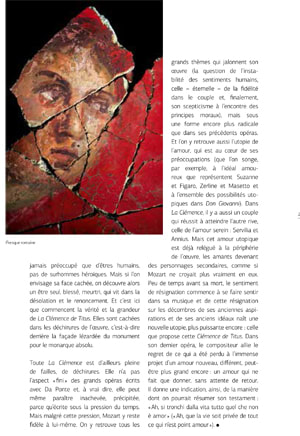
Mozart’s last opera, La Clemenza di Tito was composed for Emperor Leopold II’s coronation as King of Bohemia. If Antonio Salieri was initially asked to write the work, it would finally be the composer of Don Giovanni who would inherit the commission. Written by Caterino Mazzolà, after Metastasio, the libretto was imposed on Mozart and set to music in record time – in under three weeks. It was an exhausting period for the composer because, in addition to this work and despite failing health, he was also working on the scores of The Magic Flute and the Requiem.

BUY THE PROGRAM
  • Cloakrooms

    Free cloakrooms are at your disposal. The comprehensive list of prohibited items is available here.

  • Bars

    Reservation of drinks and light refreshments for the intervals is possible online up to 24 hours prior to your visit, or at the bars before each performance.

At the Palais Garnier, buy €10 tickets for seats in the 6th category (very limited visibility, two tickets maximum per person) on the day of the performance at the Box offices.

In both our venues, discounted tickets are sold at the box offices from 30 minutes before the show:

  • €35 tickets for under-28s, unemployed people (with documentary proof less than 3 months old) and senior citizens over 65 with non-taxable income (proof of tax exemption for the current year required)
  • €70 tickets for senior citizens over 65

Get samples of the operas and ballets at the Paris Opera gift shops: programmes, books, recordings, and also stationery, jewellery, shirts, homeware and honey from Paris Opera.

Palais Garnier
  • Every day from 10 a.m. to 6:30 p.m. and until performances end
  • Get in from Place de l’Opéra or from within the theatre’s public areas
  • For more information: +33 1 53 43 03 97

Immerse in the Paris Opera universe

Jean-Pierre Delagarde / OnP

Sign up for our newsletter

Our latest news

* Required fields

By clicking on "submit", you agree to receive electronic communications from the Opéra national de Paris and to the processing of your data.
Learn more about managing your data and your rights.

Back to top