My special offers

Prices

    0
    300
    0€
    300€

Show / Event

Venue

Experience

Calendar

  • Between   and 

Prices

Charles Duprat / OnP

Charles Duprat / OnP

Opera

Il Trovatore

Giuseppe Verdi

Opéra Bastille

from 16 January to 27 February 2027

from €17 to €205

2h50 with 1 interval

Synopsis

Listen to the synopsis

0:00 / 0:00

The story could be straightforward: a nobleman – the Count di Luna – and a troubadour – Manrico – both covet the same woman, Leonora. But this classic rivalry is complicated by a vendetta spanning two generations, seasoned with witchcraft, burning at the stake and swapped babies. Far-fetched? No matter!


Il Trovatore is one of three masterpieces that Giuseppe Verdi triumphantly unveiled in the 1850s, along with Rigoletto and La Traviata. Its success lies in a keen sense of drama and fiery music that elevates the libretto beyond its improbabilities. At the height of his artistic maturity, Verdi offers each protagonist arias of breathtaking beauty and the chorus its own unforgettable moments.


Director Alex Ollé sets the action in the context of the First World War, lending weight to the extreme situations the characters must confront.

Duration : 2h50 with 1 interval

Language : Italian

Surtitle : French / English

Show acts and characters

CHARACTERS

Ferrando: Captain of the Count di Luna’s guard
Leonora: Lady-in-waiting to the Princess of Aragon
Ines: Leonora’s confidante
The Count di Luna: A young nobleman of Aragon
Manrico: A troubadour, he is Count di Luna’s political rival and rival in love
Azucena: A gypsy, believed to be Manrico’s mother
Ruiz: A partisan of Manrico  

First part

Act 1 - The duel

Ferrando tells his soldiers the story of a gypsy who was burned at the stake for having bewitched the younger of the two sons of the old Count di Luna. Soon thereafter, the gypsy’s daughter abducted the child out of vengeance and its charred remains were discovered on the very spot where her mother had been tortured to death. Ferrando has not yet found the gypsy’s daughter but he is certain that he will be able to recognise her in spite of all the years that have passed.

It is evening and Leonora awaits her lover, the troubadour Manrico. She tells Ines, her confidante, how she met him. Ines advises Leonora to forget Manrico. The present Count di Luna, who is also enamoured of Leonora, approaches, having finally decided to declare his love for her. Just then, the melodious voice of Manrico is heard. Fooled by the darkness, Leonora rushes towards the Count, but she soon realises her mistake when Manrico appears. Furious, the Count regards the singer not just as a rival, but also as a political adversary. Their dispute will be settled by a duel.

Act 2 - The gypsy woman

In their camp, the gypsies prepare for their day. The sight of the flames reminds Azucena of her mother burning at the stake. Even though Manrico emerged victorious from the duel with the Count di Luna, he left the latter alive in order to confront him in armed combat later. Left for dead on the battlefield, he was nursed back to health by his mother Azucena. The gypsy recounts how her mother was consumed by the flames and how, out of vengeance, and in a moment of mental confusion, she threw her own son into the flames and not the Count’s child. Manrico asks her: if he is not her son, then who is he in reality?

Azucena composes herself and manages to reassure him. A messenger arrives with news that Leonora, believing Manrico to be dead, is about to enter a convent. Manrico races to her side to prevent her from doing so. The Count di Luna, who has also learned of Leonora’s intentions, decides to abduct her but Manrico gets there first and the two lovers escape together.

Second part

Act 3 - The gypsy woman's son

The Count di Luna’s soldiers prepare to attack Manrico and Leonora’s hiding place. The Count fears that he has lost Leonora to his rival forever. Azucena, who has come in search of Manrico, is arrested near the lovers’ refuge and is accused of spying.

Ferrando recognises her as the woman who abducted the brother of the young Count several years earlier. When she calls on Manrico, her presumed son, for help, Luna also realises that she is the mother of his enemy and he sentences her to death. Manrico and Leonora prepare to marry in secret. Ruiz, Manrico’s friend, arrives and informs them that Azucena has been imprisoned. Manrico calls on his friends to help him free the gypsy woman whom he believes to be his mother.

Act 4 - The punishment

Manrico’s attempts to free his mother have failed. He and Azucena are now imprisoned at the mercy of the Count di Luna and are to be executed at dawn. Leonora, who nevertheless managed to escape, persuades Ruiz to take her to the prison where Manrico and his mother are to be executed the following morning at dawn. She begs the Count di Luna to spare Manrico and is even ready to give herself to him in exchange. The Count accepts the offer.

However, in order to avoid keeping her promise, she secretly swallowsa poison. Leonora reaches the prison. She tries to convince Manrico to flee without her. Believing he has been betrayed, Manrico curses his beloved. However, when the poison starts to take effect, he realises that she has sacrificed herself out of love for him. The Count di Luna, who has been listening to everything, realises that Leonora has deceived him. He orders the immediate execution of Manrico and forces Azucena to witness the death of her presumed son, after which the gypsy reveals the terrible truth to the Count: Manrico was his brother.

Show chronology

Timeline

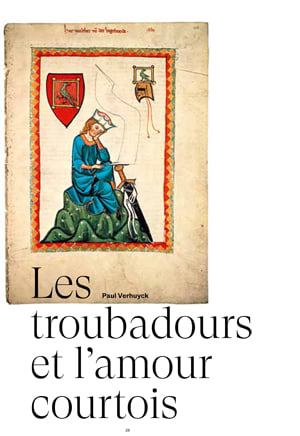
  • Xe siècle

    Troubadours and trouvères appear in France.

  • 1813

    Giuseppe Verdi is born in Le Roncole, a hamlet near Busseto, Italy.

  • 1836

    The first performance of the play El Trovador, by the Spanish dramatist Antonio García Gutiérrez, which would enjoy considerable success.

  • 1849

    Verdi chooses Gutiérrez’s drama to be the subject of his new opera. He entrusts the writing of the libretto to Salvatore Cammarano, who dies in 1852 before he can finish the task. It is completed by the young Neapolitan poet Leone Emanuele Bardare.

  • 1853

    The premiere of Il Trovatore at the Teatro Apollo in Rome.

  • 1856

    The premiere of the French version of the Opera at La Monnaie in Brussels.

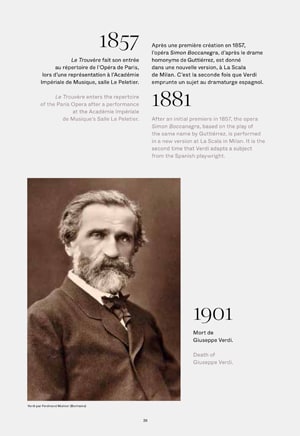
  • 1857

    Le Trouvère enters the repertoire of the Paris Opera after a performance at the Académie Impériale de Musique’s Salle Le Peletier.

  • 1881

    After an initial premiere in 1857, the opera Simon Boccanegra, based on the play of the same name by Guttiérrez, is performed in a new version at La Scala in Milan. It is the second time that Verdi adapts a subject from the Spanish playwright.

  • 1901

    Death of Giuseppe Verdi.

  • 1973

    Il Trovatore is performed in Italian for the first time at the Palais Garnier.

  • 2003

    Le Trouvère is performed for the first time at the Opéra Bastille, under the baton of Maurizio Benini in a production staged by Francesca Zambello.

  • 2016

    Created in Amsterdam in 2015, Àlex Ollé’s production enters the Paris Opera repertoire.

Artists

Opera in four parts (1853)

After Antonio García Gutiérrez

Creative team

Cast

The Paris Opera Orchestra and Chorus
A coproduction with the Nederlandse Opera, Amsterdam and the Teatro dell’Opera, Roma

Media

LE TROUVÈRE by Giuseppe Verdi (trailer)
  • Il Trovatore

    Il Trovatore

    Discover

  • Il trovatore: the true/false story

    Il trovatore: the true/false story

    Discover

© Julien Benhamou / OnP

Il Trovatore

Discover

01 min

Il Trovatore

By aria

Il Trovatore embraces all the romantic imagery of the period: the night, castles, soldiers, burnings at the stake, outlaws… In this mysterious and chivalrous context, the stories of the past shed light on the sentiments of the present to which the protagonists fall victim, namely love, jealousy, hate and the desire for vengeance.

Il trovatore: the true/false story

Discover

01 min

Il trovatore: the true/false story

By aria

Love, jealousy and family secrets: no, I’m not pitching The Royals, although… Will you manage to untangle true facts from the wrong ones in this story of Verdi’s Il trovatore?  

  • [EXTRAIT] IL TROVATORE by Giuseppe Verdi (Anna Pirozzi, Marie-Andrée Bouchard-Lesieur)
  • [EXTRAIT] IL TROVATORE by Giuseppe Verdi (Anna Pirozzi, Yusif Eyvazov, Étienne Dupuis)
  • [EXTRAIT] IL TROVATORE by Giuseppe Verdi (Yusif Eyvazov - "Di quella pira")
  • [EXTRAIT] IL TROVATORE by Giuseppe Verdi (Étienne Dupuis - "Il balen del suo sorriso")
  • [EXTRAIT] IL TROVATORE by Giuseppe Verdi
  • [EXTRAIT] IL TROVATORE by Giuseppe Verdi
  • [EXTRAIT] IL TROVATORE by Giuseppe Verdi
  • [EXTRAIT] IL TROVATORE by Giuseppe Verdi (Anna Pirozzi, Marie-Andrée Bouchard-Lesieur)
  • [EXTRAIT] IL TROVATORE by Giuseppe Verdi (Anna Pirozzi, Yusif Eyvazov, Étienne Dupuis)
  • [EXTRAIT] IL TROVATORE by Giuseppe Verdi (Yusif Eyvazov - "Di quella pira")
  • [EXTRAIT] IL TROVATORE by Giuseppe Verdi (Étienne Dupuis - "Il balen del suo sorriso")
  • [EXTRAIT] IL TROVATORE by Giuseppe Verdi
  • [EXTRAIT] IL TROVATORE by Giuseppe Verdi
  • [EXTRAIT] IL TROVATORE by Giuseppe Verdi
  • Le Trouvère (saison 22/23)- Acte III (Anna Pirozzi)

  • Le Trouvère (saison 22/23)- Acte III (Anna Pirozzi)

  • Le Trouvère (saison 22/23)- Acte II (Choeur Des Gitanes)

  • Le Trouvère (saison 22/23)- Acte II (Choeur Des Gitanes)

  • Le Trouvère (saison 22/23)- Acte I - (Anna Pirozzi , Marie - Andrée Bouchard - Lesieur)

  • Le Trouvère (saison 22/23)- Acte I - (Anna Pirozzi , Marie - Andrée Bouchard - Lesieur)

  • Le Trouvère (saison 22/23) - Acte I (Anna Pirozzi, Yusif Eyvazov, Etienne Dupuis)

  • Le Trouvère (saison 22/23) - Acte I (Anna Pirozzi, Yusif Eyvazov, Etienne Dupuis)

  • Le Trouvère (saison 22/23)- Acte I (Etienne Dupuis)

  • Le Trouvère (saison 22/23)- Acte I (Etienne Dupuis)

  • Le Trouvère (saison 22/23) - Acte II

  • Le Trouvère (saison 22/23) - Acte II

  • Le Trouvère (saison 22/23)- Acte II (Etienne Dupuis)

  • Le Trouvère (saison 22/23)- Acte II (Etienne Dupuis)

  • Le Trouvère (saison 22/23) - Acte III (Yusif Eyvazov, Anna Pirozzi)

  • Le Trouvère (saison 22/23) - Acte III (Yusif Eyvazov, Anna Pirozzi)

  • Le Trouvère (saison 22/23)- Acte III (Roberto Tagliavini)

  • Le Trouvère (saison 22/23)- Acte III (Roberto Tagliavini)

  • Le Trouvère (saison 22/23) - Acte II (Judit Kutasi)

  • Le Trouvère (saison 22/23) - Acte II (Judit Kutasi)

opera logo
Il Trovatore


Watch online the recording from season 15/16 on Paris Opera Play, with Ludovic Tézier, Hui He, Ekaterina Semenchuk, Marcelo Alvarez...

7-DAY FREE TRIAL Free trial 7 days

Access and services

Opéra Bastille

Place de la Bastille

75012 Paris

Public transport

Underground Bastille (lignes 1, 5 et 8), Gare de Lyon (RER)

Bus 29, 69, 76, 86, 87, 91, N01, N02, N11, N16

Calculate my route
Car park

Parking Indigo Opéra Bastille 1 avenue Daumesnil 75012 Paris

Book your spot at a reduced price
super alt text
super alt text
super alt text
super alt text
super alt text
super alt text
super alt text
super alt text
super alt text
super alt text

A swashbuckling opera, Il Trovatore has one of the most intricately complex intrigues of the entire repertoire. As a result, the work has often found itself in the crosshairs of the critics and been the object of operatic satires. This was notably the case in A Night at the Opera (1935), in which Il Trovatore serves as the backdrop for the Marx Brothers’ farce. In truth, Verdi’s opera wonderfully illustrates all the excesses of the genre, and the way musical virtuosity can give wings to a composite drama and endear it to audiences.

BUY THE PROGRAM

In both our venues, discounted tickets are sold at the box offices from 30 minutes before the show:

  • €35 tickets for under-28s, unemployed people (with documentary proof less than 3 months old) and senior citizens over 65 with non-taxable income (proof of tax exemption for the current year required)
  • €70 tickets for senior citizens over 65

Get samples of the operas and ballets at the Paris Opera gift shops: programmes, books, recordings, and also stationery, jewellery, shirts, homeware and honey from Paris Opera.

Opéra Bastille
  • Open 1h before performances and until performances end
  • Get in from within the theatre’s public areas
  • For more information: +33 1 40 01 17 82

Opéra Bastille

Place de la Bastille

75012 Paris

Public transport

Underground Bastille (lignes 1, 5 et 8), Gare de Lyon (RER)

Bus 29, 69, 76, 86, 87, 91, N01, N02, N11, N16

Calculate my route
Car park

Parking Indigo Opéra Bastille 1 avenue Daumesnil 75012 Paris

Book your spot at a reduced price
super alt text
super alt text
super alt text
super alt text
super alt text
super alt text
super alt text
super alt text
super alt text
super alt text

A swashbuckling opera, Il Trovatore has one of the most intricately complex intrigues of the entire repertoire. As a result, the work has often found itself in the crosshairs of the critics and been the object of operatic satires. This was notably the case in A Night at the Opera (1935), in which Il Trovatore serves as the backdrop for the Marx Brothers’ farce. In truth, Verdi’s opera wonderfully illustrates all the excesses of the genre, and the way musical virtuosity can give wings to a composite drama and endear it to audiences.

BUY THE PROGRAM

In both our venues, discounted tickets are sold at the box offices from 30 minutes before the show:

  • €35 tickets for under-28s, unemployed people (with documentary proof less than 3 months old) and senior citizens over 65 with non-taxable income (proof of tax exemption for the current year required)
  • €70 tickets for senior citizens over 65

Get samples of the operas and ballets at the Paris Opera gift shops: programmes, books, recordings, and also stationery, jewellery, shirts, homeware and honey from Paris Opera.

Opéra Bastille
  • Open 1h before performances and until performances end
  • Get in from within the theatre’s public areas
  • For more information: +33 1 40 01 17 82

Partners

Immerse in the Paris Opera universe

Jean-Pierre Delagarde / OnP

Sign up for our newsletter

Our latest news

* Required fields

By clicking on "submit", you agree to receive electronic communications from the Opéra national de Paris and to the processing of your data.
Learn more about managing your data and your rights.

Back to top