My special offers

Prices

    0
    300
    0€
    300€

Show / Event

Venue

Experience

Calendar

  • Between   and 

Prices

Émilie Brouchon / OnP

Émilie Brouchon / OnP

Opera

Discover Price

L’Elisir d’amore

Gaetano Donizetti

Opéra Bastille

from 23 March to 13 April 2027

from €10 to €100

2h45 with 1 interval

Synopsis

Listen to the synopsis

0:00 / 0:00

It is harvest time. The wheat is tender, much like the heart of Nemorino, a young peasant consumed with love for the beautiful, capricious Adina. Faced with her indifference and fear oflosing her to a rival, he naively buys a love potion from Dulcamara, an itinerant doctor, without realising that it is... a simple bottle of wine!

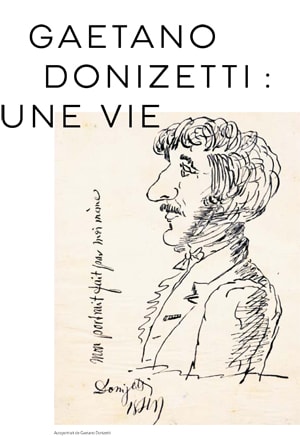
Although Gaetano Donizetti had only fourteen days to compose L’Elisir d’amore, premiered at Milan’s Teatro della Canobbiana in 1832, the opera has enjoyed unwavering success ever since. Its charm lies in a deliciously melodic score sprinkled with caressing, delicate arias such as Nemorino’s famous romance “Una furtiva lagrima”, making it a masterpiece of bel canto.

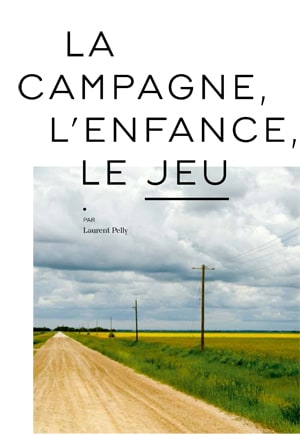
Director Laurent Pelly transposes this melodramma giocoso to 1960s Italy, giving it a heady touch of dolce vita.

Duration : 2h45 with 1 interval

Language : Italian

Surtitle : French / English

Show acts and characters

CHARACTERS

Adina: A rich landowner, capricious but educated, who reads the story of Tristan and Iseult to her peasants
Nemorino: A credulous and timid young villager, hopelessly in love
Belcore: A spry soldier, self-assured and self-important, who has also decided to win Adina
Dulcamara: A peddler and charlatan who claims to sell (among other miraculous remedies) a love potion
Giannetta: A young peasant from the village, very interested in Nemorino when she learns he has become rich  

First part

A village at harvest time. The villagers are enjoying a siesta. Nemorino admires from afar the beautiful Adina who takes an interest in the arts and is reading the legend of Tristan and Iseult and having a good laugh at the story of the love potion. She even reads the story to the peasants. Thereupon enters Sergeant Belcore at the head of his squadron. During a public seduction scene he proposes to Adina. The young woman asks him to wait a while and offers him refreshments. Nemorino, hurt, declares his love, and declares that he is willing to die for Adina. However she discourages him. She is fickle and does not want to love him. Doctor Dulcamara, a barker, arrives upon the scene. He sells a magic elixir that cures all ailments from wrinkles to diabetes and even paralysis. Nemorino has an idea: the peddler must surely possess Queen Iseult’s love potion.

Dulcamara, delighted to come across such an idiot, confirms that he has it. He sells Nemorino a small bottle of Bordeaux and promises him that he will feel the effects within twenty-four hours. (Just the time he himself will need to leave the village.) An overjoyed Nemorino tests the potion and finishes the bottle. Convinced that he is feeling the first effects of the elixir and that Adina will soon fall in love with him, Nemorino feigns indifference. A furious Adina agrees to marry Belcore within six days. Nemorino remains unperturbed.

The potion will take effect by the next day. However, unexpected complications oblige Belcore to leave for the war the next day. Adina decides to marry the soldier straight away. Nemorino, who has now sobered up, begs Adina to wait. However the latter, offended, invites the whole village to the wedding. Nemorino is grief-stricken.  

Second part

The wedding party is in full swing. The guests drink, joke and sing. Nemorino has stayed away and Adina is disappointed. Everyone steps outside for the signing of the wedding contract leaving Dulcamara alone at the buffet. Nemorino arrives, on the verge of suicide. Dulcamara advises him to take another dose of the potion. But Nemorino has no more money and resolves to join the ranks alongside Belcore to be able to afford another bottle of the magical Bordeaux.

The village girls have heard that Nemorino’s uncle has died. He has inherited a fortune. All of a sudden they find Nemorino very handsome and become very friendly with him. “It’s the magic potion” thinks the peasant who has finished the second bottle. Adina, observing Nemorino’s success and discovering that he has joined up in order to win her love, at last decides to give him her love. Dulcamara offers her a little of the magic potion but Adina places all her trust in the power of her eyes.

Nemorino, who has seen Adina’s distress, is delighted. Adina hands him his enlistment forms that she has bought back from Belcore and, at last, falls into his arms. Belcore consoles himself with the idea that there are plenty of other women in the world. The villagers fall over themselves to buy Dulcamara’s marvellous potion that brings love and riches.

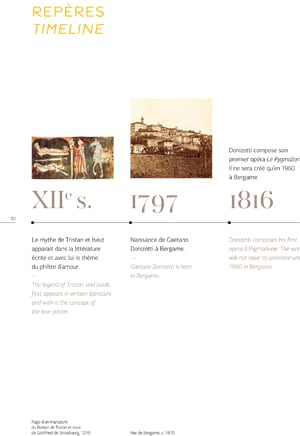
Show chronology

Timeline

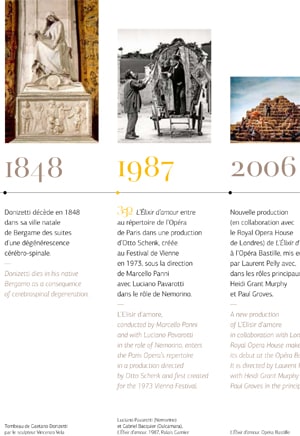
  • 1848

    Donizetti dies in his native Bergamo as a consequence of cerebrospinal degeneration.

  • 1987

    L’Elisir d’amore, conducted by Marcello Panni and with Luciano Pavarotti in the role of Nemorino, enters the Paris Opera’s repertoire in a production directed by Otto Schenk and first created for the 1973 Vienna Festival.

  • 2006

    Laurent Pelly’s production enters the Paris Opera’s répertoire.

  • XIIe s.

    The legend of Tristan and Iseult first appears in written literature and with it the concept of the love potion.

  • 1797

    Gaetano Donizetti is born in Bergamo.

  • 1816

    Donizetti composes his first opera Il Pigmalione. The work will not have its premiere until 1960 in Bergamo.

  • 1830

    Stendhal publishes a short story in the Revue de Paris entitled Le Philtre. It is supposedly adapted from an Italian work – Il Filtro by Silvio Malaperta – the existence of the work has since been called into question.

  • 1831

    The first performance of Le Philtre by the French composer Daniel-François- Esprit Auber at the Paris Opera to a libretto by Eugène Scribe.

  • 1832

    Together with the librettist Romani, Donizetti composes L’Elisir d’amore in two weeks. The work is inspired by Scribe’s Le Philtre and it makes its debut at the Teatro alla Canobbiana in Milan.

  • 1835

    Bellini’s death and Rossini’s premature retirement contribute to Donizetti’s growing success in Europe. The first performance of Lucia di Lammermoor at the Teatro San Carlo in Naples.

  • 1838

    With his opera Poliuto banned by the Neapolitan censors, Donizetti decides to settle in Paris.

  • 1840

    A French version of Poliuto entitled Les Martyrs has its premiere at the Paris Opera.

Artists

Melodramma Giocoso in two acts (1832)

Creative team

Cast

The Paris Opera Orchestra and Chorus
A coproduction with the Royal Ballet and Opera, Covent Garden, London

Media

L'ÉLIXIR D'AMOUR by Gaetano Donizetti (trailer)
  • Draw me L'Élixir d'amour

    Draw me L'Élixir d'amour

    Watch the video

  • L’Elisir d’amore: the true/false story

    L’Elisir d’amore: the true/false story

    Discover

  • 5 questions about L’Elisir d’amore

    5 questions about L’Elisir d’amore

    Discover

  • Whoever loves me will follow me

    Whoever loves me will follow me

    Watch the video

Draw me L'Élixir d'amour

Watch the video

Understand the plot in 1 minute

1:42 min

Draw me L'Élixir d'amour

By Matthieu Pajot

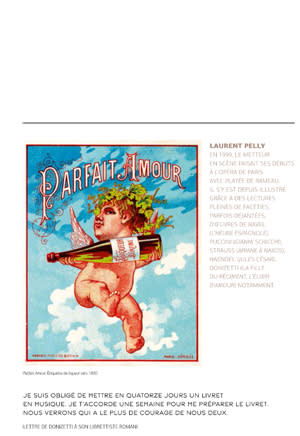
“I am obliged to set a libretto to music within fourteen days. I give you one week to prepare it for me. We shall see which of the two of us has the most courage.” Donizetti’s instructions to his librettist Romani signalled the beginning of the composition of L’Elisir d’amore, an opera that is, without a doubt, the Italian composer’s comic masterpiece. Laurent Pelly’s playful production transposes this melodramma giocoso into the Italy of the 1960s – complete with bales of hay and Vespas. The staging is a deft combination of fantasy and poetry, from the roaring arrival of Doctor Dulcamara to Nemorino’s legendary romance to Adina. This production of the quintessential bel canto opera has become a Paris Opera classic that cannot be missed.

© Guergana Damianova / OnP

L’Elisir d’amore: the true/false story

Discover

01 min

L’Elisir d’amore: the true/false story

By aria

Can you unravel the true story from the false? Over to you!  

© Guergana Damianova / OnP

5 questions about L’Elisir d’amore

Discover

01 min

5 questions about L’Elisir d’amore

By aria

If the exceptionally voluminous nature of his output – 71 operas, many of which have been lost to posterity – is sometimes cited as a cause for suspicion, Gaetano Donizetti nevertheless occupies a major place in the history of Italian opera and musical romanticism between Rossini and Verdi. With their highly demanding technical construction, placing the emphasis on vocal agility, his works – Lucia di Lammermoor in particular – elevate him to the highest rank of representatives of bel canto, alongside Bellini.

© Guergana Damianova / OnP

Whoever loves me will follow me

Watch the video

Interview with Lisette Oropesa

5:44 min

Whoever loves me will follow me

By Simon Hatab

After triumphing in "Les Huguenots", Lisette Oropesa returns to the Paris Opera in her much-awaited new role of Adina in "L'Elisir d'amore". An opportunity for the soprano to talk about her relationship with this proud yet endearing character, and the genuine feeling that Laurent Pelly seeks to brings out in his production.

Press

  • No matter how many times we’ve tasted it, this elixir, skillfully crafted by Laurent Pelly, can always be enjoyed without moderation.

    Concertclassic, 2018
  • The audience gave a triumphant welcome to this revival of L’Elixir d’amour at the Opéra Bastille.

    Forum Opéra, 2018

Access and services

Opéra Bastille

Place de la Bastille

75012 Paris

Public transport

Underground Bastille (lignes 1, 5 et 8), Gare de Lyon (RER)

Bus 29, 69, 76, 86, 87, 91, N01, N02, N11, N16

Calculate my route
Car park

Parking Indigo Opéra Bastille 1 avenue Daumesnil 75012 Paris

Book your spot at a reduced price
super alt text
super alt text
super alt text
super alt text
super alt text
super alt text

Literally, “The truth is in wine.” This Latin proverb, quoted in particular by Pliny, bears witness to a belief rooted in many cultures, ranging from Greece to China: alcohol is said to have the power of making people speak the truth. The Roman historian Tacitus recounts that the Germans used to get drunk during their political meetings, believing that, under the influence of alcohol, they expressed themselves with the utmost frankness.

BUY THE PROGRAM
  • Cloakrooms

    Free cloakrooms are at your disposal. The comprehensive list of prohibited items is available here.

  • Bars

    Reservation of drinks and light refreshments for the intervals is possible online up to 24 hours prior to your visit, or at the bars before each performance.

In both our venues, discounted tickets are sold at the box offices from 30 minutes before the show:

  • €35 tickets for under-28s, unemployed people (with documentary proof less than 3 months old) and senior citizens over 65 with non-taxable income (proof of tax exemption for the current year required)
  • €70 tickets for senior citizens over 65

Get samples of the operas and ballets at the Paris Opera gift shops: programmes, books, recordings, and also stationery, jewellery, shirts, homeware and honey from Paris Opera.

Opéra Bastille
  • Open 1h before performances and until performances end
  • Get in from within the theatre’s public areas
  • For more information: +33 1 40 01 17 82

Opéra Bastille

Place de la Bastille

75012 Paris

Public transport

Underground Bastille (lignes 1, 5 et 8), Gare de Lyon (RER)

Bus 29, 69, 76, 86, 87, 91, N01, N02, N11, N16

Calculate my route
Car park

Parking Indigo Opéra Bastille 1 avenue Daumesnil 75012 Paris

Book your spot at a reduced price
super alt text
super alt text
super alt text
super alt text
super alt text
super alt text

Literally, “The truth is in wine.” This Latin proverb, quoted in particular by Pliny, bears witness to a belief rooted in many cultures, ranging from Greece to China: alcohol is said to have the power of making people speak the truth. The Roman historian Tacitus recounts that the Germans used to get drunk during their political meetings, believing that, under the influence of alcohol, they expressed themselves with the utmost frankness.

BUY THE PROGRAM
  • Cloakrooms

    Free cloakrooms are at your disposal. The comprehensive list of prohibited items is available here.

  • Bars

    Reservation of drinks and light refreshments for the intervals is possible online up to 24 hours prior to your visit, or at the bars before each performance.

In both our venues, discounted tickets are sold at the box offices from 30 minutes before the show:

  • €35 tickets for under-28s, unemployed people (with documentary proof less than 3 months old) and senior citizens over 65 with non-taxable income (proof of tax exemption for the current year required)
  • €70 tickets for senior citizens over 65

Get samples of the operas and ballets at the Paris Opera gift shops: programmes, books, recordings, and also stationery, jewellery, shirts, homeware and honey from Paris Opera.

Opéra Bastille
  • Open 1h before performances and until performances end
  • Get in from within the theatre’s public areas
  • For more information: +33 1 40 01 17 82

Immerse in the Paris Opera universe

Jean-Pierre Delagarde / OnP

Sign up for our newsletter

Our latest news

* Required fields

By clicking on "submit", you agree to receive electronic communications from the Opéra national de Paris and to the processing of your data.
Learn more about managing your data and your rights.

Back to top