Synopsis
Listen to the synopsis
What is Gandhi’s influence on the contemporary political world? This is the question explored by Philip Glass’s opera Satyagraha (1980), the second in his trilogy devoted to historical figures, alongside Einstein on the Beach (1976) and Akhnaten (1984). But Satyagraha – Sanskrit for “truth force” – is not a biopic.
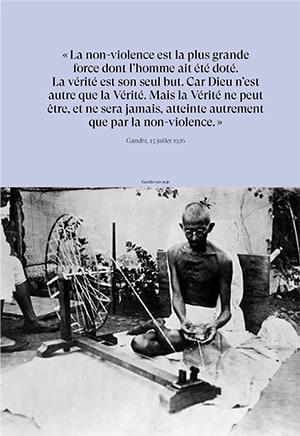
This work, with its mesmerising music, interweaves timelines, relating each of its three acts to a key figure linked to Gandhi in order to better understand the genesis of his political thought: Leo Tolstoy, with whom he corresponded; the poet Rabindranath Tagore, who supported him; and Martin Luther King, who was inspired by his principles of non-violence.
Satyagraha is entering the Paris Opera repertoire directed by Bobbi Jene Smith and Or Schraiber, who have already created the dance piece Pit. For them, this opera “is not simply a meditation on history, but a call to action and a forceful lesson that rings ever more true today.”
Duration : 3h35 with 2 intervals
Language : Sanskrit
Surtitle : French / English
-
Opening
-
First part 55 min
-
Intermission 20 min
-
Second part 55 min
-
Intermission 25 min
-
Third part 60 min
-
End
Artists
Opera in three acts (1980)
After Bhagavad-Gita
Creative team
-
Philip Glass Music (1937) -

Constance De Jong Libretto -
Ingo Metzmacher Conductor -
Bobbi Jene Smith Direction and choreography -
Or Schraiber Direction and choreography -
Christian Friedländer Set design -
Wojciech Dziedzic Costume design -
John Torres Lighting design -
Jacob Mallinson Bird Dramaturgy -
Ching-Lien Wu Chorus master


Cast
-
Anthony Roth Costanzo Countertenor -
Ilanah Lobel-Torres Soprano -
Davóne Tines Baritone -
Adriana Bignagni Lesca Alto -
Olivia Boen Soprano -
Deepa Johnny Mezzo-soprano -
Amin Ahangaran Baritone -
Nicky Spence Tenor -
Nicolas Cavallier Bass -
Alexander Bozinoff Dancer -
Lorrin Brubaker Dancer -
Jeremy Coachman Dancer -
Jonathan Fredrickson Dancer -
Marion Gautier de Charnacé Dancer -
Awa Joannais Dancer -
Héloïse Jocqueviel Dancer -
Payton Johnson Dancer -
Rachel McNamee Dancer -
Mermoz Melchior Dancer -
Adrien Ouaki Dancer -
Ido Toledano Dancer


The Paris Opera Orchestra and Chorus
A recording of Satyagraha will be made, produced by the Opéra national de Paris with the support of the Orange Foundation, sponsor of the Paris Opera's audiovisual broadcasts, for a live broadcast on Friday 24 April 2026, 7:30pm on Paris Opera Play, the Paris Opera's streaming website.
Satyagraha will be recorded by France Musique for broadcast on May 23, 2026 at 8:00 p.m. on the program Samedi à l’Opéra, hosted by Judith Chaine, and will then be available for streaming on the France Musique website and the Radio France app.
Media
-
Les Grands Entretiens
Watch the video
-
(TOÏ TOÏ TOÏ) - Satyagraha
Watch the video
-
SATYAGRAHA by Philip Glass in rehearsal
Watch the video
-
SATYAGRAHA and the figures of nonviolence?
Watch the video
-
Satyagraha: the true/false story
Discover


-
© Yonathan Kellerman / OnP
-
Satyagraha (saison 25/26) © Yonathan Kellerman / OnP
-
Satyagraha (saison 25/26) © Yonathan Kellerman / OnP
-
© Yonathan Kellerman / OnP
-
Satyagraha (saison 25/26) © Yonathan Kellerman / OnP
-
© Yonathan Kellerman / OnP
-
© Yonathan Kellerman / OnP
-
© Yonathan Kellerman / OnP
-
Satyagraha (saison 25/26) © Yonathan Kellerman / OnP
-
© Yonathan Kellerman / OnP
-
© Yonathan Kellerman / OnP
-
© Yonathan Kellerman / OnP
-
© Yonathan Kellerman / OnP
-
© Yonathan Kellerman / OnP
-
© Yonathan Kellerman / OnP
-
© Yonathan Kellerman / OnP
-
© Yonathan Kellerman / OnP
-
© Yonathan Kellerman / OnP
-
Satyagraha (saison 25/26) © Yonathan Kellerman/ OnP
-
Satyagraha (saison 25/26) © Yonathan Kellerman/ OnP
-
Satyagraha (saison 25/26) © Yonathan Kellerman/ OnP
-
Satyagraha (saison 25/26) © Yonathan Kellerman/ OnP


-
A triumph! The artists received unanimous applause, and Philip Glass’s appearance on stage at the Palais Garnier at the age of 89 sparked a well-justified wave of emotion and enthusiasm.
Les Échos, 2026 -
A captivating performance in which, with every note, love triumphs over violence.
Télérama, 2026 -
A unique musical and spiritual experience, at the intersection of history, philosophy, and contemporary opera.
Sortir à Paris, 2026 -
Satyagraha evolves from tight minimalism into a more operatic form of lyricism.
Le Monde, 2026 -
The choreography by the two directors is particularly striking, expressing through physical exertion a “form of embodied resistance.”
Les Échos, 2026


Friday 24 April 2026, 7:30pm, watch Satyagraha live on POP!
Access and services
Palais Garnier
Place de l'Opéra
75009 Paris
Public transport
Underground Opéra (lignes 3, 7 et 8), Chaussée d’Antin (lignes 7 et 9), Madeleine (lignes 8 et 14), Auber (RER A)
Bus 20, 21, 27, 29, 32, 45, 52, 66, 68, 95, N15, N16
Calculate my routeCar park
Parking Q-Park Edouard VII and Q-Park Meyerbeer 16 rue Bruno Coquatrix 4 rue de la Chaussée d'Antin 75009 Paris
Book your spot at a reduced price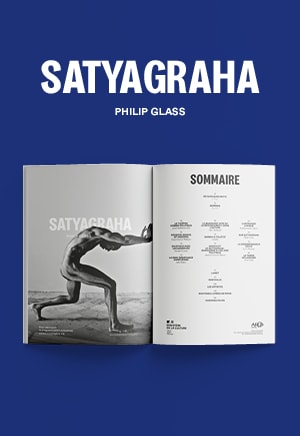

-
Cloakrooms
Free cloakrooms are at your disposal. The comprehensive list of prohibited items is available here.
-
Bars
Reservation of drinks and light refreshments for the intervals is possible online up to 24 hours prior to your visit, or at the bars before each performance.
-
Restaurant
CoCo is open every day from 12:00 pm to 2:00 am. More information on coco-paris.com or at +33 1 42 68 86 80 (reservations).
At the Palais Garnier, buy €10 tickets for seats in the 6th category (very limited visibility, two tickets maximum per person) on the day of the performance at the Box offices.
In both our venues, discounted tickets are sold at the box offices from 30 minutes before the show:
- €35 tickets for under-28s, unemployed people (with documentary proof less than 3 months old) and senior citizens over 65 with non-taxable income (proof of tax exemption for the current year required)
- €70 tickets for senior citizens over 65
Get samples of the operas and ballets at the Paris Opera gift shops: programmes, books, recordings, and also stationery, jewellery, shirts, homeware and honey from Paris Opera.
Palais Garnier
- Every day from 10 a.m. to 6:30 p.m. and until performances end
- Get in from Place de l’Opéra or from within the theatre’s public areas
- For more information: +33 1 53 43 03 97
Online
Palais Garnier
Place de l'Opéra
75009 Paris
Public transport
Underground Opéra (lignes 3, 7 et 8), Chaussée d’Antin (lignes 7 et 9), Madeleine (lignes 8 et 14), Auber (RER A)
Bus 20, 21, 27, 29, 32, 45, 52, 66, 68, 95, N15, N16
Calculate my routeCar park
Parking Q-Park Edouard VII and Q-Park Meyerbeer 16 rue Bruno Coquatrix 4 rue de la Chaussée d'Antin 75009 Paris
Book your spot at a reduced price
-
Cloakrooms
Free cloakrooms are at your disposal. The comprehensive list of prohibited items is available here.
-
Bars
Reservation of drinks and light refreshments for the intervals is possible online up to 24 hours prior to your visit, or at the bars before each performance.
-
Restaurant
CoCo is open every day from 12:00 pm to 2:00 am. More information on coco-paris.com or at +33 1 42 68 86 80 (reservations).
At the Palais Garnier, buy €10 tickets for seats in the 6th category (very limited visibility, two tickets maximum per person) on the day of the performance at the Box offices.
In both our venues, discounted tickets are sold at the box offices from 30 minutes before the show:
- €35 tickets for under-28s, unemployed people (with documentary proof less than 3 months old) and senior citizens over 65 with non-taxable income (proof of tax exemption for the current year required)
- €70 tickets for senior citizens over 65
Get samples of the operas and ballets at the Paris Opera gift shops: programmes, books, recordings, and also stationery, jewellery, shirts, homeware and honey from Paris Opera.
Palais Garnier
- Every day from 10 a.m. to 6:30 p.m. and until performances end
- Get in from Place de l’Opéra or from within the theatre’s public areas
- For more information: +33 1 53 43 03 97
Online


Partners
-
Grande Mécène de la saison
-
With the support of The American Friends of the Paris Opera & Ballet
-
With the exceptional support of Howard & Sarah D. Solomon Foundation