My special offers

Prices

    0
    300
    0€
    300€

Show / Event

Venue

Experience

Calendar

  • Between   and 

Prices

Guergana Damianova / OnP

Guergana Damianova / OnP

Opera

La Bohème

Giacomo Puccini

Opéra Bastille

from 12 September to 14 October 2025

2h30 with 1 interval

Synopsis

Listen to the synopsis

0:00 / 0:00

Before seeing their names at the top of the bill, how many artists have endured poverty? The writer Henri Murger knew precisely what he was talking about when he wrote his Scènes de la vie de bohème (Scenes of Bohemian Life), the chronicle of a group of young people painting canvases or penning verse in humble garrets whilst awaiting their moment of glory.

But youth, however poor, only lasts for so long: Giacomo Puccini was well aware of this, and adapted Murger’s novel to propose his opera La Bohème, premiered in 1896, a poignant score, brimming with nostalgia. By embellishing the past, he gives all the more value – that of the ephemeral – to the love affair between the poet Rodolphe and the grisette Mimi.

This nostalgia lies at the heart of Claus Guth’s staging, which sets the characters in outer space, all the better to reveal the distance that separates us from our memories.

Duration : 2h30 with 1 interval

Language : Italian

Surtitle : French / English

Show acts

Detail of acts

First part

Act 1
Day 126 – 40°45’53’’N 74 – Expedition in danger – off course – engines inoperative – life-support resources almost exhausted – we are working without respite – time is running out – water is rationed – life depends on the last reserves of oxygen – a constant struggle with the darkness and the cold – each day increasingly difficult – last remnants of humour – using our imagination – to evoke times long past.

Rodolfo, Marcello, Schaunard and Colline.

The atmosphere is morose. It is cold and there is practically nothing left to eat. Nevertheless, Schaunard manages to finds a few scraps. Meanwhile, in a stream of words, everyone starts to reminisce and evoke memories of better times. The four friends, having regained a degree of good humour, recall an evening spent in their favourite café in the Latin Quarter. When they evoke Benoît, their former landlord, the latter suddenly appears. They strike up a conversation with him, and then he vanishes as suddenly as he appeared. Colline, Schaunard and Marcello leave Rodolfo alone for a moment. Mimi appears, in the clutches of a coughing fit... Their hands touch in the darkness... They draw closer. Rodolfo asks Mimi to stay with him.

Act 2
Day 129 – 41°43’63’’N 54 – Situation hopeless – time fluctuates between states of sleep and wakefulness – Mimi has returned – in the space capsule reality begins to blur – delirium takes root – Mimi, always Mimi – like a spectral dream – dreaming sometimes transports us back into our past – the happiest times of our lives are revived – moments of exuberance and ecstasy.

Rodolfo and Marcello are overwhelmed by a variety of physical sensations: the crowds of people, the colours and smells of the street. The atmosphere of the city takes over the entire space. They find themselves in their favourite café in the company of Mimi, Colline and Schaunard. In an atmosphere brimming with euphoria, Rodolfo, very much in love with Mimi, buys her a bonnet. Musetta, Marcello’s one-time mistress, arrives accompanied by her new lover Alcindoro. Marcello falls under her spell and can no longer take his eyes off the vision. She makes Alcindoro pay the bill and comes back to Marcello. Just then, an annoying military

Second part

Act 3
Day 132 – 45°47’73’’N 57 – Impossible to continue the voyage – forced landing – our last refuge is lost – attempts to make contact unsuccessful – giant heaps of dust everywhere – dense fog – every outline is blurred – we are at the mercy of the emptiness – our days are numbered – Mimi... – if only I could touch her face again one more time...

Time has passed. The cold, the snow, the emptiness and the isolation take hold over everything. In the distance, we can hear the customs officers inspecting the farmers and the dairy maids. One by one, we catch sight of familiar faces. Mimi arrives. She confides in Marcello: Rodolfo’s jealousy is making her life a living hell. Rodolfo in turn confides in Marcello and reveals the truth to him: Mimi is suffering from tuberculosis and is very ill. He knows that he can only offer her wretched living conditions, and that if they stay together she will die. Overwhelmed by her suffering, he decides to leave her. The two separate but the memory of happier days endures.

Act 4
Day 159 – 46°77’75’’N 69 – The end – where are we? – No more contact – Death has reared its head – Schaunard and Colline have already lost the fight – solitude is total – acceptance of the situation – I am extremely calm – feverish delusions – nightmares – my life flashes by in isolated images as if on a stage – there is little time left – but Mimi is still here.

Once again, time has passed. Marcello and Rodolfo, trying to overcome their grief in order to continue living, are possessed by the idea of love, women, good food, and the joys of life. Schaunard and Colline appear and everyone engages in a grotesque game: they improvise, vent their passions, fight and then enjoy a sumptuous meal: a bottle of water becomes champagne, a herring is transformed into an exquisite fish. Musetta then reappears with a dying Mimi. Distressed, the others decide to leave Rodolfo and Mimi alone. They reminisce about their first encounter, the happy times they spent together, and promise never to leave each other again. But Rodolfo must let Mimi go… he is alone.

Artists

Opera in four acts (1896)

After Henry Murger, Scènes de la vie de bohème

Creative team

Cast

The Paris Opera Orchestra and Chorus
Avec la Maîtrise populaire de l’Opéra-Comique

Media

LA BOHÈME by Giacomo Puccini - TRAILER (english version)
  • Kids react to Nicole Car & Etienne Dupuis

    Kids react to Nicole Car & Etienne Dupuis

    Watch the video

  • We boarded Puccini's Bohemia space shuttle

    We boarded Puccini's Bohemia space shuttle

    Read the article

  • La Bohème goes into orbit

    La Bohème goes into orbit

    Watch the video

  • Mimi, Bohemian muse

    Mimi, Bohemian muse

    Watch the video

  • Draw-me La Bohème

    Draw-me La Bohème

    Watch the video

  • The Bohemian Spirit

    The Bohemian Spirit

    Read the article

Kids react to Nicole Car & Etienne Dupuis

Watch the video

2:52 min

Kids react to Nicole Car & Etienne Dupuis

By Ming Fai Sham Lourenco

© Monika Rittershaus/OnP

We boarded Puccini's Bohemia space shuttle

Read the article

08 min

We boarded Puccini's Bohemia space shuttle

By Usbek & Rica

How can one revisit one of the most frequently performed operas in the world? By projecting it into the future. Puccini's La Bohème—which will be performed at the Paris Opera from September 12 to October 14—invokes the lost loves of Mimi and Rodolfo in a dreamlike space epic. We discussed this with directors Claus Guth and Sébastien Guèze, who staged and performed in an equally futuristic version of La Bohème, broadcast on France Télévisions.

In 2025, what has become of the bohemian lifestyle? This movement has long been associated with young people pursuing the arts, living frugally on love and fresh water under the rooftops of Paris. “Bohemians have nothing and live on everything they have,” wrote Balzac in his short story A Prince of Bohemia. Its young practitioners were already the subject of pastiches at the time. While in the 21st century it continues to be regularly portrayed in film and television to convey a romanticized image of Paris, in reality it now reflects a more bourgeois reality. This obsession with bohemianism in our cultural imagination is a legacy of Puccini's masterpiece, created in 1896.

The Italian composer aspired to immortalize his younger years spent among penniless, rebellious artists, and found the perfect inspiration in Henry Murger's Scènes de la vie de bohème, which tells the story of the thwarted love between the poet Rodolphe and the seamstress Mimi. Like their friends Marcello and Musette, these penniless lovers prefer to keep warm by attending parties, going to cabarets, and loving each other. The outcome? Tragic, of course. After separating for a time, our two heroes are reunited. She dies, choosing love over the security of a wealthy protector. 

The images conveyed by the libretto of La Bohème correspond to “something that has long since ceased to exist, a cultural Disneyland.” Claus Guth, metteur en scène

The work was an almost immediate success and became one of the greatest hits in the history of opera. Every year, La Bohème continues to attract millions of spectators to theaters. In 2023, it was performed 782 times worldwide, an average of more than twice a day. At first glance, it seems difficult to reinvent the genre. Yet that is precisely what tenor and director Sébastien Guèze and director Claus Guth have set out to do.   

Towards space and memory

“When I was asked to stage La Bohème, I dragged my feet a little,” he recalls with amusement. “I deeply love Puccini's music, but the story is a web of clichés.” For Claus Guth, these are not penniless artists, confined to languishing in their attic and never knowing fame. The images conveyed by the libretto of La Bohème correspond “to something that has long since ceased to exist, to a cultural Disneyland.”  

La Bohème (saison 25/26)
La Bohème (saison 25/26) © Monika Rittershaus/OnP

With his eyes closed, the director listens to the opera over and over again. "At first, it was a joke, but I told Stéphane Lissner—director of the Paris Opera at the time, editor's note—that it sounded more like floating through space. If you don't worry about the text, [Puccini's work] is more about the power of love and imagination.“ Claus Guth then immersed himself in reading the original novel, Scènes de la vie de bohème by Henry Murger. ”In fact, it's mainly about men reminiscing about their youth. They idealize the past and their memories," he continues.

From there, he imagines moving the action “to a world where Paris probably no longer exists, ravaged by nuclear war or climate crisis.” In Claus Guth's staging, Rodolfo and Marcello live out their last hours in a drifting spaceship. The characters regularly lose themselves in contemplation of a distant planet, Earth. “Day 126. Lost our way. Last reserves exhausted. Mimi returned,” reads the logbook kept by cosmonaut Rodolfo, projected above the stage. 

Dying from lack of fresh water in 2050

In his version, La Bohème 2050, broadcast on France TV, Sébastien Guèze propels our protagonists into the corridors of the Palace of Versailles, which has become a refuge from global warming. “Young people who once died of cold under the roofs of Paris now perish from heat,” explains the tenor and director, whose interpretation also highlights the profoundly universal nature of the issues addressed in opera librettos: “They tell stories of love, social inequality, the quest for freedom, and youth.”

And this universality also rhymes with avant-garde, he points out: “La Traviata (adapted from La Dame aux Camélias by Dumas fils, editor's note) invokes a subject that was little or not at all dealt with in the 19th century, prostitution, while Carmen depicts a fiercely free woman.” Sébastien Guèze's approach is no exception to this futuristic tradition, imagining a Bohème that brilliantly questions the effects of the environmental crisis and the excesses of technosolutionism. One of the characters even takes the form of artificial intelligence.

“When you don't have enough oxygen to breathe, your brain starts to go haywire.” Claus Guth, metteur en scène

In doing so, he takes the exercise further by taking a gamble on staging an opera that is 80% carbon-free. “The idea behind this work is to present a desirable future, and that required this experiment.” To change people's imaginations, you have to experiment with them, anchor them in reality: “I believe that sobriety, working with limited resources, also goes hand in hand with creative freedom. After all, Mozart lived in a carbon-free world, and that didn't stop him from composing sublime works that have stood the test of time.” And indeed, this ecological gamble does not detract from the beauty of an opera film that is certainly apocalyptic in tone but furiously optimistic.

Pas de deux and pas de côté

While Sébastien Guèze's La Bohème anchors its plot in the impulses of youth, Claus Guth's explores the other side of life. “All that remains for Rodolfo and Marcel,” he explains, “are their memories.” In a black-and-white and pastel setting, their lovers Mimi and Musetta appear in bright colors. “When you don't have enough oxygen to breathe, your brain starts to hallucinate.” For the director, when Mimi appears in the first act, “it's a memory of Rodolfo.” A big fan of films set in space, Claus Guth pays homage to scenes in which the loved one appears before the cosmonaut, as in Tarkovsky's Solaris (1972). 

He also manages the feat of bringing together the finest moments of space cinema—including 2001: A Space Odyssey—and cinema in general, combining a Gilda-style striptease, a golden dragon, and a cosmonaut's spacewalk. The curtain rises on the third act to reveal a lunar crater. Here and there lie shuttle debris. The engines are buried in the lunar sand, while beneath the snow, the cosmonauts struggle to move. Sublime.  

La Bohème (saison 25/26)
La Bohème (saison 25/26) © Monika Rittershaus/OnP

Beyond creating images of literally interstellar beauty, Claus Guth's dramatic shift, which sets the action in space, also allows us to question a future with limited resources. When they sing about delicious wine, reality shows the protagonists feasting on meager drops of water. They have to share their food. “It was already in the original text. When they talk about champagne, it's actually cheap wine. We just had to take it further.”

In a world that is falling apart, what becomes precious, Puccini's work already asked. "The arts, love, glory? What is important when everything is falling apart?“ agrees Claus Guth. ”I suggest, the audience decides." And that is the beauty of revisiting our cultural hits. They make us dream, surprise us, shake us up, make us think and, perhaps unexpectedly, move us...

© Guergana Damianova / OnP

La Bohème goes into orbit

Watch the video

Interview with Ailyn Pérez, Sandra Westphal and Nicolas Beaud

8:57 min

La Bohème goes into orbit

By Isabelle Stibbe

Encounter with soprano Ailyn Pérez who talks about the role Mimi that she performed in 2023, vocal coach Sandra Westphal who analyses the story of La Bohème, and Nicolas Beaud, head of the Bastille Lighting Department, who talks about the LEDs installed in a spectacular piece of scenery: the space shuttle.  

Mimi, Bohemian muse

Watch the video

Interview with Nicole Car

5:19 min

Mimi, Bohemian muse

By Marion Mirande

Sensitive and love-struck, La Bohème's Mimi is one of Puccini's greatest heroines.

Soprano Nicole Car is delighted to return to the role in Claus Guth's production – a masterpiece of poetry and originality – which she premiered in 2017.

A return that promises to be as exciting as it is heart-rending.

© Matthieu Pajot / OnP

Draw-me La Bohème

Watch the video

Understand the plot in 1 minute

1:36 min

Draw-me La Bohème

By Matthieu Pajot

© Sotheby's / AKG images

The Bohemian Spirit

Read the article

Henri Murger's little-known masterpiece

06 min

The Bohemian Spirit

By Tristan Bera

On the occasion of Claus Guth’s futuristic production for the Paris Opera, we turn back to Scènes de la vie de bohème, the little-known work by Henri Murger that inspired Puccini to write one of his most beautiful operas.    


Appearing first in serial form in 1845 in Le Corsaire Satan, then performed at the Théâtre des Variétés in 1849, Scènes de la vie de bohème became a novel in 1851 at the instigation of the publisher Michel Lévy, only too pleased to prolong the commercial success of the play, and with the agreement of its author, equally delighted to sign a new contract ensuring, in the short term at least, some additional income. Like his characters - Rodolphe the poet, Schaunard the musician or Marcel the painter, Henri Murger was himself bohemian.

It was directly from incidents in his own existence that Murger drew the raw materials for his novel, thus making his opus an example of auto-fiction before the time. The motherless son of a tailor, self-taught, a poor Latin scholar though hardworking and not without talent, he worked first as a painter and a poet before frequenting the publishing houses where, in the mid-nineteenth century, business was booming (Balzac’s Illusions perdues comes to mind) and devoting his time to prose. On the advice of a journalist friend, with a view to launching his career and in a flight of literary fancy, he changed his name to Henry Mürger, anglicizing his first name and germanising his surname.

In 1841, he founded the Buveurs d’eau (the Water-drinkers), an informal collective for artists with Romantic ideals, with headquarters in the Nouvelle-Athènes neighbourhood in Paris, in the Rue de la Tour-d’Auvergne, to be precise. The name of this association, which was dedicated to mutual assistance and solidarity among penniless artists in want of patronage, originated in the fact that they generally met over a carafe of water. The chapter entitled “L’Ecu de Charlemagne” in the novel is a thinly veiled transcription of those meetings – gatherings improvised in a garret by candlelight during which a succession of performances, recitals and readings were given with unavoidable economy of means. Within the cenacle of bohemian life, poverty rubbed shoulders with the most poetic spirit of invention.    

Henri Murger (1822 – 1861)
Henri Murger (1822 – 1861) © AKG images / Imagno / Pierre Petit

So what does bohemian life really refer to? Besides being an auto-fiction, the novel is also a vivid sociological portrait of a particular fringe community within the population of Paris. Indeed, “Bohemian life only exists and is only possible in Paris”. The term was not actually invented by Murger, it can be traced back to 1830.

Deriving from Bohemia, an area in central Europe, and designating a Romany or Gipsy nomadic traveller, the term took on new significance in the work of Balzac who modified its spelling by adding an accent to make bohème rhyme with poème, and used it to qualify a marginal type relegated to society’s side lines for its classless, transgressional or even monstrous character. Unknown or rather, unrecognised Parisian artists, became the bohemians of the period and figures of the media society that the newspapers, magazines and other press organs were in the process of founding. In 1837, George Sand, who contributed to the creation of the romantic myth surrounding the Nouvelle-Athènes neighbourhood, stated in La Dernière Aldini, “Vive la bohème!”

Why did Paris house such a concentration of bohemians? A major nineteenth-century capital, the Ville Lumière was the ultimate cultural metropolis where not only provincials but also foreigners converged to try their luck. In the midst of industrial transformation and the crystallisation of the capitalist system, Paris was to undergo an initial, and unprecedented, inflation of its cultural life in relation to the local demand. As a result, the well-known law of supply and demand condemned an entire population of artists to temporary or endless poverty. La bohème is a road with three lanes (the garret, the café and the street) that leads either to glory or to the gutter.

Murger, in the wake of such illustrious pioneers, and as a genuine insider, becomes the chronicler of the milieu, “the common historian of the bohemian saga.” Combining lyrical, epic, tragic, ironic and pathetic registers, the preface to the novel is, so to speak, the phenomenon’s founding text, as it definitively consecrates the terminology and the definition: “La bohème is an apprenticeship for artistic life; It is the preface to the Academy, the hospice or the morgue”.

The heterogeneity of Murger’s phraseology, varying from romantic parody to social realism, from academic or aristocratic culture to popular culture, makes the work eminently contemporary. Although the use of a vernacular bearing the hallmark of the 1830s requires the odd footnote, the miserably precarious situations faced by the artists and the sparkling resourcefulness with which they survive them, seem to have remained resolutely timeless ever since the emergence of the media society.

Rodolfo et Mimi, Marcello et Musetta dans la rue (acte III). Série d’illustrations pour La Bohème, Puccini, 1905
Rodolfo et Mimi, Marcello et Musetta dans la rue (acte III). Série d’illustrations pour La Bohème, Puccini, 1905 © AKG images

The success of Murger’s play is undeniable. Indeed, in 1849, the Prince-President, the future Napoleon III, even attended the first performance. In spite of everything, the novel, still not widely read, and the name of its creator, who died in penury at the age of thirty-nine, have not attained equal glory.

Giacomo Puccini’s opera was performed for the first time in Paris in 1898 at the Opéra-Comique, in French, under the title La Vie de bohème. Today, the libretto, inspired by the theatrical version of Scenes and written by Giuseppe Giacosa and Luigi Illica, has eclipsed the literary work and become the focus of all critical and literary acclaim. 

However, it has tended to simplify the plot of the novel which, in describing bohemian life episodically, sketched an artistic map of Paris that was absolutely new and radical. Even more than the bildungsroman or coming-of-age novels of Balzac, Flaubert, Maupassant and Zola, or the anthologies and destinies of the poètes maudits, Murger’s book is a vade-mecum: essential reading for any artist starting out in a metropolis because it is addressed to those “who enter the arts, with no other means of existence than art itself”. La bohème is an obligatory rite of passage.

  • LA BOHÈME by Giacomo Puccini - Rodolfo "Chi son" (Charles Castronovo)
  • LA BOHÈME by Giacomo Puccini "Mi chiamano Mimi" (Nicole Car)
  • LA BOHÈME by Giacomo Puccini "O Mimì, tu più non torni" (Charles Castronovo & Étienne Dupuis)
  • LA BOHÈME de Giacomo Puccini (extrait)#opera
  • LA BOHÈME de Giacomo Puccini (extrait)#opera
  • LA BOHÈME de Giacomo Puccini (extrait)#opera
  • LA BOHÈME by Giacomo Puccini - Rodolfo "Chi son" (Charles Castronovo)
  • LA BOHÈME by Giacomo Puccini "Mi chiamano Mimi" (Nicole Car)
  • LA BOHÈME by Giacomo Puccini "O Mimì, tu più non torni" (Charles Castronovo & Étienne Dupuis)
  • LA BOHÈME de Giacomo Puccini (extrait)#opera
  • LA BOHÈME de Giacomo Puccini (extrait)#opera
  • LA BOHÈME de Giacomo Puccini (extrait)#opera
  • La Bohème (saison 25/26) - Chi son

  • La Bohème (saison 25/26) - Acte 3 - Donde lieta usci al tuo grido

  • La Bohème (saison 25/26) - Acte 4

  • La Bohème (saison 25/26) - Acte 1 - Oh sventata, sventata

  • La Bohème (saison 25/26) - Acte 1 - Si Mi chiamano Mimi

Press

  • This intergalactic Bohemia has the charm of a dream as powerful as it is exhilarating.

    Les Inrockuptibles
  • A salutary vision

    Libération
  • The sets and costumes are fascinating.

    Le Monde
opera logo
La Bohème


Watch online the recording from season 17/18 on Paris Opera Play!


starring Nicole Car, Atalla Ayan, Aida Garifullina, Artur Ruciński...

7-DAY FREE TRIAL Free trial 7 days

Access and services

Opéra Bastille

Place de la Bastille

75012 Paris

Public transport

Underground Bastille (lignes 1, 5 et 8), Gare de Lyon (RER)

Bus 29, 69, 76, 86, 87, 91, N01, N02, N11, N16

Calculate my route
Car park

Parking Indigo Opéra Bastille 1 avenue Daumesnil 75012 Paris

Book your spot at a reduced price
super alt text
super alt text
super alt text
super alt text
super alt text
super alt text

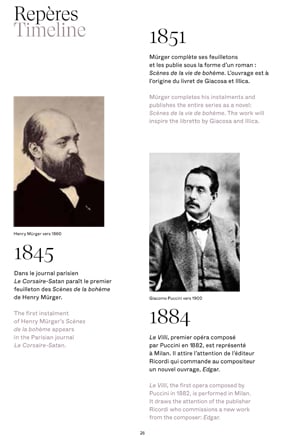
After Rigoletto and Lohengrin, Claus Guth’s La Bohème was his third production for the Paris Opera in 2017. Far from Paris and its Latin Quarter, he transposes the action of Puccini’s opera into the infinity of space where everything is in a state of suspension. In a doomed spaceship, confronted with a threatened future, the characters are reminded of a vanished era to which they seek to cling in order to stay alive. 

BUY THE PROGRAM

In both our venues, discounted tickets are sold at the box offices from 30 minutes before the show:

  • €35 tickets for under-28s, unemployed people (with documentary proof less than 3 months old) and senior citizens over 65 with non-taxable income (proof of tax exemption for the current year required)
  • €70 tickets for senior citizens over 65

Get samples of the operas and ballets at the Paris Opera gift shops: programmes, books, recordings, and also stationery, jewellery, shirts, homeware and honey from Paris Opera.

Opéra Bastille
  • Open 1h before performances and until performances end
  • Get in from within the theatre’s public areas
  • For more information: +33 1 40 01 17 82

Opéra Bastille

Place de la Bastille

75012 Paris

Public transport

Underground Bastille (lignes 1, 5 et 8), Gare de Lyon (RER)

Bus 29, 69, 76, 86, 87, 91, N01, N02, N11, N16

Calculate my route
Car park

Parking Indigo Opéra Bastille 1 avenue Daumesnil 75012 Paris

Book your spot at a reduced price
super alt text
super alt text
super alt text
super alt text
super alt text
super alt text

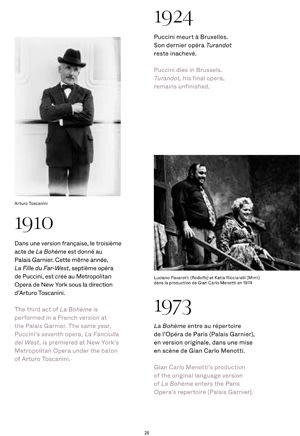
After Rigoletto and Lohengrin, Claus Guth’s La Bohème was his third production for the Paris Opera in 2017. Far from Paris and its Latin Quarter, he transposes the action of Puccini’s opera into the infinity of space where everything is in a state of suspension. In a doomed spaceship, confronted with a threatened future, the characters are reminded of a vanished era to which they seek to cling in order to stay alive. 

BUY THE PROGRAM

In both our venues, discounted tickets are sold at the box offices from 30 minutes before the show:

  • €35 tickets for under-28s, unemployed people (with documentary proof less than 3 months old) and senior citizens over 65 with non-taxable income (proof of tax exemption for the current year required)
  • €70 tickets for senior citizens over 65

Get samples of the operas and ballets at the Paris Opera gift shops: programmes, books, recordings, and also stationery, jewellery, shirts, homeware and honey from Paris Opera.

Opéra Bastille
  • Open 1h before performances and until performances end
  • Get in from within the theatre’s public areas
  • For more information: +33 1 40 01 17 82

Discover opera and ballet in another way

QR code

Dive into the Opera world and get insights on opera and pop culture or ballet and cinema. Scan this code to access all the quiz and blindtests on your mobile.

opera logo

3 min

La Bohème

La Bohème goes into space

I’m not talking about Gravity but about Puccini’s opera. Next season, Claus Guth takes La Bohème into a space station.

Discover

Immerse in the Paris Opera universe

Follow us

Back to top