My special offers

Prices

    0
    300
    0€
    300€

Show / Event

Venue

Experience

Calendar

  • Between   and 

Prices

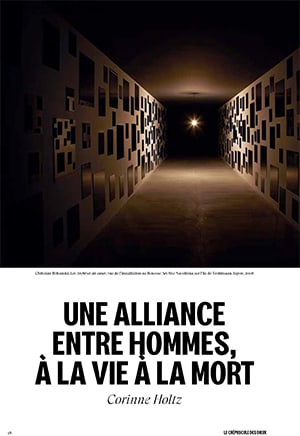
Edward Burtynsky, courtesy Flowers Gallery, London / Nicholas Metivier Gallery, Toronto

Edward Burtynsky, courtesy Flowers Gallery, London / Nicholas Metivier Gallery, Toronto

Opera

New

Götterdämmerung

Richard Wagner

Opéra Bastille

from 08 to 18 October 2026

from €145 to €225

5h50 with 2 intervals

Synopsis

In Götterdämmerung, Siegfried takes leave of Brünnhilde to travel the world and accomplish new feats. These will be his last: during his journey along the Rhine, he falls victim to a sinister plot hatched by Alberich and his son Hagen. The downfall of the gods is now inevitable...

Bringing the Ring cycle to a close with Götterdämmerung, its most metaphysical chapter, Richard Wagner unleashes music as blazing as the pyre on which Brünnhilde immolates herself. Emotion runs equally high, as in Siegfried’s Funeral March, one of the score’s most striking orchestral passages. Premiered in 1876 at the inaugural Bayreuth Festival, the work is presented here in a production by Calixto Bieito, thus concluding his vision of the Ring Cycle for the Paris Opera, begun in 2025.

Duration : 5h50 with 2 intervals

Language : German

Surtitle : French / English

Show acts and characters

CHARACTERS

Siegfried: Grandson of Wotan, son of Siegmund and Sieglinde
Gunther: Prince of the Gibichungs, brother of Gutrune, half-brother of Hagen
Hagen: Son of Alberich, half-brother of Gunther and Gutrune
Alberich: Former ruler of the Nibelungs, father of Hagen
Brünnhilde: Former Valkyrie, daughter of Wotan and Erda
Gutrune: Gunther’s sister, Hagen’s half-sister
Waltraute: Valkyrie, sister of Brünnhilde
The Three Norns: Daughters of Erda
Woglinde
Wellgunde
Flosshilde

Rhinemaidens
Men and women

First part

Prelude

The three Norns stand at their loom and gaze into the past, the present and the future. Long ago, Wotan cut a spear from the World Ash, causing it to wither and die. When his grandson Siegfried shattered this spear, on which the treaties were inscribed, he thereby deprived Wotan of his power. Wotan had the World Ash felled. He now sits among its logs in Valhalla, waiting with the heroes and the gods. The end of the gods is drawing near. Then the rope on the loom breaks. The Norns plunge down to join their mother, Erda. Brünnhilde feels so inseparably bound to her beloved Siegfried that she lets him set out into the world “in search of new exploits”. Because she has given him all her knowledge and strength, Siegfried gives her the ring as a parting gift. In return for this token of love, Brünnhilde gives him her horse Grane.

Act 1

SCENE 1. A t t he c ourt o f t he G ibichungs, G unther a nd his sister Gutrune officially rule, but behind the scenes their half-brother Hagen secretly controls the course of events.

Under the pretence of helping his still-unmarried halfsiblings find suitable spouses, Hagen sets an ingenious plot in motion. Gutrune is to marry “Siegfried, the mightiest hero”, while Gunther is to wed “the most glorious woman in the world” – Brünnhilde, who is in fact Siegfried’s beloved. For Hagen’s plan to succeed, Siegfried must be manipulated with the siblings’ help, and Gunther and Gutrune willingly go along with it.

SCENE 2.
When Siegfried appears among the Gibichungs, he enters human society for the first time in his life. Gunther seeks to win his friendship, while Hagen uses a “potion of forgetfulness” to make Siegfried forget where he comes from and who he is, thereby turning him into an instrument of his own designs. Siegfried immediately falls in love with Gutrune. To win her, he is prepared to help his new friend Gunther win Brünnhilde. Using the Tarnhelm, Siegfried intends to transform himself into Gunther. After the two men have sealed a pact of blood brotherhood and sworn their oaths, they set off for the Rock of the Valkyries.

SCENE 3
Waltraute, one of the Valkyrie sisters, secretly visits Brünnhilde to tell her of the catastrophic plight of Wotan and the world. She tells Brünnhilde to return the ring to the Rhinemaidens, but Brünnhilde refuses to answer for Wotan’s past mistakes. By insisting on keeping this token of love, Brünnhilde breaks definitively with her family and her past. She sends Waltraute away. Shortly afterwards, Siegfried arrives, having assumed Gunther’s form. He overpowers Brünnhilde in combat and tears the ring from her.

Second part

Act 2

PRELUDE AND SCENE 1
Alberich appears to his son Hagen in a dream and reminds him of his mission. His “prematurely aged and pale” son, whom he has “raised in relentless hatred”, must recover the ring for him.

SCENE 2
On his return, Siegfried triumphantly recounts the cunning means by which he “won” Brünnhilde for Gunther. He now claims his reward: Gutrune. As Gunther and Brünnhilde are due to arrive shortly, preparations must be made for a double wedding.

SCENE 3
With a martial summons, Hagen gathers the Gibichung warriors to prepare them for the return of Gunther and his bride, Brünnhilde.

SCENE 4
When Gunther presents his bride to the Gibichungs, Brünnhilde is horrified to see her beloved Siegfried and, on his finger, the ring that the man she took for “Gunther” had torn from her. Since Gunther knows nothing of this, Brünnhilde accuses Siegfried of deceit. Siegfried, however, can only remember winning the ring from a dragon, not from a woman. While Brünnhilde recounts her wedding night with Siegfried, he defends himself by referring to the previous night, when the sword Nothung lay between them. In doing so, he publicly admits the blood brothers’ plot. As the general confusion mounts and one person’s word is set against another’s, Hagen demands that Siegfried swear an oath to establish his innocence. Without realising it, Siegfried commits the very perjury by which he delivers himself into Hagen’s hands and gives him the right to exact retribution. Brünnhilde counters by swearing to her version of the truth. To create a diversion, Siegfried ridicules Brünnhilde’s anger as “women’s squabbling” and calls for the festivities.

SCENE 5
Hagen seizes the opportunity to offer himself as an avenger and persuades Brünnhilde to reveal Siegfried’s only vulnerable spot. To Gunther, who still has doubts but realises that he is the “deceiver who has been deceived”, Hagen suggests that Siegfried’s ring could bring himimmense power. Finally, all three swear revenge and resolve to put Siegfried to death.

Third part

Act 3

PRELUDE AND SCENE 1
Siegfried, having lost his way while out hunting, encounters the three Rhinemaidens. When he refuses to give them the ring, they treat him with condescension and prophesy his imminent death. Siegfried, however, feels invincible. He has no interest in the ring’s power to rule the world. He prefers love.

SCENE 2
Shortly afterwards, Siegfried rejoins the rest of the hunting party. Goaded by Hagen, Siegfried entertains the company by recounting episodes from his life: how he grew up with Mime, how he defeated the dragon, and how he learned from the Forest Bird what powers the ring and the Tarnhelm possess. When Hagen restores his memory with a “potion of remembrance”, Siegfried also recalls his encounter with Brünnhilde and their love. In doing so, he unwittingly confesses his perjury. Hagen kills him with a treacherous blow from behind. As he dies, Siegfried becomes aware of his own life for the first time.

SCENE 3
Plagued by nightmares, Gutrune awaits Siegfried’s return. Hagen brings back Siegfried’s body. In the ensuing dispute over Siegfried’s inheritance, Hagen kills Gunther. Gutrune realises in despair that she was part of Hagen’s plot. Unlike the others, Brunnhilde, fully aware of what is at stake, is left alone. She bids farewell to Siegfried, to her love and to the world. She bids farewell to Siegfried, to her love and to the world.

Show chronology

Timeline

  • Vers 1200

    An anonymous author writes The Song of the Nibelungs, a Germanic epic combining the mythology of the Norse sagas with the historical reality of the Burgundians.

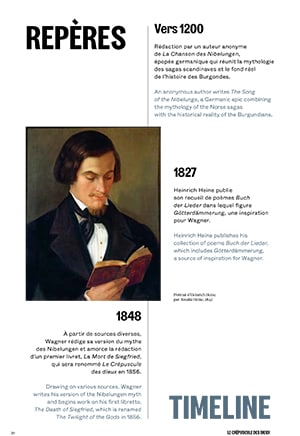
  • 1827

    Heinrich Heine publishes his collection of poems Buch der Lieder, which includes Götterdämmerung, a source of inspiration for Wagner.

    Götterdämmerung
  • 1848

    Drawing on various sources, Wagner writes his version of the Nibelungen myth and begins work on his first libretto, The Death of Siegfried, which is renamed The Twilight of the Gods in 1856.

  • 1850

    During the summer, Wagner produces musical sketches for The Death of Siegfried.

    Götterdämmerung
  • 1854

    Two years after completing the four librettos for his cycle, Wagner finishes composing Das Rheingold and begins work on Die Walküre.

  • 1868

    Die Meistersinger von Nürnberg premieres in Munich, conducted by Hans von Bülow. Three years earlier, the conductor had led the premiere of Tristan und Isolde in the same city.

    Götterdämmerung
  • 1874

    Begun in October 1869, the composition of Götterdämmerung is completed in November 1874. Less than six months later, Wagner conducts excerpts from the first act in concert in Vienna.

  • 1876

    As part of the premiere of the complete Ring of the Nibelung cycle at the Bayreuth Festival, Götterdämmerung is performed for the first time.

    Götterdämmerung
  • 1908

    Götterdämmerung is premiered at the Paris Opera in a French version.

  • 1955

    Hans Knappertsbusch conducts Wagner’s cycle at the Paris Opera, where it is performed in its entirety and in the original language for the first time.

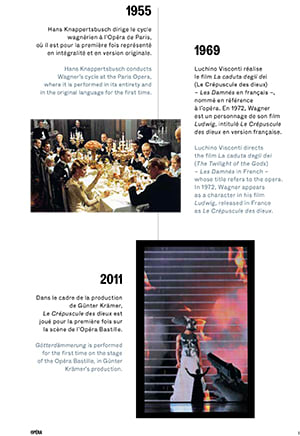
  • 1969

    Luchino Visconti réalise le film La caduta degli dei (Le Crépuscule des dieux) – Les Damnés en français –, nommé en référence à l’opéra. En 1972, Wagner est un personnage de son film Ludwig, intitulé Le Crépuscule des dieux en version française.

    Götterdämmerung
  • 2011

    Götterdämmerung is performed for the first time on the stage of the Opéra Bastille, in Günter Krämer’s production.

    Götterdämmerung

Artists

Third evening in three acts of Der Ring des Nibelungen

1876

Creative team

Orchestre de l’Opéra national de Paris

Media

  • Richard Wagner’s Ring Cycle: The Gods

    Richard Wagner’s Ring Cycle: The Gods

    Read the article

  • Richard Wagner’s Ring Cycle: The Nibelungen and the giants

    Richard Wagner’s Ring Cycle: The Nibelungen and the giants

    Read the article

  • Richard Wagner’s Ring Cycle: The Valkyries and the Wälsung

    Richard Wagner’s Ring Cycle: The Valkyries and the Wälsung

    Read the article

  • Richard Wagner’s Ring Cycle: The Humans

    Richard Wagner’s Ring Cycle: The Humans

    Read the article

  • About Götterdämmerung

    About Götterdämmerung

    Read the article

  • The Ring? What's that? #4

    The Ring? What's that? #4

    Watch the video

  • Richard Wagner’s Ring Cycle: The Rhinemaidens and the Norns

    Richard Wagner’s Ring Cycle: The Rhinemaidens and the Norns

    Read the article

  • Les Grands Entretiens - Götterdämmerung

    Les Grands Entretiens - Götterdämmerung

    Watch the video

  • Leitmotifs in the Ring #4

    Leitmotifs in the Ring #4

    Watch the video

© Pablo Grand Mourcel

Richard Wagner’s Ring Cycle: The Gods

Read the article

Discover the characters

05 min

Richard Wagner’s Ring Cycle: The Gods

By Marion Mirande

The characters in the Ring Cycle are primarily inspired from Medieval transcriptions of Norse and Germanic mythology, and more particularly from the 13th century German saga The Nibelungenlied (The Song of the Nibelungs). As he developed the librettos of the four operas which make up The Ring of the Nibelung, Richard Wagner brought those legends and their variations closer to his other sources of inspiration—namely Greek tragedy and Shakespearian drama—and added his own interpretations.


The Gods

© Pablo Grand Mourcel

Wagner retained seven gods from the pantheon of Norse mythology. These gods represent the highest order of beings in the universe. In Siegfried, where he appears as the Wanderer, Wotan describes his fellow deities as "light spirits who inhabit the cloudy heights ". Their mad quest for absolute power, represented by gold forged into a ring will lead them to their own destruction.

Wotan

The god of the gods—Odin or Wotan, depending on Norse or Germanic mythology—is the god of the dead, victory and knowledge. Left blind in his left eye after he sacrificed it in exchange for knowledge, he can be identified by his spear and the presence of two crows at his side—Huginn and Muninn (who respectively embody “thought” and “memory”). These attributes are replicated in the character created by Wagner. Wotan appears as the archetypal man of power: insatiable, unscrupulous and hypocritical. He is the master of Valhalla, a castle fortress perched on top of the mountains; a dazzling manifestation of his power. His power over the world is based on laws and covenants which will progressively be undermined and erased. Throughout the libretto, his authoritarianism gives way to growing insecurity. The husband of Fricka, he is also the father of the Valkyries as well as of Siegmund and Sieglinde.

Loge

Loge, the demigod of fire, is an amalgam of two mythological figures: Logi and Loki. While both embody fire, the latter also personifies cunning and trickery. In the Ring cycle, Loge retains this duality: he appears as both the god of fire and Wotan’s masterly advisor ultimately enabling Wotan to take possession of the ring. He is also one of the rare characters who is truly free. He alone will be able to distance himself from the system that Wotan has created, and he alone will resist the lure of the ring. A calculating character, Loge takes pleasure in playing with the gods and he possesses a perceptiveness that his peers lack. Throughout the Ring cycle, he forsakes his human persona to appear in his elemental form: fire.

Fricka

Fricka, the wife of Wotan and sister of Freia, Donner and Froh, is a divinity inspired by the goddess Frigg (or Frigga) from Norse mythology. In the Ring cycle she is the personification of lawfulness and fidelity. Tired of her husband’s infidelities, Fricka trys to make Wotan settle down and urges him to build Valhalla, a divine abode for them to live in. While Fricka is eager to defend the institution of marriage, she seeks above all to preserve the original values of divine society: respect for law and morality. In Die Walküre, she confronts Wotan with his own contradictions by reminding him that the guarantor of laws should not support Siegmund.  

Freyja

Freyja is a key divinity of Norse and Germanic mythology. A creature of incredible beauty, she is the goddess of love and fertility. In the Ring cycle, Freia is the sister of Fricka. In Valhalla, the gods are blessed with eternal youth thanks to her cultivation of golden apples. Coveted by Fafner and Fasolt in Das Rheingold, Freia serves as a bargaining chip for Wotan who promises her to two giants in exchange for the construction of Valhalla. Without Freia, the gods find themselves deprived of their source of eternal youth and begin to waste away.

Donner

The personification of Strength and power, Thor (also known as Donner) is one of the most popular gods in Germanic mythology. His hallmark is his hammer which is the source of thunder and lightning. Present only in Das Rheingold, Donner nevertheless occupies a strategic place among the other characters. He embodies the figure of a military leader who thinks in warlike terms to counter the threat posed by Alberich. His hammer, evocative of violence, is a symbolic counterforce to the inherent lawfulness represented by Wotan's spear.  

Froh

Along with Odin and Thor, Freyr is one of the three major gods in Germanic mythology. The personification of fertility he is also the brother of Freyja. Known as Froh in the Ring cycle, he only appears in Das Rheingold. His perseverance in defending Freia and the words he has for her reflects the closeness of the two characters. 

Erda

Inspired by the goddesses Jördh and Gaia from Nordic and Greek mythology, Erda is the maternal god of the Earth. She is the personification of ancestral, intuitive and prophetic wisdom. A veritable Pythia, she can simultaneously see the past, the present and the future. As the mother of the Norns who spin the threads of fate, she holds universal knowledge. In Das Rheingold, she arouses doubt and anxiety in Wotan by warning him that his thirst for power risks provoking his own demise. By begetting Brünnhilde with the latter, she gives life to the woman who will save the universe. In Siegfried, Wotan, in the guise of the Wanderer, calls on Erda one last time in a scene that seals their antagonisms.    

© Pablo Grand Mourcel

Richard Wagner’s Ring Cycle: The Nibelungen and the giants

Read the article

Discover the characters

04 min

Richard Wagner’s Ring Cycle: The Nibelungen and the giants

By Marion Mirande

The characters in the Ring Cycle are primarily inspired from Medieval transcriptions of Norse and Germanic mythology, and more particularly from the 13th century German saga The Nibelungenlied (The Song of the Nibelungs). As he developed the librettos of the four operas which make up The Ring of the Nibelung, Richard Wagner brought those legends and their variations closer to his other sources of inspiration—namely Greek tragedy and Shakespearian drama—and added his own interpretations.


The Nibelungen

© Pablo Grand Mourcel

In Norse mythology, the albes are a race apart from men, gods and giants. They are divided into two distinct species, the quasi-angelic albes of light, and the quasi-demonic black albes. In Germanic legend, the were called the Nibelungen, a name that means “those from the world below”. These denizens of the Nibelheim or underworld work as craftsmen or blacksmiths and possess great wealth. In the Ring cycle, the Nibelungen are portrayed as jealous, cunning, ambitious creatures, fundamentally hostile to the gods. 

Alberich

In the Ring cycle, Alberich is the one through whom misfortune manifests itself. He is dubbed the “black albe”. He dreams of conquering the world, renouncing love and cursing the one who gains possession of the ring which he forged. Associated with the gold he stole in Das Rheingold, Alberich’s power is utterly lawless and built on theft. 

Mime

Mime is Alberich’s brother and Siegfried’s adoptive father. In the Ring cycle, he represents permanent failure. Aware of the powers of the sword Nothung, and recognising the fact that only he who forged it will be capable of seizing the ring and the Tarnhelm which are held by the giant Fafner, he seeks in vain to restore it to its original form. Siegfried manages to reforge his father’s sword and recover the treasure, but he knows he is threatened with death by Mime. However, the latter is ultimately killed by the hero. 

Hagen

Hagen is one of the principal heroes of The Song of The Nibelungen. Motivated by moral values, this Medieval character becomes a manipulator and a cynic under Wagner. The son of Alberich and half-brother to Gunther and Gutrune, he represents in his father’s eyes the primary means of recovering the lost ring. His Machiavellian nature allows him to gain the upper hand over the other characters in Götterdämmerung. He manipulates Gunther and Gutrune and tricks Siegfried in order to kill him.

The giants

© Pablo Grand Mourcel

In Norse mythology, the giants are the ones who created the world and are frequently at war with the gods. To a large extent, they represent the forces of chaos. Using magic, cunning and physical force, they try to change the order of the universe. In medieval literature, they assumed the disposition of ugly and stupid characters often driven by bad intentions, as is the case in the Ring cycle.

Fasolt

Regarding the two giants in the cycle, Fasolt comes across as “the most docile”. In Das Rheingold, unlike his brother Fafner, Fasolt does not look upon Freia as a bargaining chip to seize control of Valhalla. He sincerely loves her. The motives of the two brothers are different: Fafner has political aims whereas Fasolt has a far more discreet temperament. Through their relationship, the conflict between love and power assumes all its significance.

Fafner

Of the two giants, Fafner stands out as “the malicious one”. Ever hungry for wealth, he is the first to react when he learns of the theft of the gold and the power of the ring. In his attempts to obtain the latter, he does not hesitate to murder his brother. In Siegfried, with the help of the Tarnhelm, the magic helmet, he morphs into a dragon and spends his days sleeping on his gold. He will ultimately be slain in his cave by Siegfried.

© Pablo Grand Mourcel

Richard Wagner’s Ring Cycle: The Valkyries and the Wälsung

Read the article

Discover the characters

04 min

Richard Wagner’s Ring Cycle: The Valkyries and the Wälsung

By Marion Mirande

The characters in the Ring Cycle are primarily inspired from Medieval transcriptions of Norse and Germanic mythology, and more particularly from the 13th century German saga The Nibelungenlied (The Song of the Nibelungs). As he developed the librettos of the four operas which make up The Ring of the Nibelung, Richard Wagner brought those legends and their variations closer to his other sources of inspiration—namely Greek tragedy and Shakespearian drama—and added his own interpretations.


The Valkyries

© Pablo Grand Mourcel

In Norse mythology, the Valkyries are virgin warriors charged with the mission of selecting the most courageous warriors fallen on the battlefield and leading them into Valhalla. In the Ring cycle, there are nine of them: Brünnhilde, Grimgerde, Gerhilde, Helmwige, Ortlinde, Rossweisse, Schwertleite, Siegrune, and Waltraute. Presented as the daughters of Wotan and of different conquests, they appear together for the first time in Act III of Die Walküre. Only two of them have major roles: Waltraute and Brünnhilde, both of whom were the love children of Wotan and Erda.

Brünnhilde

In Germanic literature, Brynhildr is portrayed as a Valkyrie who an adept of magic and the art of healing. In the Ring cycle, Brünnhilde appears as Wotan’s favourite even though she has rebelled against her father. Wagner made Brünnhilde the only character who connects the three days of the Ring. Her psychological and spiritual development progresses in three stages: her realisation of the greatness of love in Die Walküre, her emotional growth from experiencing love in Siegfried, and her rise to tragic greatness through renunciation in Götterdämmerung.

Waltraute

Waltraute is arguably the closest to Brünnhilde. She flouts Wotan’s interdictions to go and find her sister on her rock. In Götterdämmerung, concerned by Valhalla’s decline, she tries to convince Brünnhilde to part with the accursed ring and return it to the Rhinemaidens. In her mind, it is the only way to re-establish the course of things and save the gods.

The Wälsungen

© Pablo Grand Mourcel

Children of the "wolf" in Norse and Germanic mythology—one of Wotan’s reincarnations originally known as Wälse—they are the descendants of a mortal woman and Wotan. These creatures have an instinctive sense of freedom and for Wotan they represent a means to win back the ring. 

Siegmund

Siegmund is the earthly son of Wotan and the twin brother of Sieglinde. His incestuous relationship with Sieglinde gives rise to the line of the Wälsung. He is the father of Siegfried and he possesses the sword Nothung. He was sired by Wotan to fulfil the task of retrieving the ring. Courageous and of rare nobility, he has inherited the positive qualities of his father without any of his faults, and places love before self-interest. The intrinsic heroism of the character is revealed when he refuses to abandon Sieglinde and to enter Valhalla, preferring to die with her.

Sieglinde

Sieglinde is Siegmund’s twin sister. Abandoned as a child, she was forced to marry Hunding. In Die Walküre, Sieglinde possesses the valour of the heroes of mythical times. Despite her distress following the death of Siegmund, she gives birth to Siegfried with the assistance of Brünnhilde. Through the Valkyrie, Sieglinde realises that the salvation of the world depends on her maternity.

Siegfried

The son of Siegmund and Sieglinde, and the grandson of Wotan, Siegfried is one of the most significant characters in the Ring cycle. The embodiment of the quintessential hero, he symbolises hope. Wotan counts on him to retrieve the ring. More unsophisticated than cerebral, he acts on instinct. He has no conception of fear which enables him to confront Fafner and pass through the circle of fire on the rock on which Brünnhilde is imprisoned. Siegfried is also the archetypal Wagnerian character in search of his roots.

© Pablo Grand Mourcel

Richard Wagner’s Ring Cycle: The Humans

Read the article

Discover the characters

02 min

Richard Wagner’s Ring Cycle: The Humans

By Marion Mirande

The characters in the Ring Cycle are primarily inspired from Medieval transcriptions of Norse and Germanic mythology, and more particularly from the 13th century German saga The Nibelungenlied (The Song of the Nibelungs). As he developed the librettos of the four operas which make up The Ring of the Nibelung, Richard Wagner brought those legends and their variations closer to his other sources of inspiration—namely Greek tragedy and Shakespearian drama—and added his own interpretations.

The Humans

© Pablo Grand Mourcel

The Gibichungen are a family of humans who reign over the Rhine under a monarchic system.

Gunther

Gunther, the half-brother of Hagen, reigns over his people, the Gibichungen. However, all the major decisions are really determined by his half-brother. A man of weak character, he is depicted as a puppet manipulated by Hagen. Blinded by his faith in the latter, he has no qualms about following his advice. As such, he allows his wife Brünnhilde to be seduced by Siegfried and then takes credit for the exploit. Gunther is often regarded as one of Wagner’s weakest characters.

Gutrune

Gutrune is the victim of a deal struck between Hagen, Gunther and Siegfried. Offered to Siegfried by Hagen in Götterdämmerung in exchange for Gunther’s conquest of Brünnhilde, Gutrune falls in love with the hero. However, she will never be able to experience the joys of a genuine loving relationship. Manipulated by Hagen, she gives Siegfried the potion of forgetfulness and, distraught by her act, she flees. Like the other female characters in the Ring, she is intuitive and, in Act III of Götterdämmerung she senses that a dire event has come to pass.

Hunding

Hunding is the only human in the Ring cycle who does not belong to the Gibichungen family. A brutal hunter, he is a symbol of machismo. Hunding is Sieglinde’s husband but Sieglinde hates him, so he repays her by enslaving her and abusing her. He looks on power in a boorish way: his land, his spoils and his wife. He is dependent on his clan and its customs and has no true personal values or sentiments. In Die Walküre, by receiving Siegmund into his home, he is merely conforming to the laws of hospitality and the code of honour.

© Edward Burtynsky, courtesy Flowers Gallery, London / Nicholas Metivier Gallery, Toronto

About Götterdämmerung

Read the article

07 min

About Götterdämmerung

By Bettina Auer

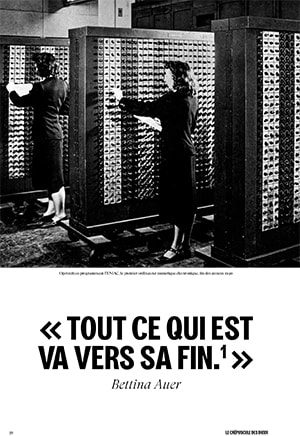
At the dawn of the industrial age, the advent of the mechanical loom revolutionised textile production, making it possible to manufacture fabrics on a large scale and at lower cost, while depriving many artisanal weavers of their livelihoods. Another technological advance, the “programmable” loom operated using punched cards, invented by Lyon-born Joseph-Marie Jacquard, made it possible to create complex textile patterns and foreshadowed, as early as the 19th century, the development of control technologies, making the loom a kind of precursor to computing and the modern computer.

It was against the backdrop of the profound social upheavals brought about by the Industrial Revolution that Richard Wagner composed Der Ring des Nibelungen. Today, exactly 150 years after the first performance of the complete cycle of his magnum opus, the Paris Ring comes to its conclusion with Götterdämmerung. Wagner, who always wrote his own librettos, was the only composer to have a theatre built during his lifetime according to his artistic vision and dedicated entirely to his works. It was at the first Bayreuth Festival, in August 1876, that Siegfried and Götterdämmerung were premiered, and the first complete performance of the Ring was given.

The final part of the Tetralogy was Wagner’s starting point. In 1848, he had initially conceived a single work entitled Siegfried’s Death, a heroic grand opera. Thus, it was with the ending, and with the death of his hero, that the composer first envisioned beginning his Ring. Only later did he add the story of the events that preceded it, eventually arriving at Das Rheingold and the initial theft of the Ring. Wagner had indeed realised that it was impossible to have the complex events leading up to Siegfried’s murder recounted retrospectively: instead, they had to be shown to the audience and brought to life on stage.

In Götterdämmerung, the “magic of musical allusions” (“Beziehungszauber”, in the words of Thomas Mann, a great admirer of Wagner) unfolds to its full effect. To ensure the musical cohesion of the Tetralogy and its approximately sixteen hours of music, Wagner developed what he himself called “motifs of remembrance” (“Erinnerungs-Motive”), a term he had already used in Der fliegende Holländer and which he preferred to the now more commonly used term “leitmotif”. A motif of remembrance can blur different layers of time: it may refer to the past, shed light on the present, or anticipate the future.

In Götterdämmerung, the motifs of remembrance from throughout the Tetralogy are woven into the musical fabric. Those heard, for example, in the “Funeral March” – the orchestral epilogue that follows Siegfried’s death in the penultimate scene – recapitulate the hero’s destiny and downfall. Wagner’s decision to entrust the orchestra with an autonomous commentary on the stage action was a major innovation.

For the Paris Ring, director Calixto Bieito and his team have chosen a discontinuous narrative in which past and future intertwine. Their journey through the Ring began with Das Rheingold, in a “big data” universe where humans had risen to the status of gods, and where greed and selfishness had banished all sense of transcendence. In the militarised and violent world of Die Walküre, compassion was scarce, even though love was able to flourish amid the destruction. At the end, Wotan witnessed the collapse of the digital world he himself had created. In Siegfried, by contrast, nature had reclaimed a devastated world that had become uncontrollable as a result of human manipulation. The forest has been transformed, and the bond between humanity and nature has been broken.

In Götterdämmerung, it is the descendants of the great adversaries Wotan and Alberich who ultimately face one another: Siegfried, Wotan’s grandson, who has definitively stripped his grandfather of his power and who, unknowingly, has “transformed” the Ring, a symbol of power, into a token of love; and Hagen, fathered by Alberich for the sole purpose of carrying out his revenge and reclaiming the Ring. Both have been used as instruments, but a decisive difference sets them apart: Hagen knows his mission, just as he knows the history of the Ring. This advantage allows him to manipulate Gunther and Gutrune, his half-brother and half-sister who sit on the throne of the Gibichungs, at will, just as he will manipulate Siegfried, the newcomer. Siegfried, who has grown up in isolation, rather like Kaspar Hauser, comes into contact here with human society for the very first time, knowing nothing of its rules. It is therefore easy for Hagen, with the help of a “potion of forgetfulness”, to make Siegfried forget where he comes from and who he is, and to turn him into his instrument. Only Brünnhilde, who has long since emancipated herself from her father Wotan, possesses the strength, intelligence and independence needed to stand up to Hagen’s machinations. But by the time she finally understands what is happening, it is too late.

Nous sommes notre mémoire,
nous sommes ce musée chimérique de formes inconstantes,
ce monceau de miroirs brisés.

Jorge Luis Borges, Cambridge

“In Götterdämmerung, the world we have followed over the course of these four evenings disappears, and perhaps humanity disappears with it,” says director Calixto Bieito of the opera’s ending. “But the universe has not necessarily come to an end. Something could come after it, something post-human, natural, technological, or something else for which we do not yet have a name. With Götterdämmerung, our aim was not to present yet another apocalyptic work. We are already constantly surrounded by images and narratives of catastrophes, collapses and extinction. Yet the final bars of Wagner’s music, more ambiguous, stranger and deeper, provide us with no answers.

“What happens in the final music of Götterdämmerung – its surge, its clarity, its liberating atmosphere – is, in our production, pierced by a black hole, like a paradox: the music soars, the world collapses; harmony rises, memory disappears; beauty remains, the universe goes dark. This anti-human ending, in all its desolation, is profoundly human. Everything disappears: matter, humanity, post-humanity, narrative, culture, memory, identity. Nothing remains to be passed on. And, as memory gradually disappears, silence reigns.”

In her recently published book, The Rise and Fall of the Artificial State, American historian Jill Lepore warns us not to allow machines, or the corporations that own them, to control our social and political lives. She challenges us to recognise that, since this imbalance is the product of history and human actions, it is up to us, as human beings, to work towards transforming it. Lepore’s critical analysis does not lead to an apocalypse or a catastrophic scenario, but rather to a call to action: we must reclaim our collective capacity for judgement, our human responsibility, our power to make decisions, democracy and respect for nature.

For Calixto Bieito, Wagner’s Ring will remain as relevant as ever: “The Ring contains a number of fundamental human contradictions: our thirst for power and possession, our capacity to love and destroy, our need to create systems and our tendency to remain trapped within them. Wagner offers us no comforting moral lesson. The Ring does not tell us where we are going. It confronts us with who we are, who we have been and what we might become. All the questions remain unanswered.”

The Ring? What's that? #4

Watch the video

Third journey: Götterdämmerung

4:13 min

The Ring? What's that? #4

By Octave


4 operas, 34 characters, 15 hours of music ... and 4 videos to find your way! 

© Pablo Grand Mourcel

Richard Wagner’s Ring Cycle: The Rhinemaidens and the Norns

Read the article

Discover the characters

02 min

Richard Wagner’s Ring Cycle: The Rhinemaidens and the Norns

By Coline Delreux

The characters in the Ring Cycle are primarily inspired from Medieval transcriptions of Norse and Germanic mythology, and more particularly from the 13th century German saga The Nibelungenlied (The Song of the Nibelungs). As he developed the librettos of the four operas which make up The Ring of the Nibelung, Richard Wagner brought those legends and their variations closer to his other sources of inspiration—namely Greek tragedy and Shakespearian drama—and added his own interpretations.


The Rhinemaidens

© Pablo Grand Mourcel

In the Ring cycle, the Rhinemaidens, Woglinde, Wellgunde and Flosshilde, are a trio of elemental creatures from the depths of the river who are also the guardians of the gold. If at the beginning of the narrative, they divulge the secret of the gold to Alberich, it is because it is unthinkable for them to renounce love. They cannot imagine that a creature can be so hungry for power. Their insouciance is the expression of a naïve harmony that unites them to the mythical world. In Götterdämmerung, they try to convince Siegfried to give them back the ring. When the latter refuses, they inform him of the ring’s curse and predict his imminent demise.

The Norns

© Pablo Grand Mourcel

In Scandinavian mythology, the Norns are characterised by their capacity to determine the course of events or at least to predict them. In Germanic mythology, these three unreal creatures are the counterpart of the three Parcae of Greece. Daughters of Erda, they spin the thread of fate and are the collective memory of the world. The three Norns in the Ring cycle have a distinct role. The first personifies the past, the second the present and the third, the future. Like their mother Erda, they are associated with darkness and the night, namely, a form of intuitive and visionary awareness.

Les Grands Entretiens - Götterdämmerung

Watch the video

Pablo Heras-Casado, Alexander Neef

17:11 min

Les Grands Entretiens - Götterdämmerung

By Isabelle Stibbe

When an artist meets the General Director of the Paris Opera or its Director of Dance, what do they talk about? For the second season of the series Les Grands Entretiens, the Paris Opera reveals the behind-the-scenes process behind the artistic programming of the new productions for the 2026/27 season. Choice of guest artists, key themes, staging intentions, or choreographic styles: these exclusive conversations, lasting between fifteen and thirty minutes, offer the first keys to understanding the works soon to appear on the bill.

Alexander Neef, General Director of the Paris Opera, and conductor Pablo Heras-Casado share their perspectives on Götterdämmerung, the final part of Richard Wagner’s Ring Cycle, in Calixto Bieito’s new production.  

Leitmotifs in the Ring #4

Watch the video

Siegfried

3:21 min

Leitmotifs in the Ring #4

By Matthieu Pajot, Coline Delreux

Musical themes to describe a character, an object, a place or an emotion. In Wagner's work, leitmotifs have a closely related dramatic and musical role.
Octave invites you to discover four of them from the Cycle: the ring, Siegfried, Valhalla and the Ride of the Valkyries.

opera logo
[LIVE] Götterdämmerung


Join us on Sunday 22 November at 2pm to watch Wagner's opera live on POP!

7-DAY FREE TRIAL Free trial 7 days

Access and services

Opéra Bastille

Place de la Bastille

75012 Paris

Public transport

Underground Bastille (lignes 1, 5 et 8), Gare de Lyon (RER)

Bus 29, 69, 76, 86, 87, 91, N01, N02, N11, N16

Calculate my route
Car park

Parking Indigo Opéra Bastille 1 avenue Daumesnil 75012 Paris

Book your spot at a reduced price
super alt text
super alt text
super alt text
super alt text
super alt text
super alt text

As the Third Day and final part of the tetralogy, Götterdämmerung is the work from which Der Ring des Nibelungen grew. Its libretto was the first Wagner wrote for the cycle. The composer-librettist centred his narrative on Siegfried, a character drawn from the Nibelungenlied. Once the libretto was complete, Wagner worked backwards to give the hero’s destiny a prehistory, first depicting his youth and then the story of his parents in Siegfried and Die Walküre. The cycle was completed with the last libretto Wagner wrote – the prologue to the story, Das Rheingold.

BUY THE PROGRAM
  • Cloakrooms

    Free cloakrooms are at your disposal. The comprehensive list of prohibited items is available here.

  • Bars

    Reservation of drinks and light refreshments for the intervals is possible online up to 24 hours prior to your visit, or at the bars before each performance.

In both our venues, discounted tickets are sold at the box offices from 30 minutes before the show:

  • €35 tickets for under-28s, unemployed people (with documentary proof less than 3 months old) and senior citizens over 65 with non-taxable income (proof of tax exemption for the current year required)
  • €70 tickets for senior citizens over 65

Get samples of the operas and ballets at the Paris Opera gift shops: programmes, books, recordings, and also stationery, jewellery, shirts, homeware and honey from Paris Opera.

Opéra Bastille
  • Open 1h before performances and until performances end
  • Get in from within the theatre’s public areas
  • For more information: +33 1 40 01 17 82

Opéra Bastille

Place de la Bastille

75012 Paris

Public transport

Underground Bastille (lignes 1, 5 et 8), Gare de Lyon (RER)

Bus 29, 69, 76, 86, 87, 91, N01, N02, N11, N16

Calculate my route
Car park

Parking Indigo Opéra Bastille 1 avenue Daumesnil 75012 Paris

Book your spot at a reduced price
super alt text
super alt text
super alt text
super alt text
super alt text
super alt text

As the Third Day and final part of the tetralogy, Götterdämmerung is the work from which Der Ring des Nibelungen grew. Its libretto was the first Wagner wrote for the cycle. The composer-librettist centred his narrative on Siegfried, a character drawn from the Nibelungenlied. Once the libretto was complete, Wagner worked backwards to give the hero’s destiny a prehistory, first depicting his youth and then the story of his parents in Siegfried and Die Walküre. The cycle was completed with the last libretto Wagner wrote – the prologue to the story, Das Rheingold.

BUY THE PROGRAM
  • Cloakrooms

    Free cloakrooms are at your disposal. The comprehensive list of prohibited items is available here.

  • Bars

    Reservation of drinks and light refreshments for the intervals is possible online up to 24 hours prior to your visit, or at the bars before each performance.

In both our venues, discounted tickets are sold at the box offices from 30 minutes before the show:

  • €35 tickets for under-28s, unemployed people (with documentary proof less than 3 months old) and senior citizens over 65 with non-taxable income (proof of tax exemption for the current year required)
  • €70 tickets for senior citizens over 65

Get samples of the operas and ballets at the Paris Opera gift shops: programmes, books, recordings, and also stationery, jewellery, shirts, homeware and honey from Paris Opera.

Opéra Bastille
  • Open 1h before performances and until performances end
  • Get in from within the theatre’s public areas
  • For more information: +33 1 40 01 17 82

Immerse in the Paris Opera universe

Jean-Pierre Delagarde / OnP

Sign up for our newsletter

Our latest news

* Required fields

By clicking on "submit", you agree to receive electronic communications from the Opéra national de Paris and to the processing of your data.
Learn more about managing your data and your rights.

Back to top