My special offers

Prices

    0
    300
    0€
    300€

Show / Event

Venue

Experience

Calendar

  • Between   and 

Prices

Benoîte Fanton / OnP

Benoîte Fanton / OnP

Ballet

La Fille mal gardée

Frederick Ashton

Palais Garnier

from 07 to 22 May 2027

from €35 to €175

2h05 with 1 interval

Synopsis

A rooster and hens, peasants wielding scythes, headscarves and clogs: such is the bucolic world of La Fille mal gardée, where young Lise, a farm girl in love with the peasant Colas, continually outwits her watchful mother, who wants to force her to marry another man – wealthier but simple-minded.

Created in July 1789 at Bordeaux’s Grand Théâtre, this ballet, the classical repertoire’s oldest, originally choreographed by Jean Dauberval, took on new colours in 1960 with Frederick Ashton’s version for the Royal Ballet in London.

Entering the Paris Opera’s repertoire in 2007, its choreography delights with its freshness and sometimes comical fantasy. A virtuoso craftsman, Frederick Ashton created a gallery of irresistible characters to the strains of popular songs and comic-opera arias, adding here and there touches of tender romantic poetry, embodied in the delicacy of a pink satin ribbon.

Duration : 2h05 with 1 interval

  • Opening

  • First part 65 min

  • Intermission 20 min

  • Second part 40 min

  • End

Show acts and characters

CHARACTERS

Lise
Colas
Widow Simone
Thomas: Alain’s father
Alain: The suitor
A dancer with a flute
The Rooster

The Notary
His assistant
Four Hens
Lise’s friends
Colas’ friends
Two Peasants
Male and Female dancers

Act 1:

Scene 1: The farmyard
The dawn of a busy day on the farm is heralded by the cock and his attendant hens. Lise, disappointed at not seeing Colas, leaves a ribbon tied in a lover’s knot as a token of her devotion. Colas finds it and binds it to his staff. The lovers meet, but are interrupted by Simone, who sets her daughter a task churning butter. Colas, hiding in the loft, joins her. The work is shared and then forgotten as they declare their love. The farm girls summon Lise to play, but her mind is elsewhere. Her suspicious and ever- watchful mother catches hold of her and chastizes her. Just then Thomas, the pompous and wealthy proprietor of a vineyard, arrives with his son Alain. Simone, aware of their mission, dismisses Lise, and Thomas asks for her hand for his son. When Lise returns, Alain coyly and clumsily shows off his paces. She is amused and a little shocked by his antics, but not interested. They set off for the harvest.

Scene 2: The cornfield

It is harvest time and, after working in the fields, the harvesters, led by Colas, relax in a joyful dance. Lise and Alain dance, but Colas intervenes, and the young girl makes it clear where her preference lies. One of the harvesters plays the flute, to everybody’s general delight, and Alain thinks he will have a try; but the harvesters mock him and he is rescued from their horseplay by his indignant father. The field is now left clear for the triumphant Colas, who dances with Lise. Simone joins in the merriment of the harvesters. Suddenly they are interrupted by a storm that drenches them, scattering them far and wide.

Act 2:

Interior of the farmhouse
Mother and daughter, soaked by the storm, return to the farmhouse. They sit down to spin; work, thinks the mother, should keep Lise out of mischief. But she is overcome by sleep, and Lise, who has seen Colas through the gate, tries to take the key from her. Simone wakes up and, in order to remain watchful, plays the tambourine for Lise to dance. But the taps grow feebler, she begins to nod, and now she is fast asleep. Colas opens the top part of the farmhouse door and leans towards Lise. She runs joyfully into his arms. The knocking of the harvesters, coming for their pay, awakens Simone. Simone tells her daughter to get on with her chores as she leaves to give the harvesters a drink. Lise, thinking she is alone, dreams of the delights of married life. Colas cannot resist, and comes out from hiding. She is bashful at having been taken by surprise, but once again they declare their love, exchanging scarves as a token. As Simone reappears, Lise hustles Colas into her bedroom. The ever-suspicious mother realizes that the lovers have been meeting, and in her turn hustles Lise into the bedroom, locking the door. Alain and his father now arrive with a notary to complete the contract. When it has been signed, Simone hands Alain the bedroom key. After a moment of idiotic indecision, he opens the door and to everyone’s dismay Colas and Lise come out. The lovers fall on their knees to ask Simone for forgiveness and a blessing. In spite of Thomas and Alain, she finally gives in amid general rejoicing.

Show chronology

Timeline

  • XVIe s.

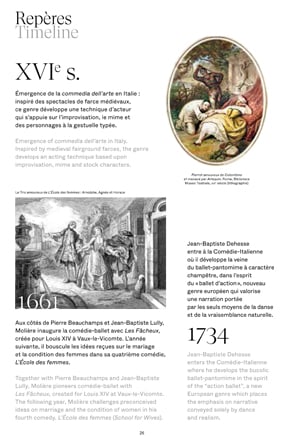
    Emergence of commedia dell’arte in Italy. Inspired by medieval fairground farces, the genre develops an acting technique based upon improvisation, mime and stock characters.

  • 1661

    Together with Pierre Beauchamps and Jean‑Baptiste Lully, Molière pioneers comédie-ballet with Les Fâcheux, created for Louis XIV at Vaux-le-Vicomte. The following year, Molière challenges preconceived ideas on marriage and the condition of women in his fourth comedy, L’École des femmes (School for Wives).

  • 1734

    Jean-Baptiste Dehesse enters the Comédie-Italienne where he develops the bucolic ballet‑pantomime in the spirit of the “action ballet”, a new European genre which places the emphasis on narrative conveyed solely by dance and realism.

  • 1758

    Egidio Duni’s La Fille mal gardée, with libretto by Justine Favart, is considered the first opéra-comique. It was performed by the Comédiens Italiens ordinaires du Roi on March 4.

  • 1760

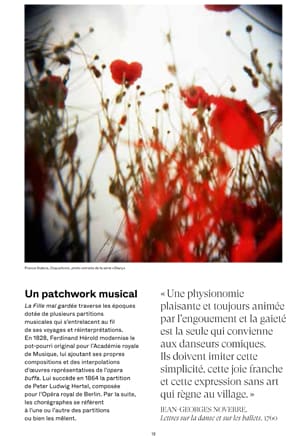
    In his work Letters on Dancing and Ballet, Jean‑Georges Noverre, the renowned champion of “action ballet”, distinguishes comic or grotesque dance of a “gay and amusing” nature from noble “heroic and serious” dance.

  • 1789

    On July 1, Jean Dauberval, a disciple of Noverre, stages the premiere of Le Ballet de la paille ou Il n’est qu’un pas du mal au bien. The work, built around popular tunes, travels around Europe and the United States from 1791 onwards, becoming a staple in the boulevard theatres of Paris.

  • 1828

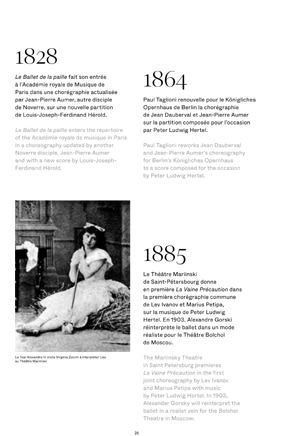
    Le Ballet de la paille enters the repertoire of the Académie royale de musique in Paris in a choreography updated by another Noverre disciple, Jean‑Pierre Aumer and with a new score by Louis‑Joseph- Ferdinand Hérold.

  • 1864

    Paul Taglioni reworks Jean Dauberval and Jean‑Pierre Aumer’s choreography for Berlin’s Königliches Opernhaus to a score composed for the occasion by Peter Ludwig Hertel.

  • 1885

    The Mariinsky Theatre in Saint Petersburg premieres La Vaine Précaution in the first joint choreography by Lev Ivanov and Marius Petipa with music by Peter Ludwig Hertel. In 1903, Alexander Gorsky will reinterpret the ballet in a realist vein for the Bolshoi Theatre in Moscow.

  • 1940

    Bronislava Nijinska, guest chorographer at the New York Ballet Theatre, revisits the work of Ivanov and Petipa that she herself had performed in Saint Petersburg.

  • 1960

    Frederick Ashton unveils his version for the Royal Opera House to a musical arrangement by John Lanchbery that draws inspiration from the score by Louis-Joseph-Ferdinand Hérold. Tamara Karsavina, who danced the ballet alongside Vaslav Nijinsky, offers her own personal insight.

  • 2007

    Frederick Ashton’s version enters the Paris Opera’s repertoire. It is preceded by the productions of Heinz Spoerli (1981) and Joseph Lazzini (1981) as well as Claude Bessy’s version specially created for the Ballet School (1985).

Artists

Ballet in two acts

Choreography after Jean Dauberval

Creative team

With the Paris Opera Étoiles, First Soloists and Corps de Ballet
With the Paris Opera Orchestra

Media

LA FILLE MAL GARDÉE by Frederick Ashton (trailer)
  • 5 questions about La Fille mal gardée

    5 questions about La Fille mal gardée

    Discover

  • La Fille mal gardée: the true/false story

    La Fille mal gardée: the true/false story

    Discover

© Francette Levieux / OnP

5 questions about La Fille mal gardée

Discover

01 min

5 questions about La Fille mal gardée

By aria

La Fille mal gardée is one of the oldest ballets in the history of dance. Are you ready for a journey back in time to discover its many versions?  

© Francette Levieux / OnP

La Fille mal gardée: the true/false story

Discover

01 min

La Fille mal gardée: the true/false story

By aria

A revolutionary ballet in more than one way, La Fille mal gardée never ceases to surprise, and you'll soon understand why. Will you be able to sort out the truth from the false among the following statements?  

  • [EXTRAIT] LA FILLE MAL GARDÉE (Léonore Baulac, Guillaume Diop)
  • [EXTRAIT] LA FILLE MAL GARDÉE (danse des claquettes)
  • [EXTRAIT] LA FILLE MAL GARDÉE (Léonore Baulac, Guillaume Diop)
  • [EXTRAIT] LA FILLE MAL GARDÉE (Léonore Baulac, Guillaume Diop)
  • [EXTRAIT] LA FILLE MAL GARDÉE
  • [EXTRAIT] LA FILLE MAL GARDÉE
  • [EXTRAIT] LA FILLE MAL GARDÉE
  • [EXTRAIT] LA FILLE MAL GARDÉE
  • [EXTRAIT] LA FILLE MAL GARDÉE (Léonore Baulac, Guillaume Diop)
  • [EXTRAIT] LA FILLE MAL GARDÉE (danse des claquettes)
  • [EXTRAIT] LA FILLE MAL GARDÉE (Léonore Baulac, Guillaume Diop)
  • [EXTRAIT] LA FILLE MAL GARDÉE (Léonore Baulac, Guillaume Diop)
  • [EXTRAIT] LA FILLE MAL GARDÉE
  • [EXTRAIT] LA FILLE MAL GARDÉE
  • [EXTRAIT] LA FILLE MAL GARDÉE
  • [EXTRAIT] LA FILLE MAL GARDÉE

Access and services

Palais Garnier

Place de l'Opéra

75009 Paris

Public transport

Underground Opéra (lignes 3, 7 et 8), Chaussée d’Antin (lignes 7 et 9), Madeleine (lignes 8 et 14), Auber (RER A)

Bus 20, 21, 27, 29, 32, 45, 52, 66, 68, 95, N15, N16

Calculate my route
Car park

Parking Q-Park Edouard VII and Q-Park Meyerbeer 16 rue Bruno Coquatrix 4 rue de la Chaussée d'Antin 75009 Paris

Book your spot at a reduced price
super alt text
super alt text
super alt text
super alt text
super alt text

Frederick Ashton’s version, created in 1960 for London’s Royal Ballet, entered the Paris Opera’s repertoire in 2007 thus bringing together the French and Anglo‑Russian traditions. Creating a world reminiscent of childhood that one might easily imagine populated by the characters of La Fontaine’s Fables, he punctuates his choreography with endearing details drawn from La Fille mal gardée’s myriad tales, such as pretty silk ribbons and precious jewels which in the 18th century, were emblematic of social cohesion and a testimony to the fidelity of love.  

BUY THE PROGRAM
  • Cloakrooms

    Free cloakrooms are at your disposal. The comprehensive list of prohibited items is available here.

  • Bars

    Reservation of drinks and light refreshments for the intervals is possible online up to 24 hours prior to your visit, or at the bars before each performance.

At the Palais Garnier, buy €10 tickets for seats in the 6th category (very limited visibility, two tickets maximum per person) on the day of the performance at the Box offices.

In both our venues, discounted tickets are sold at the box offices from 30 minutes before the show:

  • €25 tickets for under-28s, unemployed people (with documentary proof less than 3 months old) and senior citizens over 65 with non-taxable income (proof of tax exemption for the current year required)
  • €40 tickets for senior citizens over 65

Get samples of the operas and ballets at the Paris Opera gift shops: programmes, books, recordings, and also stationery, jewellery, shirts, homeware and honey from Paris Opera.

Palais Garnier
  • Every day from 10 a.m. to 6:30 p.m. and until performances end
  • Get in from Place de l’Opéra or from within the theatre’s public areas
  • For more information: +33 1 53 43 03 97

Palais Garnier

Place de l'Opéra

75009 Paris

Public transport

Underground Opéra (lignes 3, 7 et 8), Chaussée d’Antin (lignes 7 et 9), Madeleine (lignes 8 et 14), Auber (RER A)

Bus 20, 21, 27, 29, 32, 45, 52, 66, 68, 95, N15, N16

Calculate my route
Car park

Parking Q-Park Edouard VII and Q-Park Meyerbeer 16 rue Bruno Coquatrix 4 rue de la Chaussée d'Antin 75009 Paris

Book your spot at a reduced price
super alt text
super alt text
super alt text
super alt text
super alt text

Frederick Ashton’s version, created in 1960 for London’s Royal Ballet, entered the Paris Opera’s repertoire in 2007 thus bringing together the French and Anglo‑Russian traditions. Creating a world reminiscent of childhood that one might easily imagine populated by the characters of La Fontaine’s Fables, he punctuates his choreography with endearing details drawn from La Fille mal gardée’s myriad tales, such as pretty silk ribbons and precious jewels which in the 18th century, were emblematic of social cohesion and a testimony to the fidelity of love.  

BUY THE PROGRAM
  • Cloakrooms

    Free cloakrooms are at your disposal. The comprehensive list of prohibited items is available here.

  • Bars

    Reservation of drinks and light refreshments for the intervals is possible online up to 24 hours prior to your visit, or at the bars before each performance.

At the Palais Garnier, buy €10 tickets for seats in the 6th category (very limited visibility, two tickets maximum per person) on the day of the performance at the Box offices.

In both our venues, discounted tickets are sold at the box offices from 30 minutes before the show:

  • €25 tickets for under-28s, unemployed people (with documentary proof less than 3 months old) and senior citizens over 65 with non-taxable income (proof of tax exemption for the current year required)
  • €40 tickets for senior citizens over 65

Get samples of the operas and ballets at the Paris Opera gift shops: programmes, books, recordings, and also stationery, jewellery, shirts, homeware and honey from Paris Opera.

Palais Garnier
  • Every day from 10 a.m. to 6:30 p.m. and until performances end
  • Get in from Place de l’Opéra or from within the theatre’s public areas
  • For more information: +33 1 53 43 03 97

Immerse in the Paris Opera universe

Jean-Pierre Delagarde / OnP

Sign up for our newsletter

Our latest news

* Required fields

By clicking on "submit", you agree to receive electronic communications from the Opéra national de Paris and to the processing of your data.
Learn more about managing your data and your rights.

Back to top