My special offers

Prices

    0
    300
    0€
    300€

Show / Event

Venue

Experience

Calendar

  • Between   and 

Prices

Edward Burtynsky, courtesy Flowers Gallery, London / Nicholas Metivier Gallery, Toronto

Edward Burtynsky, courtesy Flowers Gallery, London / Nicholas Metivier Gallery, Toronto

Opera

New

Siegfried

Richard Wagner

Opéra Bastille

from 17 to 31 January 2026

from €15 to €220

5h10 with 2 intervals

Synopsis

Listen to the synopsis

0:00 / 0:00

With Siegfried, staged in Calixto Bieito’s new production, the Paris Opera presents the third part of Richard Wagner’s extraordinary undertaking, the Ring of the Nibelung. Siegfried, the son of Sieglinde and Siegmund, has become a dauntless young man who knows no fear.

Armed with his sword Notung, he sets off on an adventure, defeating the dragon Fafner before seizing the ring, unaware of its power. Crossing the flames that encircle Brünnhilde, he awakens her from her long sleep, ushering in a mutual love that will profoundly transform them.

To describe the initiatory journey of this free and instinctive hero, representing the hope of a new world, Richard Wagner’s orchestral writing unfolds with impressive scope. Murmuring forests, horns and dramatic dialogues build to a crescendo until the final duet between Siegfried and Brünnhilde, one of the pinnacles of the Ring.

Duration : 5h10 with 2 intervals

Language : German

Surtitle : French / English

Show acts and characters

CHARACTERS

Siegfried: Son of the late Siegmund and Sieglinde, raised by Mime
Mime: A Nibelung who seeks to seize the Ring of Power
The Traveller: Wotan, god of the gods, Siegfried’s grandfather
Alberich: A Nibelung, originator of the Ring’s curse
Fafner: A giant transformed into a dragon, guardian of the Ring
Erda: Goddess of the Earth
Brünnhilde: Valkyrie, daughter of Wotan and Erda
The Forest Bird: Siegfried’s ally

First part

Previous events:

Fafner has transformed himself into a great dragon and guards the Nibelung hoard, the helmet of invisibility and the Ring, in the forest. Sieglinde has died after giving birth to Siegfried entrusting her child to Mime’s care. She also given him the fragments of Notung, Siegmund’s sword.

Act 1:

Scene 1
Siegfried l ives with h is adoptive father Mime in the forest, cut off from the rest of the world. Mime is in despair because he has tried in vain to forge a sword capable of withstanding Siegfried’s strength. Only Notung could succeed, but Mime is unable to assemble its fragments. His secret plan is to use his supposedly beloved foster son for his own ends: Siegfried must kill Fafner and steal the ring for Mime. Siegfried, who feels very lonely since he knows no one but Mime, has concluded for himself, by observing nature, that Mime cannot be his father, contrary to what Mime claims. Only under pressure does Mime finally reveal Siegfried’s true origins: his father was killed, his motherSieglinde died shortly after his birth. Siegfried demands that Mime reforge Notung so that he can finally set out with the right weapon to conquer the world.

Scene 2
In order to carry out his plan to recover the ring more discreetly, Wotan travels the world incognito as the Wanderer, but continues to behave like a god. He forces Mime to play a devious “knowledge game” in which each stakes his head. Mime asks questions about the Nibelungs, the giants and the gods, but fails to answer the Wanderer’s final question: who can reforge Notung? The Wanderer leaves Mime, in mortal anguish, with the following oracle: only he who has never learned to fear can reforge Notung. That person will also be the master of Mime’s life.

Scene 3
Siegfried returns from the forest, notices Mime’s anguish and now wants to know what fear is. Mime suggests that he could learn about it from the terrible dragon Fafner. In order to succeed in this encounter, Siegfried forges the sword Notung himself. Meanwhile, Mime is already plotting to kill Siegfried once he has slain Fafner. In a fantasy of absolute power, Mime already sees himself as master of the world.

Second part

Act 2:

Scene1
In front of Fafner’s “cave of greed”, two former rivals meet in the darkness: Alberich and Wotan, the Wanderer. Alberich knows the power of his curse, Wotan’s contractual entanglements and his strategy to recover the ring through Siegfried. But he sees himself as the future master of the world. For his part, Wotan warns Alberich about his brother Mime and the dragon slayer Siegfried, and awakens the sleeping Fafner. When Alberich tells Fafner about the arrival of the dangerous Siegfried and offers him a deal, Fafner refuses. He is content with what he has.

Scene 2
Mime has led Siegfried to the “cave of greed” and describes the dangers of fighting Fafner. Overcome with fear, Mime flees, hoping that his adopted son and Fafner will kill each other. Alone in the forest, in dialogue with nature, Siegfried reflects on his identity. He yearns for his mother. Seeking companionship, he tries to talk to the forest bird by imitating its song. When Siegfried plays his horn, Fafner awakens. In single combat, Siegfried defeats Fafner, who, with his dying breath, warns him about Mime. Accidentally tasting the dragon’s blood, Siegfried suddenly understands the forest bird’s language. The latter advises him to seize the treasure, the helmet of invisibility and the ring.

Scene3
No sooner have the brothers Alberich and Mime met in front of the “cave of greed” than they immediately argue over who should get the treasure, the helmet and the ring. When Siegfried returns with the helmet and the ring, unaware of their true significance, the forest bird warns him against Mime. Thanks to the dragon’s blood, Siegfried now perceives Mime’s true (murderous) intentions, even though Mime tries to conceal them behind a hypocritical show of concern. Siegfried kills Mime. Feeling alone, Siegfried asks the forest bird for advice. The bird tells him about the “most wonderful of women” and shows him the way to Brünnhilde, whom only Siegfried, who “knows no fear”, can rescue.

Third part

Act 3:

Scene 1
The Wanderer summons Erda, the “wise woman of ancient times” and Brünnhilde’s mother, awakening her from her “sleep of knowledge”. How can he, a god, overcome his anxiety? But just as his wife Fricka did in the past, Erda makes him understand that with his plan for Siegfried, he is breaking his own laws and accuses him of perjury. To her, he is no longer a god. The Wanderer then declares that he himself wills the end of the gods. It is now up to Siegfried and Brünnhilde to shape the future.

Scene 2
When Siegfried meets the Wanderer on the path that leads him to Brünnhilde, he shows no respect for the old man. When the Wanderer tries to block his path and forbids him in an authoritative tone from waking Brünnhilde, since this would deprive him “eternally of all power”, Siegfried shatters the Wanderer’s spear. Thus, Wotan, the Wanderer, is definitively stripped of his power. Siegfried sets off in search of love, undaunted by the sea of flames.

Scene 3
Upon reaching Brünnhilde, Siegfried is overwhelmed by his feelings. He suddenly discovers love, a physical desire that deeply disturbs him and inspires “fear” in him. When he awakens Brünnhilde and restores her to a new, human life, she recognises in him the man she has always loved. Torn between fear and desire, attraction and shame, both suddenly feel helpless and vulnerable, but together they overcome their timidity. Brünnhilde turns away from Valhalla for good and already foresees “the twilight of the gods”. Together, Siegfried and Brünnhilde set off towards new horizons: “radiant love, laughing death!”


Show chronology

Timeline

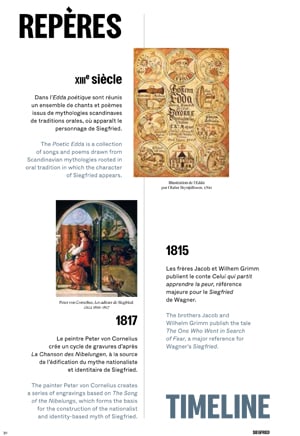
  • XIIIe siècle

    The Poetic Edda is a collection of songs and poems drawn from Scandinavian mythologies rooted in oral tradition in which the character of Siegfried appears.

    Siegfried
  • 1815

    The brothers Jacob and Wilhelm Grimm publish the tale The One Who Went in Search of Fear, a major reference for Wagner’s Siegfried.

  • 1817

    The painter Peter von Cornelius creates a series of engravings based on The Song of the Nibelungs, which forms the basis for the construction of the nationalist and identity-based myth of Siegfried.

    Siegfried
  • 1852

    Wagner completes the libretto for Siegfried, begun in May 1851. He begins composing the music in 1856.

  • 1863

    In Vienna, Wagner conducts a concert version of excerpts from the first act of Siegfried.

  • 1870

    On the morning of her thirty‑third birthday, 25 December, Cosima Wagner is awakened by musicians performing Siegfried-Idyll, a chamber piece composed of selections from the opera of the same name and a wedding gift from Richard to his new wife.

    Siegfried
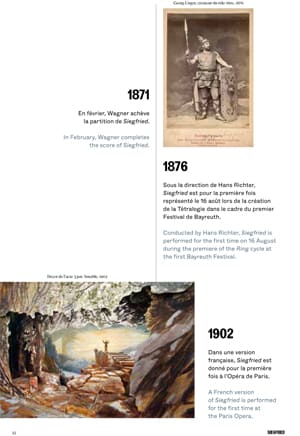
  • 1871

    In February, Wagner completes the score of Siegfried.

    Siegfried
  • 1876

    Conducted by Hans Richter, Siegfried is performed for the first time on 16 August during the premiere of the Ring cycle at the first Bayreuth Festival.

  • 1902

    A French version of Siegfried is performed for the first time at the Paris Opera.

    Siegfried
  • 1922

    Jean Giraudoux publishes the novel Siegfried et le Limousin, which debunks the idea of racial identity and extols, in a European spirit, the reconciliation of German and French cultures.

  • 1955

    Hans Knappertsbusch conducts the complete cycle of Der Ring des Nibelungen in its original language at the Paris Opera for the first time.

  • 2013


    Siegfried

Artists

Second day of the stage festival play The Ring of the Nibelung

1876

Creative team

Cast

The Paris Opera Orchestra

Siegfried will be recorded by France Musique for broadcast on February 21, 2026, at 8 p.m. on the program “Samedi à l'Opéra” presented by Judith Chaine, then available for streaming on the France Musique website and the Radio France app.

Media

PABLO HERAS-CASADO about DIE WALKÜRE & SIEGFRIED (interview)
  • Leitmotifs in the Ring #4

    Leitmotifs in the Ring #4

    Watch the video

  • About the staging of Siegfried

    About the staging of Siegfried

    Read the article

  • Les Grands Entretiens with Alexander Neef and Pablo Heras-Casado

    Les Grands Entretiens with Alexander Neef and Pablo Heras-Casado

    Watch the video

  • Toï toï toï: Die Walküre and Siegfried

    Toï toï toï: Die Walküre and Siegfried

    Watch the video

  • Richard Wagner’s Ring Cycle: The Gods

    Richard Wagner’s Ring Cycle: The Gods

    Read the article

  • Richard Wagner’s Ring Cycle: The Nibelungen and the giants

    Richard Wagner’s Ring Cycle: The Nibelungen and the giants

    Read the article

  • Richard Wagner’s Ring Cycle: The Valkyries and the Wälsung

    Richard Wagner’s Ring Cycle: The Valkyries and the Wälsung

    Read the article

  • Richard Wagner’s Ring Cycle: The Humans

    Richard Wagner’s Ring Cycle: The Humans

    Read the article

  • Leitmotifs in the Ring

    Leitmotifs in the Ring

    Watch the video

Leitmotifs in the Ring #4

Watch the video

Siegfried

3:21 min

Leitmotifs in the Ring #4

By Matthieu Pajot, Coline Delreux

Musical themes to describe a character, an object, a place or an emotion. In Wagner's work, leitmotifs have a closely related dramatic and musical role.
Octave invites you to discover four of them from the Cycle: the ring, Siegfried, Valhalla and the Ride of the Valkyries.

A Ring Odyssey - A film by Jérémie Cuvillier

At the end of November 2020, Philippe Jordan conducted The Ring of the Nibelung at the Opéra Bastille...  

© Edward Burtynsky, courtesy Flowers Gallery, London / Nicholas Metivier Gallery, Toronto

About the staging of Siegfried

Read the article

06 min

About the staging of Siegfried

By Bettina Auer

In Siegfried, the third part of The Ring of the Nibelung, the narrative definitively reconnects with the medieval heroic legend of the Nibelungenlied, Richard Wagner’s original point of departure. Siegfried has become a young man in search of his true identity, eager to set out and discover the world and, as befits a “hero,” slay a dragon, rescue a maiden, and win a precious treasure. In accordance with Wotan’s secret plan, Siegfried is the “free hero,” capable of reclaiming the ring of power on his behalf. The gods, by contrast, have had their day. Only Wotan himself still roams the world, incognito under the name of the “Wanderer.” While he no longer reveals himself as the most powerful of the powerful, he continues to behave like a “god” intent on manipulating and controlling everyone.

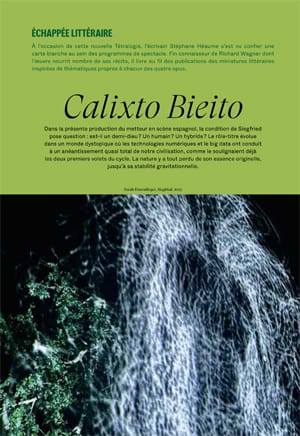
For the tetralogy of The Ring, Calixto Bieito and his team opted for a discontinuous mode of storytelling, in which past and future intertwine. The composer himself referred to this as the “visualization in the present” of “premonition” and “memory” that is, the anchoring of foreshadowing and retrospective moments within moments that are always present. Our journey to the heart of The Ring began in Das Rheingold with big data, set in the darkness of the “light” of total information and total surveillance of private life, and continued in the militarized cosmos of Die Walküre, where the digital world collapses at every level as a result of war—an apocalypse in which love nonetheless blossomed amid destruction.

“At the end of Die Walküre, the world is contaminated,” Bieito explains. “A toxic orange smoke spreads everywhere, the computer of Valhalla is blown apart, Wotan, the artist of destruction, disappears into chemical poison, and Brünnhilde is frozen in time. The poison has contaminated the forest. It has not destroyed it, but mutated it. Mutation is the direct consequence of the collapse of the system. Nature has lost its code. The forest in which Mime and Siegfried live has not been cleared, burned, or felled. It has been reprogrammed. The trees fall with their crowns downward, piercing space horizontally like lances; they emerge from the ground distorted and move as if they were the joints of a machine an organism whose most fundamental structure has been altered. This is the literal definition of a mutation. Gravity no longer works. Verticality no longer exists. Symmetry disappears. Ecological logic is broken. Nature no longer responds to itself.”

In this distorted world, Siegfried grows up in complete isolation. He knows only his adoptive father, Mime, and the strange mutant creatures that survived the apocalypse. But Mime has raised Siegfried solely so that the boy will kill Fafner, allowing Mime himself to seize the Nibelung treasure. Siegfried knows nothing of the world or the past. It is through observing nature that he has, on his own, come to understand what love and family are. He can no longer accept that Mime has until now hidden his true origin. In an adolescent questioning of himself and in rebellion against his adoptive father’s schemes, Siegfried is desperate to know: Who am I? Wagner here depicts a complex father-son relationship, characterized by mutual dependence, manipulation, love and hatred, rejection and need. “Siegfried is a kind of Kaspar Hauser,” says Calixto Bieito, “a hero, a complex being who behaves at times like an animal, at times like a human. He may even be a post-human existence, becoming truly human only at the end, through his encounter with Brünnhilde, through the discovery of love. Mime, by contrast, has survived the catastrophe like a rat and seeks only to use Siegfried for his own ends.”

From the perspective of the work’s creation, we have reached a turning point in The Ring tetralogy, because Richard Wagner interrupted the composition of his magnum opus in 1857, halfway through Siegfried, after completing the second act, and did not resume it until twelve years later. Between these two phases lie not only the poetic writing and the composition of major works that push the limits, such as Tristan and Isolde and The Mastersingers of Nuremberg, but also decisive political and personal upheavals for the composer. The reasons why Wagner interrupted Siegfried without being certain he would ever resume it have been widely debated. Were they private reasons? His affair with Mathilde Wesendonck, the wife of his important patron during his exile in Zurich, who had hosted and financially supported him for many years, and the scandal that ensued? Or philosophical influences? In 1856, reading the works of Arthur Schopenhauer plunged Wagner into a kind of existential crisis. Moreover, the chances of seeing his work performed were slim for a composer living in exile and sought by the police. In any case, Wagner did not return to The Ring until twelve years later, after finding a new benefactor: Ludwig II of Bavaria, who later even commissioned him to build his own Festival Hall in Bayreuth.

It should be noted that Wagner interrupted his composition precisely at the point in the story where the young Siegfried is on his way to finally dethrone Wotan, his corrupt grandfather, and thus bring an end once and for all to the old unjust system. Indeed, for the composer, Siegfried embodies “the spirit of man in the fullness of his supreme and immediate strength and his undeniable charm,” the long-awaited “free hero.” The fact that Siegfried discovers love and desire with Brünnhilde, and that this encounter briefly hints at the utopia of a better future, is something Wagner could compose only after completing Tristan. In his scene with Erda at the beginning of Act III, Wotan, the Wanderer, also alludes to this potential transformation for the better and, in doing so, already hints at the conclusion of Götterdämmerung:  

« Ce doux héros éveillera
l’enfant que tu m’as donnée, Brünnhilde :
en s’éveillant, ton enfant si sage
accomplira l’exploit qui sauvera le monde.
Dors tranquillement, ferme les yeux :
contemple ma fin en rêve !
Quoi qu’il advienne, le dieu s’efface avec joie
devant l’éternellement jeune ! »

Les Grands Entretiens with Alexander Neef and Pablo Heras-Casado

Watch the video

Alexander Neef, Pablo Heras-Casado

20:45 min

Les Grands Entretiens with Alexander Neef and Pablo Heras-Casado

By Isabelle Stibbe

When an artist meets the Paris Opera's General Manager or its Director of Dance, what do they discuss? In this new series entitled Les Grands Entretiens, the Paris Opera lifts the veil on the artistic line-up of new productions for the 25/26 season. The choice of guest artists, the key themes, the directors' creative intentions and the choreographic styles: these exclusive twenty-minute exchanges offer you the first keys to the works that will soon be on the bill. 

What does the Ring represent for an opera house? On the occasion of the new productions of Die Walküre and Siegfried, Paris Opera General Manager Alexander Neef discusses the unique aspects of this colossal undertaking with conductor Pablo Heras-Casado.   

Toï toï toï: Die Walküre and Siegfried

Watch the video

Meet TAMARA WILSON and STANISLAS DE BARBEYRAC

1:29:56 min

Toï toï toï: Die Walküre and Siegfried

By Octave

The Ring adventure continues with a high-profile encounter between soprano Tamara Wilson and tenor Stanislas de Barbeyrac, who perform the roles of Brünnhilde and Siegmund. This special moment devoted to Wagner offers an opportunity to discuss their connection to the composer, his monumental tetralogy, and Calixto Bieito’s new production.

For the second consecutive season, the Paris Opera is offering monthly encounters with artists to shed light on upcoming productions, just days before opening night. Titled Toï toï toï, these exclusive events held at the Amphitheatre or Studio of the Opéra Bastille give audiences a chance to discover new productions or explore the repertoire, and to engage directly with the artists at the end of each session.

© Pablo Grand Mourcel

Richard Wagner’s Ring Cycle: The Gods

Read the article

Discover the characters

05 min

Richard Wagner’s Ring Cycle: The Gods

By Marion Mirande

The characters in the Ring Cycle are primarily inspired from Medieval transcriptions of Norse and Germanic mythology, and more particularly from the 13th century German saga The Nibelungenlied (The Song of the Nibelungs). As he developed the librettos of the four operas which make up The Ring of the Nibelung, Richard Wagner brought those legends and their variations closer to his other sources of inspiration—namely Greek tragedy and Shakespearian drama—and added his own interpretations.


The Gods

© Pablo Grand Mourcel

Wagner retained seven gods from the pantheon of Norse mythology. These gods represent the highest order of beings in the universe. In Siegfried, where he appears as the Wanderer, Wotan describes his fellow deities as "light spirits who inhabit the cloudy heights ". Their mad quest for absolute power, represented by gold forged into a ring will lead them to their own destruction.

Wotan

The god of the gods—Odin or Wotan, depending on Norse or Germanic mythology—is the god of the dead, victory and knowledge. Left blind in his left eye after he sacrificed it in exchange for knowledge, he can be identified by his spear and the presence of two crows at his side—Huginn and Muninn (who respectively embody “thought” and “memory”). These attributes are replicated in the character created by Wagner. Wotan appears as the archetypal man of power: insatiable, unscrupulous and hypocritical. He is the master of Valhalla, a castle fortress perched on top of the mountains; a dazzling manifestation of his power. His power over the world is based on laws and covenants which will progressively be undermined and erased. Throughout the libretto, his authoritarianism gives way to growing insecurity. The husband of Fricka, he is also the father of the Valkyries as well as of Siegmund and Sieglinde.

Loge

Loge, the demigod of fire, is an amalgam of two mythological figures: Logi and Loki. While both embody fire, the latter also personifies cunning and trickery. In the Ring cycle, Loge retains this duality: he appears as both the god of fire and Wotan’s masterly advisor ultimately enabling Wotan to take possession of the ring. He is also one of the rare characters who is truly free. He alone will be able to distance himself from the system that Wotan has created, and he alone will resist the lure of the ring. A calculating character, Loge takes pleasure in playing with the gods and he possesses a perceptiveness that his peers lack. Throughout the Ring cycle, he forsakes his human persona to appear in his elemental form: fire.

Fricka

Fricka, the wife of Wotan and sister of Freia, Donner and Froh, is a divinity inspired by the goddess Frigg (or Frigga) from Norse mythology. In the Ring cycle she is the personification of lawfulness and fidelity. Tired of her husband’s infidelities, Fricka trys to make Wotan settle down and urges him to build Valhalla, a divine abode for them to live in. While Fricka is eager to defend the institution of marriage, she seeks above all to preserve the original values of divine society: respect for law and morality. In Die Walküre, she confronts Wotan with his own contradictions by reminding him that the guarantor of laws should not support Siegmund.  

Freyja

Freyja is a key divinity of Norse and Germanic mythology. A creature of incredible beauty, she is the goddess of love and fertility. In the Ring cycle, Freia is the sister of Fricka. In Valhalla, the gods are blessed with eternal youth thanks to her cultivation of golden apples. Coveted by Fafner and Fasolt in Das Rheingold, Freia serves as a bargaining chip for Wotan who promises her to two giants in exchange for the construction of Valhalla. Without Freia, the gods find themselves deprived of their source of eternal youth and begin to waste away.

Donner

The personification of Strength and power, Thor (also known as Donner) is one of the most popular gods in Germanic mythology. His hallmark is his hammer which is the source of thunder and lightning. Present only in Das Rheingold, Donner nevertheless occupies a strategic place among the other characters. He embodies the figure of a military leader who thinks in warlike terms to counter the threat posed by Alberich. His hammer, evocative of violence, is a symbolic counterforce to the inherent lawfulness represented by Wotan's spear.  

Froh

Along with Odin and Thor, Freyr is one of the three major gods in Germanic mythology. The personification of fertility he is also the brother of Freyja. Known as Froh in the Ring cycle, he only appears in Das Rheingold. His perseverance in defending Freia and the words he has for her reflects the closeness of the two characters. 

Erda

Inspired by the goddesses Jördh and Gaia from Nordic and Greek mythology, Erda is the maternal god of the Earth. She is the personification of ancestral, intuitive and prophetic wisdom. A veritable Pythia, she can simultaneously see the past, the present and the future. As the mother of the Norns who spin the threads of fate, she holds universal knowledge. In Das Rheingold, she arouses doubt and anxiety in Wotan by warning him that his thirst for power risks provoking his own demise. By begetting Brünnhilde with the latter, she gives life to the woman who will save the universe. In Siegfried, Wotan, in the guise of the Wanderer, calls on Erda one last time in a scene that seals their antagonisms.    

© Pablo Grand Mourcel

Richard Wagner’s Ring Cycle: The Nibelungen and the giants

Read the article

Discover the characters

04 min

Richard Wagner’s Ring Cycle: The Nibelungen and the giants

By Marion Mirande

The characters in the Ring Cycle are primarily inspired from Medieval transcriptions of Norse and Germanic mythology, and more particularly from the 13th century German saga The Nibelungenlied (The Song of the Nibelungs). As he developed the librettos of the four operas which make up The Ring of the Nibelung, Richard Wagner brought those legends and their variations closer to his other sources of inspiration—namely Greek tragedy and Shakespearian drama—and added his own interpretations.


The Nibelungen

© Pablo Grand Mourcel

In Norse mythology, the albes are a race apart from men, gods and giants. They are divided into two distinct species, the quasi-angelic albes of light, and the quasi-demonic black albes. In Germanic legend, the were called the Nibelungen, a name that means “those from the world below”. These denizens of the Nibelheim or underworld work as craftsmen or blacksmiths and possess great wealth. In the Ring cycle, the Nibelungen are portrayed as jealous, cunning, ambitious creatures, fundamentally hostile to the gods. 

Alberich

In the Ring cycle, Alberich is the one through whom misfortune manifests itself. He is dubbed the “black albe”. He dreams of conquering the world, renouncing love and cursing the one who gains possession of the ring which he forged. Associated with the gold he stole in Das Rheingold, Alberich’s power is utterly lawless and built on theft. 

Mime

Mime is Alberich’s brother and Siegfried’s adoptive father. In the Ring cycle, he represents permanent failure. Aware of the powers of the sword Nothung, and recognising the fact that only he who forged it will be capable of seizing the ring and the Tarnhelm which are held by the giant Fafner, he seeks in vain to restore it to its original form. Siegfried manages to reforge his father’s sword and recover the treasure, but he knows he is threatened with death by Mime. However, the latter is ultimately killed by the hero. 

Hagen

Hagen is one of the principal heroes of The Song of The Nibelungen. Motivated by moral values, this Medieval character becomes a manipulator and a cynic under Wagner. The son of Alberich and half-brother to Gunther and Gutrune, he represents in his father’s eyes the primary means of recovering the lost ring. His Machiavellian nature allows him to gain the upper hand over the other characters in Götterdämmerung. He manipulates Gunther and Gutrune and tricks Siegfried in order to kill him.

The giants

© Pablo Grand Mourcel

In Norse mythology, the giants are the ones who created the world and are frequently at war with the gods. To a large extent, they represent the forces of chaos. Using magic, cunning and physical force, they try to change the order of the universe. In medieval literature, they assumed the disposition of ugly and stupid characters often driven by bad intentions, as is the case in the Ring cycle.

Fasolt

Regarding the two giants in the cycle, Fasolt comes across as “the most docile”. In Das Rheingold, unlike his brother Fafner, Fasolt does not look upon Freia as a bargaining chip to seize control of Valhalla. He sincerely loves her. The motives of the two brothers are different: Fafner has political aims whereas Fasolt has a far more discreet temperament. Through their relationship, the conflict between love and power assumes all its significance.

Fafner

Of the two giants, Fafner stands out as “the malicious one”. Ever hungry for wealth, he is the first to react when he learns of the theft of the gold and the power of the ring. In his attempts to obtain the latter, he does not hesitate to murder his brother. In Siegfried, with the help of the Tarnhelm, the magic helmet, he morphs into a dragon and spends his days sleeping on his gold. He will ultimately be slain in his cave by Siegfried.

© Pablo Grand Mourcel

Richard Wagner’s Ring Cycle: The Valkyries and the Wälsung

Read the article

Discover the characters

04 min

Richard Wagner’s Ring Cycle: The Valkyries and the Wälsung

By Marion Mirande

The characters in the Ring Cycle are primarily inspired from Medieval transcriptions of Norse and Germanic mythology, and more particularly from the 13th century German saga The Nibelungenlied (The Song of the Nibelungs). As he developed the librettos of the four operas which make up The Ring of the Nibelung, Richard Wagner brought those legends and their variations closer to his other sources of inspiration—namely Greek tragedy and Shakespearian drama—and added his own interpretations.


The Valkyries

© Pablo Grand Mourcel

In Norse mythology, the Valkyries are virgin warriors charged with the mission of selecting the most courageous warriors fallen on the battlefield and leading them into Valhalla. In the Ring cycle, there are nine of them: Brünnhilde, Grimgerde, Gerhilde, Helmwige, Ortlinde, Rossweisse, Schwertleite, Siegrune, and Waltraute. Presented as the daughters of Wotan and of different conquests, they appear together for the first time in Act III of Die Walküre. Only two of them have major roles: Waltraute and Brünnhilde, both of whom were the love children of Wotan and Erda.

Brünnhilde

In Germanic literature, Brynhildr is portrayed as a Valkyrie who an adept of magic and the art of healing. In the Ring cycle, Brünnhilde appears as Wotan’s favourite even though she has rebelled against her father. Wagner made Brünnhilde the only character who connects the three days of the Ring. Her psychological and spiritual development progresses in three stages: her realisation of the greatness of love in Die Walküre, her emotional growth from experiencing love in Siegfried, and her rise to tragic greatness through renunciation in Götterdämmerung.

Waltraute

Waltraute is arguably the closest to Brünnhilde. She flouts Wotan’s interdictions to go and find her sister on her rock. In Götterdämmerung, concerned by Valhalla’s decline, she tries to convince Brünnhilde to part with the accursed ring and return it to the Rhinemaidens. In her mind, it is the only way to re-establish the course of things and save the gods.

The Wälsungen

© Pablo Grand Mourcel

Children of the "wolf" in Norse and Germanic mythology—one of Wotan’s reincarnations originally known as Wälse—they are the descendants of a mortal woman and Wotan. These creatures have an instinctive sense of freedom and for Wotan they represent a means to win back the ring. 

Siegmund

Siegmund is the earthly son of Wotan and the twin brother of Sieglinde. His incestuous relationship with Sieglinde gives rise to the line of the Wälsung. He is the father of Siegfried and he possesses the sword Nothung. He was sired by Wotan to fulfil the task of retrieving the ring. Courageous and of rare nobility, he has inherited the positive qualities of his father without any of his faults, and places love before self-interest. The intrinsic heroism of the character is revealed when he refuses to abandon Sieglinde and to enter Valhalla, preferring to die with her.

Sieglinde

Sieglinde is Siegmund’s twin sister. Abandoned as a child, she was forced to marry Hunding. In Die Walküre, Sieglinde possesses the valour of the heroes of mythical times. Despite her distress following the death of Siegmund, she gives birth to Siegfried with the assistance of Brünnhilde. Through the Valkyrie, Sieglinde realises that the salvation of the world depends on her maternity.

Siegfried

The son of Siegmund and Sieglinde, and the grandson of Wotan, Siegfried is one of the most significant characters in the Ring cycle. The embodiment of the quintessential hero, he symbolises hope. Wotan counts on him to retrieve the ring. More unsophisticated than cerebral, he acts on instinct. He has no conception of fear which enables him to confront Fafner and pass through the circle of fire on the rock on which Brünnhilde is imprisoned. Siegfried is also the archetypal Wagnerian character in search of his roots.

© Pablo Grand Mourcel

Richard Wagner’s Ring Cycle: The Humans

Read the article

Discover the characters

02 min

Richard Wagner’s Ring Cycle: The Humans

By Marion Mirande

The characters in the Ring Cycle are primarily inspired from Medieval transcriptions of Norse and Germanic mythology, and more particularly from the 13th century German saga The Nibelungenlied (The Song of the Nibelungs). As he developed the librettos of the four operas which make up The Ring of the Nibelung, Richard Wagner brought those legends and their variations closer to his other sources of inspiration—namely Greek tragedy and Shakespearian drama—and added his own interpretations.

The Humans

© Pablo Grand Mourcel

The Gibichungen are a family of humans who reign over the Rhine under a monarchic system.

Gunther

Gunther, the half-brother of Hagen, reigns over his people, the Gibichungen. However, all the major decisions are really determined by his half-brother. A man of weak character, he is depicted as a puppet manipulated by Hagen. Blinded by his faith in the latter, he has no qualms about following his advice. As such, he allows his wife Brünnhilde to be seduced by Siegfried and then takes credit for the exploit. Gunther is often regarded as one of Wagner’s weakest characters.

Gutrune

Gutrune is the victim of a deal struck between Hagen, Gunther and Siegfried. Offered to Siegfried by Hagen in Götterdämmerung in exchange for Gunther’s conquest of Brünnhilde, Gutrune falls in love with the hero. However, she will never be able to experience the joys of a genuine loving relationship. Manipulated by Hagen, she gives Siegfried the potion of forgetfulness and, distraught by her act, she flees. Like the other female characters in the Ring, she is intuitive and, in Act III of Götterdämmerung she senses that a dire event has come to pass.

Hunding

Hunding is the only human in the Ring cycle who does not belong to the Gibichungen family. A brutal hunter, he is a symbol of machismo. Hunding is Sieglinde’s husband but Sieglinde hates him, so he repays her by enslaving her and abusing her. He looks on power in a boorish way: his land, his spoils and his wife. He is dependent on his clan and its customs and has no true personal values or sentiments. In Die Walküre, by receiving Siegmund into his home, he is merely conforming to the laws of hospitality and the code of honour.

Leitmotifs in the Ring

Watch the video

The Ring

3:18 min

Leitmotifs in the Ring

By Matthieu Pajot, Coline Delreux

Musical themes to describe a character, an object, a place or an emotion. In Wagner's work, leitmotifs have a closely related dramatic and musical role.

Octave invites you to discover four of them from the Cycle: the ring, Siegfried, Valhalla and The Ride of the Valkyries. 

A Ring Odyssey - A film by Jérémie Cuvillier

At the end of November 2020, Philippe Jordan conducted The Ring of the Nibelung at the Opéra Bastille...  

Press

  • Andreas Schager, the most phenomenal of his generation – and the most phenomenal heard in ages.

    Diapason, 2026
  • The audience roars with thunderous applause for the vocal ensemble.

    Olyrix, 2026
  • Andreas Schager is undoubtedly one of the finest performers of the role of Siegfried today, embodying the character's bravery, brilliance, insolent projection, and impulsive nature.

    Forum opéra, 2026
  • The cast brings together great voices well versed in Wagnerian repertoire.

    Première loge, 2026
  • Gerhard Siegel is an impeccable Mime with impressive vocal strength.

    Première loge, 2026
  • [Andreas Schager] exudes incredible energy and flawless vocal power throughout the three acts, with clear and precise projection.

    Première loge, 2026
  • Conducting the Paris Opera Orchestra, Pablo Heras-Casado confirms his status as a world-class conductor.

    Francenetinfos, 2026

Access and services

Opéra Bastille

Place de la Bastille

75012 Paris

Public transport

Underground Bastille (lignes 1, 5 et 8), Gare de Lyon (RER)

Bus 29, 69, 76, 86, 87, 91, N01, N02, N11, N16

Calculate my route
Car park

Parking Indigo Opéra Bastille 1 avenue Daumesnil 75012 Paris

Book your spot at a reduced price
super alt text
super alt text
super alt text
super alt text
super alt text
super alt text

While Alberich’s curse has been at work since Das Rheingold, Siegfried embodies the hope of salvation for the world. Raised in the forest by the vile Nibelung Mime, Alberich’s brother, his innocence proves to be his greatest strength. Siegfried’s intuitive form of knowledge shapes the hero he becomes, enabling him to grasp and access the most mysterious meanings of things – and of Nature in particular.

BUY THE PROGRAM
  • Cloakrooms

    Free cloakrooms are at your disposal. The comprehensive list of prohibited items is available here.

  • Bars

    Reservation of drinks and light refreshments for the intervals is possible online up to 24 hours prior to your visit, or at the bars before each performance.

In both our venues, discounted tickets are sold at the box offices from 30 minutes before the show:

  • €35 tickets for under-28s, unemployed people (with documentary proof less than 3 months old) and senior citizens over 65 with non-taxable income (proof of tax exemption for the current year required)
  • €70 tickets for senior citizens over 65

Get samples of the operas and ballets at the Paris Opera gift shops: programmes, books, recordings, and also stationery, jewellery, shirts, homeware and honey from Paris Opera.

Opéra Bastille
  • Open 1h before performances and until performances end
  • Get in from within the theatre’s public areas
  • For more information: +33 1 40 01 17 82

Opéra Bastille

Place de la Bastille

75012 Paris

Public transport

Underground Bastille (lignes 1, 5 et 8), Gare de Lyon (RER)

Bus 29, 69, 76, 86, 87, 91, N01, N02, N11, N16

Calculate my route
Car park

Parking Indigo Opéra Bastille 1 avenue Daumesnil 75012 Paris

Book your spot at a reduced price
super alt text
super alt text
super alt text
super alt text
super alt text
super alt text

While Alberich’s curse has been at work since Das Rheingold, Siegfried embodies the hope of salvation for the world. Raised in the forest by the vile Nibelung Mime, Alberich’s brother, his innocence proves to be his greatest strength. Siegfried’s intuitive form of knowledge shapes the hero he becomes, enabling him to grasp and access the most mysterious meanings of things – and of Nature in particular.

BUY THE PROGRAM
  • Cloakrooms

    Free cloakrooms are at your disposal. The comprehensive list of prohibited items is available here.

  • Bars

    Reservation of drinks and light refreshments for the intervals is possible online up to 24 hours prior to your visit, or at the bars before each performance.

In both our venues, discounted tickets are sold at the box offices from 30 minutes before the show:

  • €35 tickets for under-28s, unemployed people (with documentary proof less than 3 months old) and senior citizens over 65 with non-taxable income (proof of tax exemption for the current year required)
  • €70 tickets for senior citizens over 65

Get samples of the operas and ballets at the Paris Opera gift shops: programmes, books, recordings, and also stationery, jewellery, shirts, homeware and honey from Paris Opera.

Opéra Bastille
  • Open 1h before performances and until performances end
  • Get in from within the theatre’s public areas
  • For more information: +33 1 40 01 17 82

Discover opera and ballet in another way

QR code

Dive into the Opera world and get insights on opera and pop culture or ballet and cinema. Scan this code to access all the quiz and blindtests on your mobile.

opera logo

3 min

Siegfried

5 questions about: Siegfried by Wagner

Want to know more? Click on the + at the end of our session. It’s that simple!

Discover

Partners

  • Grande Mécène de la saison

  • With the exceptional support of Bertrand and Nathalie Ferrier, Élisabeth and Bertrand Meunier

Media and technical partners

Immerse in the Paris Opera universe

Sign up for our newsletter

Our latest news

* Required fields

By clicking on "submit", you agree to receive electronic communications from the Opéra national de Paris and to the processing of your data.
Learn more about managing your data and your rights.

Back to top