My special offers

Prices

    0
    300
    0€
    300€

Show / Event

Venue

Experience

Calendar

  • Between   and 

Prices

Emilie Brouchon / OnP

Emilie Brouchon / OnP

Opera

Un ballo in maschera

Giuseppe Verdi

Opéra Bastille

from 27 January to 26 February 2026

from €53 to €200

3h00 with 1 interval

Synopsis

Listen to the synopsis

0:00 / 0:00

A masked ball may seem like the ultimate party venue, but its disguises and masks can also foster intrigue.

Verdi's opera was inspired by a true historical event: the assassination of King Gustav III of Sweden at a costume ball in 1792. But before setting this event to music, Verdi had to contend with the censors, scandalised by the idea of representing a regicide on stage.

His Masked Ball is therefore set in America and focuses on the impossible love between Riccardo, the governor of Boston, and Amelia, the wife of his best friend, who takes his revenge by killing him.

Blending frivolity and gravity, Verdi's music enjoyed huge success from its Rome premiere in 1859. Director Gilbert Deflo retains the American setting but moves it to the time of Lincoln, all the better to confront the world of reason and morality with that of intuition and belief.

Duration : 3h00 with 1 interval

Language : Italian

Surtitle : French / English

  • Opening

  • First part 95 min

  • Intermission 30 min

  • Second part 55 min

  • End

Show acts and characters

CHARACTERS

Riccardo: Count of Warwick, governor of Boston
Renato: Secretary and friend of Riccardo, Amelia’s husband
Amelia: Renato’s wife, secretly in love with Riccardo
Ulrica: A soothsayer
Oscar: Riccardo’s page
Samuel and Tom: Two conspirators, Riccardo’s enemies
Silvano: A sailor in the governor’s service

Act 1:
In Governor Riccardo Warwick’s council chamber, the people’s representatives prepare to petition him. Some sing his praises, others, led by the conspirators Tom and Samuel, dwell on their grievances against him. Oscar the page hands Riccardo the guest list for the next masked ball. Riccardo is disturbed to discover the name of Amelia, the wife of his friend and advisor, Renato. The latter arrives and informs Riccardo of the existence of a plot against him. Riccardo, however, refuses to hear the names of the conspirators: he believes that the love of his people will protect him. The Chief Judge demands exile for the witch Ulrica whom he believes guilty of commerce with Satan. Oscar takes up her defence and an intrigued Riccardo decides to see for himself. Despite Renato’s appeal for caution, he sets off to visit Ulrica, inviting all present to accompany him. Ulrica is invoking the Prince of Darkness when Riccardo, disguised as a fisherman, enters. For Silvano, a sailor, she predicts wealth and success. Riccardo discreetly slips an officer’s certificate into the young man’s pocket. The latter sings Ulrica’s praises with the people. Amelia’s servant requests a secret consultation for his mistress. Everyone leaves except for Riccardo who conceals himself. Amelia asks the prophetess to help her eradicate the guilty love in her heart. Ulrica advises Amelia to gather a herb that only grows at the foot of the gallows. Riccardo swears to follow her to the bleak location. Oscar and his companions enter. Riccardo slips amongst them and asks Ulrica to tell him his future. She refuses to reply. On Riccardo’s insistence, she finally tells him that he is soon to die: murdered by the first person to shake his hand. Riccardo extends his hand to everyone around him but all shrink away. Renato arrives and grasps Riccardo’s hand. Riccardo scoffs at the prediction: how could his best friend wish him any harm?

Act 2:
At midnight, Amelia arrives at the place indicated by Ulrica. As she begs heaven’s help, Riccardo arrives and reveals his love. In her torment, Amelia declares her mutual love. However their duet is interrupted by the arrival of Renato who has come to warn Riccardo that the conspirators will attempt to kill him that very night. Amelia has just the time to hide behind her veil. Renato urges his friend to flee. The latter makes him promise to escort his veiled companion to the city gates without looking at her. Renato promises but the conspirators’ arrival prevents him from keeping his pledge. The conspirators demand to see the face of the veiled lady accompanying the governor. Renato is appalled to discover his wife. Angered as much by his friend’s betrayal and his wife’s infidelity as by the conspirators’ taunts, he summons Samuel and Tom to his home the following day.

Act 3
Renato wants to kill Amelia to avenge his dishonour. She begs Renato to allow her to kiss her son one last time. Renato relents and Amelia leaves. Remaining alone, Renato expresses his fury against Riccardo. Samuel and Tom arrive. Each demands the right to kill Riccardo. Renato suggests they draw lots. Amelia, who comes to announce Oscar’s arrival, is forced to draw the ticket naming the killer: it is to be Renato. Oscar invites Renato and his wife to the masked ball that very evening. Amelia searches for a way to warn Riccardo without betraying her husband. Riccardo writes an edict sending Renato and Amelia abroad. It is the only way he can renounce the young woman. Oscar hands him a note brought by a masked woman. The message warns him of imminent danger. Riccardo, refusing to be taken for a coward, prepares for the ball. At the ball Renato recognizes Oscar behind his mask and tries to discover Riccardo’s whereabouts, claiming he has important revelations for the governor. Oscar describes Riccardo’s costume. A masked Amelia approaches Riccardo and urges him to flee. Riccardo tells her of his decision to send her away and they bid each other a final farewell. Renato appears and stabs him. The horrified crowd tries to seize the assassin but the dying Riccardo orders that Renato be left in freedom. Before dying, he forgives his assassin.

Show chronology

Timeline

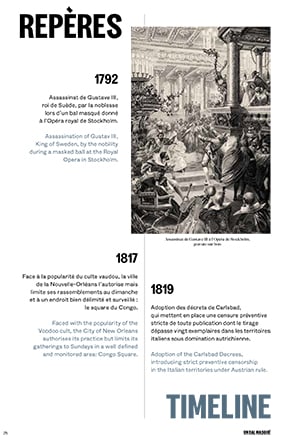
  • 1792

    Assassination of Gustav III, King of Sweden, by the nobility during a masked ball at the Royal Opera in Stockholm.

    Un ballo in maschera
  • 1817

    Faced with the growing popularity of the Voodoo cult, the City of New Orleans authorises its practise but limits its gatherings to Sundays in a well‑defined and monitored area: Congo Square.

  • 1833

    Daniel-François-Esprit Auber’s five-act opera Gustave III also known as Le bal masqué has its premiere at the Paris Opera, to a libretto by Eugène Scribe.

    Un ballo in maschera
  • 1858

    Felice Orsini, a proponent of Italian unification, tries to assassinate Napoléon III in front of the Paris Opera in the rue Peletier

    Un ballo in maschera
  • 1859

    Giuseppe Verdi’s Un ballo in maschera has its world premiere on February 17 at the Apollo Theatre in Rome.

  • 1860

    Abraham Lincoln is elected the sixteenth President of the United States.

  • 1861

    Parisian première of Giuseppe Verdi’s Un ballo in maschera at the Théâtre-Italien.

    Un ballo in maschera
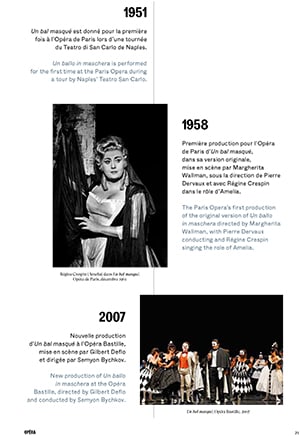
  • 1951

    Un ballo in maschera is performed for the first time at the Paris Opera during a tour by Naples’ Teatro San Carlo.

  • 1958

    The Paris Opera’s first production of the original version of Un ballo in maschera directed by Margherita Wallman, with Pierre Dervaux conducting and Régine Crespin singing the role of Amelia.

    Un ballo in maschera
  • 2007

    A new production of Un ballo in maschera at the Opéra Bastille, directed by Gilbert Deflo and conducted by Semyon Bychkov.

    Un ballo in maschera

Artists

Melodramma in three acts (1859)

After Eugène Scribe, Gustave III ou le Bal masqué

Creative team

Cast

The Paris Opera Orchestra and Chorus
A recording of Un ballo in maschera will be made on 5 and 8 February 2026, produced by the Opéra national de Paris with the support of the Orange Foundation, sponsor of the Paris Opera's audiovisual broadcasts. Information & reservations

The opera will be available for streaming at a later date on Paris Opera Play, the Paris Opera's streaming website.

Media

UN BALLO IN MASCHERA by Giuseppe Verdi - TRAILER (english version)
  • About the staging of "Un ballo in maschera"

    About the staging of "Un ballo in maschera"

    Read the article

  • Draw me A masked ball

    Draw me A masked ball

    Watch the video

© Emilie Brouchon / OnP

About the staging of "Un ballo in maschera"

Read the article

05 min

About the staging of "Un ballo in maschera"

By Gilbert Deflo

Even though we know that Verdi had to endure the ordeal of censorship, I consider his final version where the action no longer concerns King Gustav III of Sweden but the Governor of Boston to be the most coherent. Moreover, Verdi was not seeking deep psychological analysis in this work: at this point in his life, unlike what motivated him in Simon Boccanegra, he aimed to portray powerful emotions rather than to address political despair.

Here, the enlightened ruler embodies the symbol of buon governo, good governance, which from Act I onward in the governor’s audience chamber reveals his unwavering benevolence, despite the bass voices that, as in any nineteenth-century melodrama, represent traitors and conspirators. We also see the appearance of Oscar, the innocent face of fate, the messenger through whom good news arrives news that will ultimately prove fatal. The existence of Ulrica is likewise mentioned in this first act, so that traitors are shown to coexist within a world presented as harmonious.

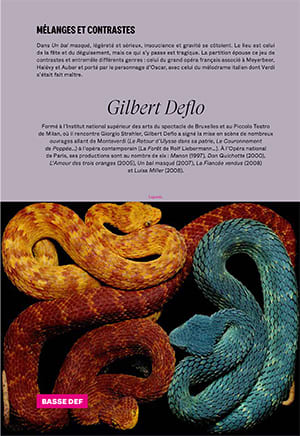
Often in Verdi’s works, such characters are entrusted with embodying society’s outcasts. Ulrica belongs to that realm of intuition we have repressed, and in my staging this world is represented by a chorus of women, priestesses of a cult whose symbol is the serpent. Within this universe, it seemed interesting to me to portray Ulrica as a priestess of the voodoo cult.

The theme of the magical plant that grants forgetfulness the plant Ulrica invites Amelia to pick can already be found in Shakespeare, and this power of plants is also familiar in the Western tradition, with the myth of the mandrake, believed to spring from the final spasm of the hanged… When the governor, Riccardo, decides almost as a bravado to consult Ulrica, we clearly perceive the difficulty of this role: on the one hand, he is a “positivist,” as one would have said in Verdi’s time, yet within him there is also a taste for entertainment, and within the same character a blend of the comic and the tragic, as was already the case with the Duke of Mantua in Rigoletto: a frivolity mixed with gravity that Verdi delights in exploring.

The composer plays with this duality just as he plays with the irrational, in much the same way that today we mock horoscopes in magazines. Nevertheless, in her “off-kilter” vision as a marginal figure, Ulrica has sensed the presence of the conspirators… A single, pared-down set represents the audience chamber. I do not claim that this governor, Riccardo Warwick, is meant to resemble President Lincoln, but the set should evoke a spiritual elevation, of which the eagle is the symbol pride included. In this sense, it is a political set, though not a small drawing room where one waits for dispatches. I wanted it to be something larger and more lyrical.

As for its opposite side, there are no longer architectural elements, nor a glossy black floor, but rather the earth, a realm where the serpent having taken the place of the eagle is the totem, the symbol of a dark psyche: Ulrica’s domain, which the characters of the first tableau visit for entertainment. The eagle represents reason and power. The serpent represents the power of the night, darkness, and also the feminine, the chthonic. These are symbolic beliefs that have been obscured in our culture by historical pressures, yet have not disappeared. The true subject of this work is impossible love the deepest despair in love, stemming from the fact that, as in Tristan and Isolde with King Marke, the rival is one’s closest friend, and such a friendship cannot tolerate betrayal.

Thus, when the governor is stabbed during the ball, everyone becomes aware of this contrast: the utmost outward display of social life confronted with the most intimate realms of love and friendship. The result is that three lives are destroyed in the end. The darkness of tragedy prevails the hidden side, the black eagle. One curious detail appears in the cast list concerning Renato, who is described as “Creole.” Creole, that is to say, born in the United States. It is also specified that Creoles are present at the ball. Did the librettist have mixed-race characters in mind? What remains, in any case, is that through his intransigence toward his wife—bordering on sadism and through his jealousy, which is not without recalling Otello, Renato directly reflects a psychology characteristic of the nineteenth century.

In depicting this passion, it is as though Verdi were searching for a new form, even abandoning a grand entrance aria for Amelia, as if the very idea of the prima donna had already become obsolete in his eyes. One senses here that Verdi is moving toward his great works: Don Carlo, Otello, Falstaff… The great lyrical moments of Act II are supremely beautiful, when the music becomes most absolute an outpouring of lyrical emotion. As with Mozart, one ends up wondering whether one prefers the recitatives or the arias. But I never choose between the expression of feeling and what drives the action forward. To my mind, every cubic meter of the stage must be filled with drama and music. Such is the lesson of my old master, Strehler.

© Pauline Andrieu

Draw me A masked ball

Watch the video

with Hop'éra!

1:25 min

Draw me A masked ball

By Pauline Andrieu

Press

  • A beautiful set evoking Washington and voodoo culture.

    Resmusica
  • Gilbert Deflo’s staging gives full rein to the power of the music.

    Toute la Culture

Access and services

Opéra Bastille

Place de la Bastille

75012 Paris

Public transport

Underground Bastille (lignes 1, 5 et 8), Gare de Lyon (RER)

Bus 29, 69, 76, 86, 87, 91, N01, N02, N11, N16

Calculate my route
Car park

Parking Indigo Opéra Bastille 1 avenue Daumesnil 75012 Paris

Book your spot at a reduced price
super alt text
super alt text
super alt text
super alt text
super alt text
super alt text

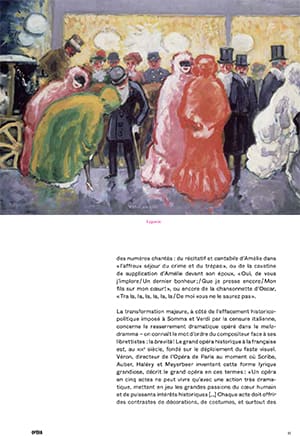
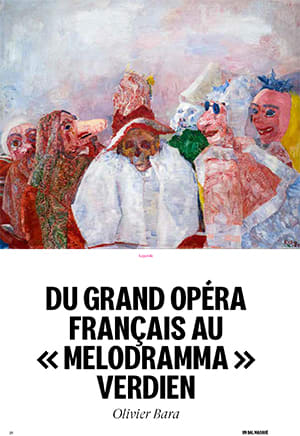
In a masked ball, lightness and seriousness, insouciance and gravity rub shoulders. The place is one of celebration and disguise, but what happens there is tragic. The score embraces this play of contrasts, interweaving different genres: that of French grand opera associated with Meyerbeer, Halévy and Auber, and carried by the character of oscar, with that of Italian melodrama, of which Verdi was a master.

BUY THE PROGRAM
  • Cloakrooms

    Free cloakrooms are at your disposal. The comprehensive list of prohibited items is available here.

  • Bars

    Reservation of drinks and light refreshments for the intervals is possible online up to 24 hours prior to your visit, or at the bars before each performance.

In both our venues, discounted tickets are sold at the box offices from 30 minutes before the show:

  • €35 tickets for under-28s, unemployed people (with documentary proof less than 3 months old) and senior citizens over 65 with non-taxable income (proof of tax exemption for the current year required)
  • €70 tickets for senior citizens over 65

Get samples of the operas and ballets at the Paris Opera gift shops: programmes, books, recordings, and also stationery, jewellery, shirts, homeware and honey from Paris Opera.

Opéra Bastille
  • Open 1h before performances and until performances end
  • Get in from within the theatre’s public areas
  • For more information: +33 1 40 01 17 82

Opéra Bastille

Place de la Bastille

75012 Paris

Public transport

Underground Bastille (lignes 1, 5 et 8), Gare de Lyon (RER)

Bus 29, 69, 76, 86, 87, 91, N01, N02, N11, N16

Calculate my route
Car park

Parking Indigo Opéra Bastille 1 avenue Daumesnil 75012 Paris

Book your spot at a reduced price
super alt text
super alt text
super alt text
super alt text
super alt text
super alt text

In a masked ball, lightness and seriousness, insouciance and gravity rub shoulders. The place is one of celebration and disguise, but what happens there is tragic. The score embraces this play of contrasts, interweaving different genres: that of French grand opera associated with Meyerbeer, Halévy and Auber, and carried by the character of oscar, with that of Italian melodrama, of which Verdi was a master.

BUY THE PROGRAM
  • Cloakrooms

    Free cloakrooms are at your disposal. The comprehensive list of prohibited items is available here.

  • Bars

    Reservation of drinks and light refreshments for the intervals is possible online up to 24 hours prior to your visit, or at the bars before each performance.

In both our venues, discounted tickets are sold at the box offices from 30 minutes before the show:

  • €35 tickets for under-28s, unemployed people (with documentary proof less than 3 months old) and senior citizens over 65 with non-taxable income (proof of tax exemption for the current year required)
  • €70 tickets for senior citizens over 65

Get samples of the operas and ballets at the Paris Opera gift shops: programmes, books, recordings, and also stationery, jewellery, shirts, homeware and honey from Paris Opera.

Opéra Bastille
  • Open 1h before performances and until performances end
  • Get in from within the theatre’s public areas
  • For more information: +33 1 40 01 17 82

Media and technical partners

Immerse in the Paris Opera universe

Sign up for our newsletter

Our latest news

* Required fields

By clicking on "submit", you agree to receive electronic communications from the Opéra national de Paris and to the processing of your data.
Learn more about managing your data and your rights.

Back to top