My special offers

Prices

    0
    300
    0€
    300€

Show / Event

Venue

Experience

Calendar

  • Between   and 

Prices

Elisa Haberer / OnP

Elisa Haberer / OnP

Opera

Nixon in China

John Adams

Opéra Bastille

from 24 February to 20 March 2026

from €37 to €175

3h10 with 1 interval

Synopsis

Listen to the synopsis

0:00 / 0:00

In 1972, Richard Nixon visited Mao Zedong in China, marking the beginning of a rapprochement between the United States and China against the backdrop of the Cold War. Fifteen years later, American composer John Adams chose this episode as the subject of his first opera, a score marked by its rhythmic pulse, shimmering colours and intense lyricism.

The work entered the Paris Opera repertoire in 2023 in a production directed by Valentina Carrasco, who eschews realism in favour of the poetry of allegory and the magical, not without a touch of humour.

The common thread running through her dramaturgy is the metaphor of “ping‑pong diplomacy” – a reference to the first diplomatic overture through sport between China and the United States in 1971 – which combines with the metaphor of illusion to deliver spectacular images and a keen reflection on history and the vanity of power.  

Duration : 3h10 with 1 interval

Language : English

Surtitle : French / English

Show acts and characters

CHARACTERS

Richard Nixon: President of the United States
Mao Tse-tung: Chairman of the Chinese Communist Party
Pat Nixon: First Lady of the United States
Chiang Ch’ing: Mao’s wife
Henry Kissinger: US National Security Advisor
Chou En-lai: Chinese Prime Minister    

First part

Act 1
Scene one – The airport outside Peking
It is a cold, clear, dry morning: Monday, February 21, 1972. Contingents of army, navy and air force circle the field and sing “The Three Main Rules of Discipline” and “The Eight Points of Attention.” Premier Chou En-lai, accompanied by a small group of officials, strolls onto the runway just as The Spirit of ‘76 taxis into view. President Nixon disembarks. They shakehands and the President sings of his excitement and his fears.

Scene two – Chairman Mao’s study
An hour later he is meeting with Chairman Mao. Mao’s conversational armory contains philosophical apothegms, unexpected political observations and gnomic jokes, and everything he sings is amplified by his secretaries and the Premier. It is not easy for a Westerner to hold his own in such a dialogue.

Scene three – The Great Hall of the People
After the audience with Mao, everyone at the first evening’s banquet is euphoric. The President and Mrs. Nixon manage to exchange a few words before Premier Chou rises to make the first of the evening’s toasts, a tribute to patriotic fraternity. The President replies, toasting the Chinese people and the hope of peace. The toasts continue, with less formality, as the night goes on.

Second part

Act 2
Scene one – Mrs. Nixon views China
Snow has fallen during the night. In the morning Mrs. Nixon is ushered onstage by her party of guides and journalists. She explains a little of what it feels like for a woman like her to be First Lady and accepts a glass elephant from the workers at the Peking Glass Factory. She visits the Evergreen People’s Commune and the Summer Palace, where she pauses in the Gate of Longevity and Goodwill to sing, “This is prophetic!” Then, on to the Ming Tombs before sunset.

Scene two – An evening at the Peking
Opera In the evening, the Nixons attend a performance of The Red Detachment of Women, a revolutionary ballet devised by Mao’s wife, Chiang Ch’ing. The ballet entwines ideological rectitude with Hollywood-style emotion. The Nixons respond to the latter; they are drawn to the downtrodden peasant girl – in fact, they are drawn into the action on the side of simple virtue. This was not precisely what Chiang Ch’ing had in mind. She sings “I am the wife of Mao Tse-tung,” ending with full choral backing.

Act 3
The last evening in Peking. The pomp and public displays of the presidential visit are over, and the main players all return to the solitude of their bedrooms. The talk turns to memories of the past. Mao and his wife dance, and the Nixons recall the early days of their marriage during the Second World War, when he was stationed as a naval commander in the Pacific. Chou En-lai concludes the opera with the questionof whether anything they did was good.

Show chronology

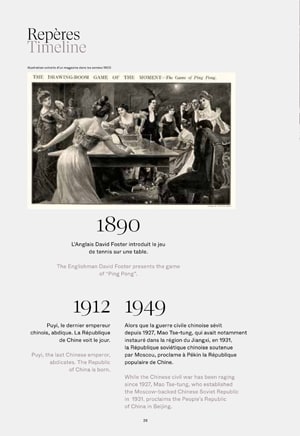
Timeline

  • 1890

    The Englishman David Foster presents the game of “Ping Pong”.

  • 1912

    Puyi, the last Chinese emperor, abdicates. The Republic of China is born.

  • 1949

    While the Chinese civil war has been raging since 1927, Mao Tse-tung, who established the Moscow-backed Chinese Soviet Republic in 1931, proclaims the People’s Republic of China in Beijing.

  • 1959

    Richard Nixon, Republican Vice-President of the United States, meets Nikita Khrushchev, the First Secretary of the Soviet Union’s Communist Party, in Moscow. The trip heralds a diplomatic détente between the East and West that is still in its teething stages.

  • 1968

    Nixon is elected President of the United States. Re-elected in 1972, he will resign in 1974.

  • 1971

    The World Table Tennis Championships are held in Nagoya, Japan. They mark the fortuitous meeting and rapprochement between Chinese and American players.

    Nixon in China

    ©Xinhua

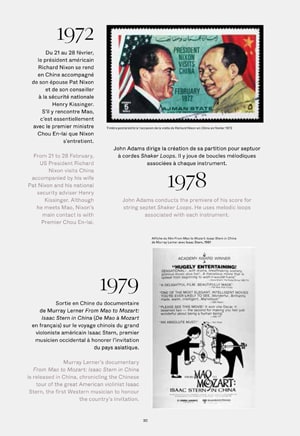
  • 1972

    From 21 to 28 February, US President Richard Nixon visits China accompanied by his wife Pat Nixon and his national security adviser Henry Kissinger. Although he meets Mao, Nixon’s main contact is with Premier Chou En-lai.

  • 1978

    John Adams conducts the premiere of his score for string septet Shaker Loops. He uses melodic loops associated with each instrument.

  • 1979

    Murray Lerner’s documentary From Mao to Mozart: Isaac Stern in China is released in China, chronicling the Chinese tour of the great American violinist Isaac Stern, the first Western musician to honour the country’s invitation.

    Nixon in China
  • 1987

    First performance of Nixon in China by John Adams to a libretto by Alice Goodman, directed by Peter Sellars at the Houston Grand Opera. The work has since become one of the most internationally performed 20th century operas.

  • 1994

    The reference to Ping-Pong Diplomacy is made explicit in a scene in Robert Zemeckis’ film Forrest Gump, where the title role plays the captain of the American table tennis team.

    Nixon in China
  • 2015

    Valentina Carrasco makes her Paris Opera debut as artistic collaborator to director Àlex Ollé for a new production of Verdi’s Il Trovatore.

Artists

Opera in three acts (1987)

Creative team

Cast

The Paris Opera Orchestra and Chorus

Media

NIXON IN CHINA by John Adams - TRAILER (english version)
  • About the staging of Nixon in China

    About the staging of Nixon in China

    Read the article

  • Nixon in China: the true/false story

    Nixon in China: the true/false story

    Discover

  • Interview with Valentina Carrasco

    Interview with Valentina Carrasco

    Watch the video

  • Podcast Nixon in China

    Podcast Nixon in China

    Listen the podcast

  • Adams in Paris

    Adams in Paris

    Watch the video

  • A presidential couple at the Opera - Interview with Renée Fleming and Thomas Hampson

    A presidential couple at the Opera - Interview with Renée Fleming and Thomas Hampson

    Watch the video

  • Nixon's true trip to China

    Nixon's true trip to China

    Watch the video

© © Elisa Haberer / OnP

About the staging of Nixon in China

Read the article

05 min

About the staging of Nixon in China

By Octave

How does one break free from a realistic treatment when staging a historical event such as the one depicted in Nixon in China?

Valentina Carrasco: When dealing with recent history, there is indeed a risk of sticking too closely to the events themselves. In the case of Nixon in China, the famous original, realistic production by Peter Sellars actually encourages one to break free from it. As I am neither Chinese nor American, and as I am taking on a work that has become a classic of the repertoire, it is my responsibility to offer a new interpretation. This is an opera that is performed regularly and, as such, can afford to be approached in a more abstract way than it was at the time of its premiere. The characters I present are historical figures, but treated in a more conceptual manner. This is made possible in particular by the progression of the work, which initially aims for realism and then gradually evolves toward something more surreal.  

Here, the concept is that of ping-pong diplomacy, which proves to be an apt metaphor for the subject at hand…

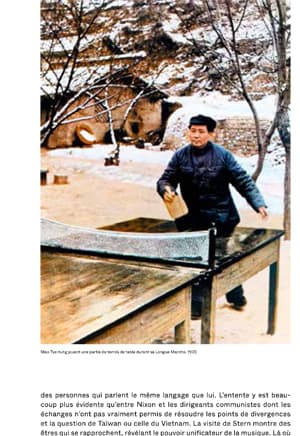
Valentina Carrasco: Yes, I started from the rather intuitive idea of a ping-pong table, which turns out to be a powerful image for symbolizing the political game: two spaces facing each other, with the players batting responsibility back and forth. Ping-pong is also very percussive, much like John Adams’s music. Several pages of the score are highly rhythmic and evoke the back-and-forth of a ball. It is also a visually striking, highly choreographic sport, which is particularly interesting for this work, where choral scenes are numerous.

This initial intuition was reinforced when I discovered an event in the history of the United States and China: ping-pong diplomacy. It refers to the invitation to China, at the initiative of the Chinese team captain, of the U.S. national table tennis team for a tour. The two teams had met at the World Championships in Japan, where Chinese players had been instructed not to interact with the American players. Nevertheless, Americans and Chinese eventually mingled and congratulated one another on their respective play…

It was this sporting visit to China—the first official trip to the country by Americans—that paved the way for Nixon’s visit the following year, subtly prepared by Henry Kissinger, who understood the need for openness and the role it could play in resolving the Vietnam conflict and in asserting influence vis-à-vis the USSR. This sporting tour was therefore decisive. Mao himself reportedly said of the Chinese captain that he could have been a diplomat.

It is interesting to see how much sport can serve as a tool of diplomatic mediation, just as it can be a means of asserting power; one thinks in particular of the Munich Olympic Games, and those in Moscow…

Valentina Carrasco: Absolutely, there are many examples. One interesting case is Romania and the use of its gymnasts, who were treated as ambassadors and subjected to enormous pressure. Sport is a concrete battlefield, particularly in a Cold War context. How do we measure a country’s power when they are not at war? In part, through sports competitions, which always celebrate a winner or a record, thereby reinforcing a country’s dominance internationally. It is a demonstration of power.

Today, with the resurgence of conflicts and political divergences leading to a new polarization of the world, sport once again occupies a central place among tools of influence. We have seen this recently with the FIFA World Cup in Qatar and the calls for boycott. Sport also asserts itself as a means of communication and exchange in situations where nations cannot talk to one another. A sporting or artistic encounter then becomes a form of mediation.

In this regard, there is an event that particularly interested me, brighter and more positive, so to speak, than Nixon’s visit: the invitation by China of the great American violinist Isaac Stern, who was invited to give concerts and masterclasses. It is interesting to see, in the documentary about him, that Stern was received and escorted in much the same way as Nixon had been. Yet he interacts with musicians, including the director of the Shanghai Conservatory—people who speak the same language as him. The rapport is much more evident than between Nixon and the communist leaders, whose exchanges did not really resolve the points of divergence or the questions of Taiwan or Vietnam. Stern’s visit shows people coming together, revealing the unifying power of music. Where politics always remains shadowy, nothing is guaranteed.

© Elena Bauer / OnP

Nixon in China: the true/false story

Discover

01 min

Nixon in China: the true/false story

By aria

A Sino-American meeting right in the middle of the Cold War… Will you spot the wrong facts from the truth in this John Adams’ opera Nixon in China quiz? It’s go time!  

Interview with Valentina Carrasco

Watch the video

3:27 min

Interview with Valentina Carrasco

By Isabelle Stibbe

© Everett Collection/Bridgeman Images

Podcast Nixon in China

Listen the podcast

"Dance! Sing! 7 minutes at the Paris Opera" - by France Musique

Podcast Nixon in China

By Charlotte Landru-Chandès

"Dance! Sing! 7 minutes at the Paris Opera" offers original incursions into the season thanks to broadcasts produced by France Musique and the Paris Opera.

For each opera or ballet production, Charlotte Landru-Chandès (opera) and Jean-Baptiste Urbain (dance), present the works and artists you are going to discover when you attend performances in our theatres.

Adams in Paris

Watch the video

Interview with John Adams

4:00 min

Adams in Paris

By Isabelle Stibbe

Present for the premiere of Nixon in China at the Opéra Bastille in 2023, the composer John Adams granted us an exclusive interview a few minutes before the performance.

An opportunity to discuss the relevance of his opera in the current international context as well as the two main performers, Renée Fleming and Thomas Hampson, conducted by Gustavo Dudamel.

A presidential couple at the Opera - Interview with Renée Fleming and Thomas Hampson

Watch the video

Interview with Renée Fleming and Thomas Hampson

6:59 min

A presidential couple at the Opera - Interview with Renée Fleming and Thomas Hampson

By Isabelle Stibbe

Renée Fleming and Thomas Hampson talk about the roles of Richard and Pat Nixon, the challenges and the importance of John Adams' score.  

Nixon's true trip to China

Watch the video

Behind the scenes of the story

7:52 min

Nixon's true trip to China

By Camera Lucida

John Adams' opera, Nixon in China, is based on a genuine historical fact: the trip taken by US President Richard Nixon and his wife to Mao Zedong's communist China in February 1972, during the Cold War. What were the aims and the outcome?

This documentary deciphers the story in just 8 minutes, using archive footage.

  • [EXTRAIT] NIXON IN CHINA de John Adams (Kathleen Kim)
  • [EXTRAIT] NIXON IN CHINA de John Adams (Yajie Zhang, Ning Liang, Emanuela Pascu)
  • [EXTRAIT] NIXON IN CHINA de John Adams (Renée Fleming)
  • [EXTRAIT] NIXON IN CHINA de John Adams (Renée Fleming)
  • [EXTRAIT] NIXON IN CHINA de John Adams
  • [EXTRAIT] NIXON IN CHINA de John Adams
  • [EXTRAIT] NIXON IN CHINA de John Adams
  • [EXTRAIT] NIXON IN CHINA de John Adams
  • [EXTRAIT] NIXON IN CHINA de John Adams (Kathleen Kim)
  • [EXTRAIT] NIXON IN CHINA de John Adams (Yajie Zhang, Ning Liang, Emanuela Pascu)
  • [EXTRAIT] NIXON IN CHINA de John Adams (Renée Fleming)
  • [EXTRAIT] NIXON IN CHINA de John Adams (Renée Fleming)
  • [EXTRAIT] NIXON IN CHINA de John Adams
  • [EXTRAIT] NIXON IN CHINA de John Adams
  • [EXTRAIT] NIXON IN CHINA de John Adams
  • [EXTRAIT] NIXON IN CHINA de John Adams
  • Nixon in China (saison 22/23) - Acte 1 - Thomas Hampson (Nixon)

  • Nixon in China (saison 22/23) - Acte 1 (Orchestre)

  • Nixon in China (saison 22/23) - Acte 2 - Yajie Zhang, Ning Liang, Emanuela Pascu

  • Nixon in China (saison 22/23) - Acte 2

  • Nixon in China (saison 22/23) - Acte 2 - Xiaomeng Zhang (Zhou Enlai), Chœur - Gambei

  • Nixon in China (saison 22/23) - Acte 1 - (John Matthew Myers)

  • Nixon in China (saison 22/23) - Acte 2 (Orchestre)

  • Nixon in China (saison 22/23) - Acte 2 - Renée Fleming (Pat Nixon)

  • Nixon in China (saison 22/23) - Acte 2 - Renée Fleming

  • Nixon in China (saison 22/23) - Acte3 - Xiaomeng Zhang (Zhou Enlai)

  • Nixon in China (saison 22/23) - Acte 3 - Kathleen Kim (Chiang Ch'ing)

Press

  • A total success.

    Le Figaro, 2023
  • Valentina Carrasco delivers a fabulous production at the Opéra Bastille.

    Le Monde, 2023
  • The vocal cast is outstanding.

    Télérama, 2023
  • Poetically and incisively staged by Valentina Carrasco, John Adams' masterpiece of ping-pong diplomacy makes a stunning entry into the Paris Opera repertoire.

    Libération, 2023
  • At the Paris Opera, “Nixon in China” is a hit

    Diapason, 2023
  • We're seduced by the audacity of a staging that oscillates between fable and realistic image, handling the second degree with virtuosity.

    ResMusica, 2023
  • The success of this evening is due in no small part to the ambition of director Valentina Carrasco, who was inspired to ask this crucial question: is it possible to move away from strict realism in a work whose subject is based on a political event so close to home?

    Bachtrack, 2023
opera logo
Nixon in China


Watch online the recording from season 22/23 on Paris Opera Play!


starring Thomas Hampson, Renée Fleming, Xiaomeng Zhang...

WATCH Free trial 7 days

Access and services

Opéra Bastille

Place de la Bastille

75012 Paris

Public transport

Underground Bastille (lignes 1, 5 et 8), Gare de Lyon (RER)

Bus 29, 69, 76, 86, 87, 91, N01, N02, N11, N16

Calculate my route
Car park

Parking Indigo Opéra Bastille 1 avenue Daumesnil 75012 Paris

Book your spot at a reduced price
super alt text
super alt text
super alt text
super alt text
super alt text

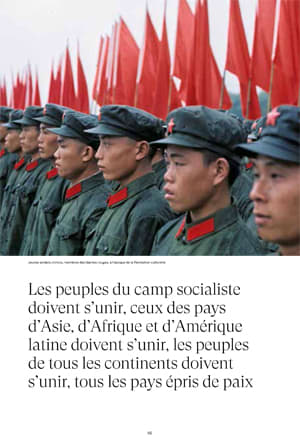
Nixon’s meeting with Mao was a meeting of two civilisations. A political milestone in Sino-American relations and a catalyst for a new international geopolitical order, it came after decades of no diplomatic relations. In the aftermath of the Second World War, the United States had taken part in the civil war in China by supporting the Republic against the victorious Communist Party.

BUY THE PROGRAM

In both our venues, discounted tickets are sold at the box offices from 30 minutes before the show:

  • €35 tickets for under-28s, unemployed people (with documentary proof less than 3 months old) and senior citizens over 65 with non-taxable income (proof of tax exemption for the current year required)
  • €70 tickets for senior citizens over 65

Get samples of the operas and ballets at the Paris Opera gift shops: programmes, books, recordings, and also stationery, jewellery, shirts, homeware and honey from Paris Opera.

Opéra Bastille
  • Open 1h before performances and until performances end
  • Get in from within the theatre’s public areas
  • For more information: +33 1 40 01 17 82

Opéra Bastille

Place de la Bastille

75012 Paris

Public transport

Underground Bastille (lignes 1, 5 et 8), Gare de Lyon (RER)

Bus 29, 69, 76, 86, 87, 91, N01, N02, N11, N16

Calculate my route
Car park

Parking Indigo Opéra Bastille 1 avenue Daumesnil 75012 Paris

Book your spot at a reduced price
super alt text
super alt text
super alt text
super alt text
super alt text

Nixon’s meeting with Mao was a meeting of two civilisations. A political milestone in Sino-American relations and a catalyst for a new international geopolitical order, it came after decades of no diplomatic relations. In the aftermath of the Second World War, the United States had taken part in the civil war in China by supporting the Republic against the victorious Communist Party.

BUY THE PROGRAM

In both our venues, discounted tickets are sold at the box offices from 30 minutes before the show:

  • €35 tickets for under-28s, unemployed people (with documentary proof less than 3 months old) and senior citizens over 65 with non-taxable income (proof of tax exemption for the current year required)
  • €70 tickets for senior citizens over 65

Get samples of the operas and ballets at the Paris Opera gift shops: programmes, books, recordings, and also stationery, jewellery, shirts, homeware and honey from Paris Opera.

Opéra Bastille
  • Open 1h before performances and until performances end
  • Get in from within the theatre’s public areas
  • For more information: +33 1 40 01 17 82

Partners

Immerse in the Paris Opera universe

Sign up for our newsletter

Our latest news

* Required fields

By clicking on "submit", you agree to receive electronic communications from the Opéra national de Paris and to the processing of your data.
Learn more about managing your data and your rights.

Back to top